
Trending
The United States is currently experiencing its worst measles outbreak since 1991, and Pennsylvania has not been immune, as officials reported two deaths in the keystone state this week, the Associated Press reported.
With cases continuing to grow, Geisinger Director of Infectious Diseases Dr. Stanley Martin held a conference call with media outlets Thursday to explain several aspects of the disease, including how to stay safe.
Though it is widely recognized by an accompanying rash, measles is a respiratory virus, Martin explained.
"It is one of the most contagious viruses we know, and it is spread very easily amongst people who may not be immune to the virus," he said, adding that an infected person can spread the disease to up to 18 other individuals.
"If somebody with measles walks into a room and just says something or they cough, the particles they've expelled into the atmosphere remain in the air for up to two hours, so, trying to avoid direct contact is very difficult. And certainly, if you're a parent and you're dealing with small children, avoidance is impossible," Martin said.
Initial symptoms include a feeling of being "run down," along with typical viral symptoms including cough, runny nose and inflammation around the eyes.
"After that, people can get these characteristic spots inside their cheeks, and then after that, of course, the rash, which is the thing that we associate most commonly with measles, generally starting around the head and neck area, and kind of spreading to the rest of the body from there," Martin said.
While many people clear the virus on their own, it is far from being of no concern.
"Measles is not always just a benign virus that causes a rash and your child to be sick for a few days. Measles can go on to cause lots of other problems, including encephalitis, which is an inflammation of the brain or spinal cord. It can cause pneumonia and other bacterial infections as a result of its effects on the immune system itself, and we see those kinds of complications, and the risk of death in those under the age of five, people who have problems with their immune system and we can see that in pregnant women as well," Martin said.
"Prior to the vaccine, roughly one out of every 1,000 people with measles would die, one out of every 500 sometimes," he added.
With some confusion as to what the phrase "measles associated death" means, Martin clarified that it simply means that the chief cause was not the virus itself, but was a direct result of infection.
"You may hear about somebody with cancer who died of respiratory failure. Well, they may have died of respiratory failure, but the reason they had respiratory failure in the first place was because they had cancer," he explained.
Asked what the most effective way to prevent contracting measles, Martin pointed to the measles, mumps and rubella (MMR) vaccine.
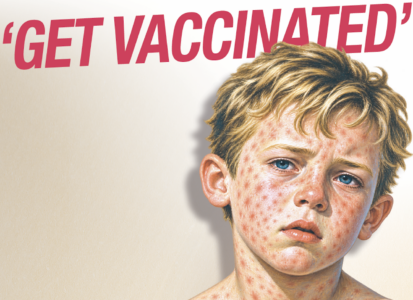
"There's one way to prevent measles, and that's to get vaccinated," he said.
"It is incredibly safe and effective, and has been in use in the U.S. since the 1960s," Martin stressed, while adding that although no vaccine is 100% effective, a fully vaccinated person cuts their risk of picking up measles by around 97%.
"At least in Pennsylvania, none of the cases we know about have occurred in anybody who's been fully vaccinated. And even when we do see the measles happen in somebody who has been vaccinated, it tends to be a much more mild illness because there's some degree of partial immunity," he said.
"Masking is helpful in certain environments, depending on the type of mask and the degree in which it's worn," Martin added.
For those who have not been fully vaccinated, defined as having two rounds of the MMR vaccine, or are unsure of their vaccination status, Martin suggests reaching out to their healthcare provider.
"If you're not sure or you can't get your medical records, there are blood tests that can be done to see if you have any pre-existing immunity to the virus," he said.
"I do want to remind people that if you've been exposed to measles and you're not immune, if you get vaccinated within 72 hours, that will generally protect you from going on to developing measles," Martin added.
Those born prior to 1957 do not need to be vaccinated due to likely being exposed as a child.
"Not everybody may remember having measles as a child, but prior to that, measles was just rampant, and all children would eventually acquire measles at some point," he said, adding that studies have not shown a benefit to receiving a booster later in life.
Martin also added that pregnant women and those with certain immune problems are not eligible for vaccination.
Martin put the recent surges in measles rates squarely on a drop-off of vaccination rates, noting that an immunity rate of 95 to 97% is needed in order to reach herd immunity.
Several years back the immunization rate of children entering kindergarten was 95% or more, however in the 2024 to 2025 school season, that rate was down to 94%.
"We've always known that there are certain people who aren't even eligible for the vaccine, and there've always been certain populations and people who didn't engage with the vaccine for whatever reason, but historically they were still relatively well protected because of herd immunity. We had enough other people in the country that were being vaccinated that it could help protect some of them," Martin said.
Though infection can result in lifelong, attempting to achieve herd immunity through natural infection comes with the heavy risk of severe complications, Martin said.
"It's obviously dangerous. We've already had two deaths here in Pennsylvania that could have potentially been prevented with the vaccine," he said.
"And you're not necessarily going to achieve herd immunity if you have an ongoing population that's always at risk, and that's what we'll have if we don't engage with vaccination," Martin said.
Asked how to approach parents who may be hesitant to get their children vaccinated, Martin said it is important to try to understand their rationale.
"I would ask them, what their concern is, what is it that they've heard, what is it that they're afraid of when it comes to the vaccine," Martin said.
"You want to be able to understand where their misunderstanding and their fears are coming from, and then try to dispel any myths that they may have unfortunately been exposed to," he said.
"Millions of people have gotten the shot, and we've tracked data over decades on its utilization and its value and its safety," Martin said.
With children returning to school en masse, Martin expects cases to continue to increase for some time yet.
"I don't think we'll see an end to the cases just yet, and I don't think any of us would be surprised if they continue to spike upwards over the next couple of months," he said.
Educators can help with efforts to ease the outbreak by being vigilant of signs and symptoms of the virus in their students.
"Hopefully the schools may even be able to play a role in helping to educate parents, which at the end of the day, this is really about not just the signs and symptoms of measles, but of course the safety and value of the vaccine," Martin said.