
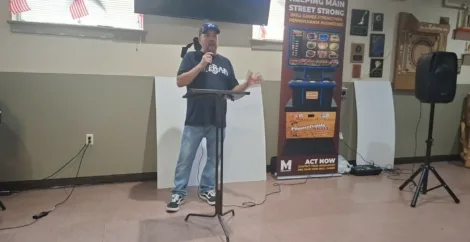
Rally held at Garrett Cochran American Legion, Williamsport, in support of proposed skill games legislation
Trending
The fate of skill games in Pennsylvania could soon be decided by lawmakers and organizations that need the income from the games continuing to operate and are worried that it won't be there soon.
"The revenue we receive from these machines helps us pay operational expenses and keeps our doors open," said Sam Aungst, commander of Garrett Cochran American Legion Post 1, 10 E. Third St., where a recent rally was held and information was distributed by the Pennsylvania Taverns and Players Association.
These machines, many made in Lycoming County, are used by small businesses and organizations that are cornerstones of communities. They are used by and made by family-owned, multigenerational establishments. These are gathering places for the community members, including veteran organizations, places where veterans who selflessly served the country now share camaraderie with peers. These are volunteer fire departments that without skill games would rely exclusively on donations that keep communities safe.
The state Supreme Court ruled on June 15 that skill games are slot machines and must adhere to the commonwealth's crime and gambling statutes. The court gave the General Assembly 120 days from the order to come up with legislation regulating skill games.
The clock ticking and the political gamesmanship is worrisome to organizations and clubs that benefit from their revenue and use it for worthwhile charities and causes in the community.
"Keeping those doors open is important because our post is much more than a social club, it is a place where veterans can come for support, friendship, resources and a sense of community," Aungst said.
Supportive of Senate Bill 1079 and House Bill 2213 -- bills that would keep skill games in the state and regulate them at a fair rate, those at the rally learned how the court ruled games offering players cash, prizes, tickets, rewards, or anything of value are illegal unless they are licensed by the state and that there was (as of last Thursday at the rally 47 days) for the lawmakers who were unable to put it into the budget.
"We work with other veterans organizations and help connect veterans with services when they need them," Aungst said. "We supply a meeting space for the Veterans Council and Blue Star Mothers and give availability, when needed, to the Lycoming County Veterans Center, a gathering place for our community and support programs and events that benefit veterans and their families," he said.
"Like so many nonprofits we are doing everything we can to survive while costs continue to increase," Aungst said. "Every source of reliable revenue matters . . . and skill games have given the Legion a way to generate income that helps cover some of those expenses."
It was estimated the legislation would generate $300 million in state tax dollars in the first year of regulation. A report from the Independent Fiscal Office estimates the games would eventually bring in more than $1 billion a year.
It was learned at the rally that if such legislation does not have a chance to be voted on as the deadline passes, the machines would be prohibited outside of casinos and police can confiscate them from the bars, restaurants, and social clubs.
"Everyone here knows how well they do for us," said Anthony "Tony" Mussare, co-owner of The Bar on Market Street, with his wife, Amber.
"Anyone who has any of these skill games and what it does for our crew, for our employees and for the people who hit some nights, and a lot who do not, but it is surprising how much people actually participate and the stories we hear and how it helps them," he said.
The couple use their game revenue for their nonprofit of scholarships for children that lost a mother to breast cancer.
"We rely on the clubs and from all of the extra income that they are getting and what people donate to us to help these scholarships survive," he said.
"What people don't realize is how this will affect us if it is gone because there is no doubt," Mussare said. "The money that these clubs get is going back to the community," he said.
"The state has to come up with some kind of arrangement so that this can't go away."
"How dare they?" asked Jeff Millay, Miele chief officer of operations:sales of the effort to crush the industry and require them to be on par with slot machines.
"This is our 91st year in business serving this community," he said.
"We're on our fourth generation of running Miele." For 12 years, Miele manufactured these skill games, starting down on Third Street building the machines, he said.
"What's crazy is this is an impact across the Commonwealth," Millay said, referring to the potential loss of the skill games if the legislation is not put before lawmakers.
For years, the steel used to make the machines came out of Radiant Steel in Williamsport; lumber from Lancaster County; paint from Berks County and the nuts, bolts and screws from Lehigh County.
"We use multiple vendors," Millay said, adding there are obviously some imports but Miele president Lou Miele forced them to "open up distributors in Pennsylvania – in Delaware County, in Chester County, he noted.
"We've done everything we can do to make this a Pennsylvania project," Millay said. "We've given back. Last year, Miele gave one-12th of the budget of the YWCA as a donation, he said.
MIllay urged those listening at a recent rally at the Post 1 to use their testimonial sheets, post them, take the picture with the yellow sign and post it, he said, adding, "ask friends to repost it. Post it on Gov. Josh Shapiro's social media. They have been listening. Our message has been getting out there."
A frantic pace
"We're up against the casinos," Millay said. "It's Wall Street versus Main Street, Pennsylvania, Williamsport, Pennsylvania."
It is Miele that provides countless jobs in the county and they are good-paying, technician jobs. "That makes a difference. That is a story," he said.
The team at Miele is working around- the-clock getting the message out – including visiting Pittsburgh, Scranton, Philadelphia, Millay said.
"We've got to share our stories," he said, pointing toward the historical significance of Pennsylvania having several firsts – including this American Legion post which was established in 1919, one of the original legions.
"The history of this location can't end because some people in Harrisburg want it to," he said.
An uphill fight
The other issue is some video gaming terminal (VGT) companies are going around acting like they are going to save the day, he said.
"If you have skill games and switch to a VGT, you're gonna take a 65 % pay cut," he said. "That's what they want you to do."
"Casinos every day tell our politicians that we pay 52% -- and pay it all on one game," he said.
"Table games they pay 16 %, sports betting the fast-growing category ... the gaming on phones, they pay about 30 % taxes on that . . they don't pay 52 % on everything but have complained for years that skill games were taking money away from them."
Somebody living in Williamsport going to a local bar or club isn't going over to the casino in the Scranton-Wilkes Barre area. "It's not happening," he said. "Why were they afraid of us?" Millay asked. "Because they want every dollar they can get," he said.
In addressing a casino, he said he asked, "If we were such a problem, why did you never pay Pace-O-Matic, (which develops skill game software) to put a game on their floor? The casinos' answers were 'we can't control the odds,''' Millay said. The casino official answered him -- "We want part of every dollar that comes in,'" he said.
"We've got to get together. We've got to share our stories. I think we can do it. We are going to go down fighting. Miele is going to go down fighting and I hope you join us."
Learn more
The state Supreme Court on June 15 ruled skill games to be slot machines under law and must adhere to the state's crime and gambling statutes.
The justices also gave the state General Assembly 120 days to come up with legislation to regulate their use.
Namely, Senate Bill 1079 and House Bill 2213 were written to regulate skill games in Pennsylvania. The bills are considered to be a "responsible framework supporting small business and public revenue," according to the association.
Legislation introduced by both chambers represents "commonsense, bipartisan measures to regulate and tax legal skill games across Pennsylvania," the organization stated in literature provided for rally goers.
Sen. Gene Yaw, R-Loyalsock Township, and Sen. Anthony Williams, D-Philadelphia, are the co-sponsors of SB 1079, with the companion legislation introduced in the House.
Yaw made an appearance at the Post rally, spoke for a few minutes on the issue and offering anyone interested his time one-on-one with questions. He noted, as did the association, that these are bills written to establish a "fair regulatory framework, protect small businesses, and generate significant immediate tax revenue for the Commonwealth."
"We need to get the legislation to a vote," Yaw said.
The legislation does the following:
• Establishes a $500 per terminal monthly fee generating $300 million in annual revenue immediately.
• Creates new revenue without disrupting existing funding streams and support small businesses and nonprofit organizations that rely on skill game income.
• Limits skill game terminals to 50,000 machines statewide, encouraging sustainable market growth, preventing market oversaturation, and protecting small business operators.
• Establishes a capable, unbiased regulator -- the Pennsylvania Lottery -- as the regulator, and thereby utilizes the lottery's strong track record with small businesses and fraternal groups.
• Supports small businesses and veterans organizations by having up to five terminals in licensed establishments; up to 10 terminals in fraternal organizations and grandfathers existing locations to preserve supplemental income.
• Attempts to stop illegal gambling and mini-casinos by strengthening enforcement against these entities and protecting compliant businesses and holding violators accountable.
• Addresses nuisance locations prohibiting skill games in stop-and-go establishments in Philadelphia.The conundrum and uphill fight
The court acknowledged that games like Skee-Ball and Chuck E. Cheese are affected by the decision.
Specifically, the case was identified as: Three Pennsylvania Skill Amusement Devices, et al. and POM of Pennsylvania, LLC v. Commonwealth of Pennsylvania, Department of Revenue, et al.
The court reversed two state Commonwealth Court decisions holding that "skill game" devices are "slot machines," under the Pennsylvania Race Horse Development and Gaming Act.