
Vet to Vet program at area hospital brings comfort to patients
Trending
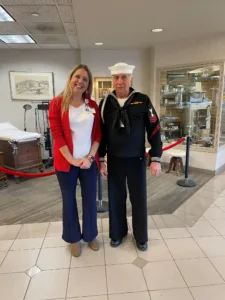
When Merrill Shaffer visits a patient at the Geisinger Lewistown Hospital, he is there on a mission. The retired Navy veteran is there to talk to other veterans who are patients at the facility, to be that friendly face in the midst of the stress of being hospitalized.
Veterans will tell you that no one understands what their journey has been like than another veteran. That is the impetus behind Geisinger's Vet to Vet program where volunteers, who are also veterans, visit veterans who are hospitalized in order to provide a connection with someone who shares their life experiences.
Shaffer admitted that every patient he visits is different and not just because of the various branches of service they represent. While some patients are welcoming, others want to know what he's doing there. Their response determines his approach. The one rule he has - never wake a sleeping patient.
"I introduce myself. I'm here to visit patients in the hospital, and from there we started talking," he said.
"One of the interesting things is at times there will be family members or friends there, and they'll say, "Oh, they don't talk much about military service." Oh, okay. And for the next 15 or 20 minutes, we're talking about military experience," Shaffer said.
There are times, he admitted, when communication might be difficult. A patient may be hard of hearing or they may be confused.
"You just talk with them about what you have and what you see," he said.
"I had one particular individual. I walked into his room, and I could sense he was faking it. He was sort of almost angry. I don't want to be bothered. I don't want to talk. I shot back simply, hey, that's fine. You're not going to bother me in any way, okay? Changed the whole attitude. And I saw him a few more times, and he was always gruff-not to me anymore, but to staff," he said.
Shaffer along with fellow vet Hershel Cram decided to try the program together, each volunteering two times a week-Shaffer on Monday and Tuesday and Cram on Thursday and Friday.
In order to volunteer, the two met with Kylle White, the regional operations manager for volunteer and guest services at Geisinger.
"We had our session with Kyle White, the coordinator, and he said, "Okay. So we got through all the legal paperwork and she said, Okay, We chose our days at that time...I went in, picked up my list of patients for the day, and from that point on, it was strictly what we decided to do when we visited the patients," Shaffer said.
"There were certain restrictions under the legal portion, but the bottom line was we walked into the room, found the patient we were visiting, introduced ourselves, what we were there for, and from there we just started talking. And for a couple years now, it's evolved quite a bit. We talked to each patient on various levels. We would kind of feel out each patient what they wanted to talk about, what they didn't want to talk about, and it became extremely rewarding. There were days I would have eight or nine patients, and there were days I had one, maybe two, or none at all, depending on when patients were discharged or if they were in treatment or sleeping...it's been very rewarding. I must admit, I get as much more out of the visits as the patients do," Shaeffer said.
Right now there are only three veterans who have volunteered to work in the program according to White, whose office covers the western region which includes the Muncy and Jersey Shore Geisinger facilities locally. Although there are no veterans who have volunteered at either of those hospitals, White said she is hopeful that will change as people become more aware of the program and its benefits.
"We pull a list every day of the patients who have registered as veterans. They just go, knock on the door, introduce themselves and it's just an awesome addition," White said.
"It's somebody who's going into the rooms that's not taking their vitals or pulling their blood or talking to them about their diagnosis. This is just a pure heart-to-heart visit - just vet-to vet," she said.
Even though patients might be from a different branch of the service, White said that there is usually some good-natured banter that goes on, but even then, she added, "it breaks up the patient's day and offers a little piece of kindness and a special touch to their visit."
The veteran volunteers are also good at reading the room, she said, knowing when someone wants to have a lengthy conversation or just wants someone to say hi, have a nice day.
Shaffer shared about one veteran who had served in the Air Force in Vietnam.
"He said, I was in for ten years and I was going to make a career of it, but I got out...he broke down and cried. He told me of his tour of duty in Vietnam and what happened. He lost six of his men and he was having a very hard time. I held his hand and we talked," he said.
Another time, he visited a patient in Intensive Care, who was in her 50's and on oxygen, so she couldn't speak.
"I introduced who I was and she saluted me and wanted to take the mask off. She had a big grin on her face. I said, no, leave the mask on, I'll do the talking and she was so happy I was there," Shaffer said.
"I went back the next day and she was gone. But, that's something that we have to face when we go in there," he added.
The patients do not request a visit from the veteran volunteer, but many have heard of the program from other vets who have been hospitalized, so that when the volunteer visits them, they are not surprised.
"I've heard from my volunteers that they popped in to see a patient they've never met before but they knew about the program and they would say, 'I'm waiting for you.' So, the word gets out," she said.
Last year, with just the two volunteers, they made 444 patient visits.
"Being in the hospitality role that we are-volunteer services is a branch of hospitality - we just want to really focus on just that little added touch to enhance their stay. Just that human connection, you know that they're not just a patient, they're human and we want to recognize and honor their military service as well," White added.
In order to apply to be a part of the program, interested veterans can go to the Geisinger website. There is a specialized training in addition to what they offer for a regular volunteer and then the new volunteer would job shadow the ones who have been doing it for a while.