
City of Williamsport officials seek public input on Safe Streets for All initiative
Trending
The City of Williamsport officials and its roadways safety project consultants have begun to get public feedback and want to get more on their "Safe Streets for All" initiative.
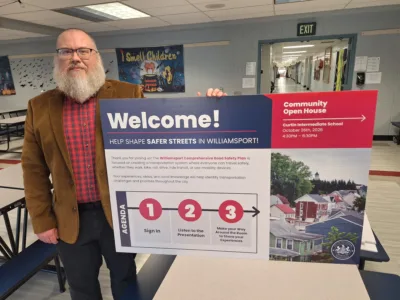
The "All" in the plan title is the operative word for those in the city department of community and economic development and planning and at Kittelson & Associates Inc., the city consultants on the project who recently held a public workshop for two hours at Curtin Intermediate School, 85 Eldred St. Other workshops are planned and the survey to add input is online and will soon be on the city website.
City Planner Scott Williams, who is also assistant director of the city Department of Community and Economic Development, and professionals with Kittelson & Associates described the process for the citywide road safety action plan funded by a U.S. Department of Transportation Safe Streets for All planning grant.
Kittelson began working in early fall and shared the results of their analysis of safety issues on city streets.
Purposes and goals
"We have a big project ahead of us," Williams said. "At the end of the day we want everyone to make it to where they are going safely."
"We are drafting a plan here that is going to get us implementable strategies in the city of what we need to do to make our roadways safer," he said.
At the workshop, boards were set up with further information about the planning process and what the intent is.
"We want you to come talk to us and tell us what your concerns might be," said Jeff Riegner, senior principal, Kittelson & Associates, Inc.
He was joined by Riva Heinrich, senior planner, Kittelson & Associates, Inc. and Nora Brown, transportation analyst, Kittelson & Associates, Inc. Other partners at the event included Pennsylvania Department of Transportation, the Highway Safety Network, and River Valley Transit Authority.
Getting feedback critical
"Our point here is not for you to hear from us, it's for us to hear from you," Riegner stressed. "We want to hear your concerns about (roadways) safety in the city of Williamsport."
Why is this being done now?
Over the last decade there have been almost 2,000 traffic crashes in the city, with 16 people killed and 55 who were seriously injured.
"Their lives have really been changed by that crash," Riegner said.
Although overall crashes have been declining slightly, which is considered to be good news, but the most severe crashes are not.
"It's very important for us to look at potential solutions to address those issues," he said. There is a multi-step process in play.
What matters for the consultants is that they will use "detailed data analysis" and "hear from the public" at the workshop and residents of the city online.
There are online opportunities to make comments in addition to the workshop (for those who missed it.)
There will be many public engagement opportunities over the course of the project.
Urged to contribute
"This plan is not successful unless we hear from you and your neighbors," Riegner said.
The comprehensive road safety plan is federally funded and there have been a lot of them across the U.S. and Kittelson & Associates has worked on many – about 20-30 estimated.
The consultants plan will look at safety conditions across the community and then provide recommendations for how to address them.
Individual issues accepted
Everyone sees concerns on their own street.
"We use our data to help the consultants to better understand where the greatest crash concerns are, especially those most severe crashes," Riegner said.
They follow something called the Safe System Approach.
What really matters is that it is not just a matter of changing the road, which is important, but it is also working with people to improve the decisions that they make on the road.
It's helping to make sure vehicles are safer, that people travel at safer speeds, that emergency responders are able to provide post-crash care.
All of those things matter and they need to be moved forward to make a big difference.
Currently, to assist in the plan there is a Safe Streets Task Force which includes a number of different agency representatives at the city, Lycoming County and state levels who are providing the consultants with information for the plan.
Timing
This will be about a year-long process.
Starting in the fall, the consultants started collecting data and that was put onto the boards for the workshop and on the website.
Over the winter, the consultants will develop draft safety countermeasures, or solutions for how to address the concerns.
Those will be brought back out to the public early in 2027, so there will be another workshop and potentially other opportunities for engagement in the community.
"We want to reach as many people as we can," he said. The plan is to wrap up next summer.
Early data analysis
The data already tells the consultants about the almost 2,000 crashes over the last 10 years, 16 fatalities and 55 other serious injury crashes.
It tells them that these crashes do tend to concentrate on a number of streets. Those streets are identified on a map that was at the workshop and available to see.
Total crashes are dropping slightly but those most severe crashes that can irreversibly affect or potentially end someone's life, those are remaining steady.
Those are not moving at all, so it is really important to address those most severe crashes.
People who are most vulnerable in these crashes are people who do not have a car.
That includes pedestrians or riding bikes. Those people, although there are far fewer dots on the map where crashes occurred, account for 30 % of all injury crashes in the city.
People who are not in a car or truck are disproportionately hurt on city streets, and it is important for the plan to address that.
Worst crash types and most prevalent
One of the big type crashes are called angle crashes, or T-bone crashes which happen mostly in intersections.
The city is a grid of streets and there are intersections everywhere.
That design is not surprising for the consultants to see.
A second most seen are those involving pedestrians.
These rashes are the second largest contributor to fatalities and serious injuries, Williams said.
There are corridors that show where the greatest number or greatest severity of crashes in the city. Less than 10 % of the city streets account for 75 % of those fatal and serious injury crashes, the data shows.
At the end of this plan, there is a good chance to make those unfortunate numbers come down.
How to give feedback
Consultants encourage people to take an online survey.
The plan includes budget consideration
"If you had $4 million, what would you spend it on?" Riegner asked. The plan provides an opportunity for people to weigh in on the budget to tell consultants their priorities.
"We would also like to hear from the public about their experiences with road safety in the city and help us identify opportunities for the city to do improvements," Williams remarked..
Safe Streets for All is for anyone who drives, walks, rides, uses mobility devices, has children going to and from schools, and commutes and cares about roadway safety to let consultants know their concerns. Early data found might actually reflect such safety concerns but there might be places or situations that consultants could add that they have not researched.
The plan is to return this data back to the public early in 2027.