
Lewis Lumber Company tour starts series
Trending
October is National Manufacturing Month, and to celebrate the occasion, Innovative Manufacturers' Center (IMC) is facilitating a number of tours highlighting local manufacturers, with its first stop being Lewis Lumber Products, located at 30 South Main Street, Picture Rocks.
During the late 1800s, the site hosted the Burrows Brothers Furniture Company, before H&E Manufacturing Co. took over the property, manufacturing wooden handles and excelsior until folding in 1984, according to Lewis Lumber Products President Keith Atherholt.
A family from Sullivan County then operated Peterman Lumber through 1990, when Pennsylvania Custom Millwork would move in, until 1995.
Three years later, Lewis Lumber, then located on Park Avenue in Williamsport, would move into the property, where they have been ever since.
While sister company, Dwight Lewis Lumber Company handles the saw milling side of business, Lewis Lumber is split roughly 50-50 between processing kiln-dried wood and dealing in rough lumber, Atherholt explained.
Dwight Lewis Lumber owns and manages approximately 15,000 acres of land, most of which is Forest Stewardship Council (FSC) certified, meaning that when lumber is harvested, new trees are planted to replace the downed ones, tour guide Larry Ryder explained.
Ryder started with the company in 2000, and currently services as Lewis Lumber's Traffic Manager/Production Scheduler.
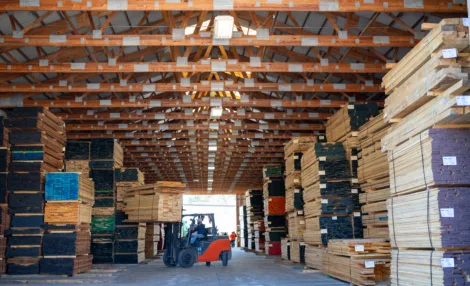
Roughly 200,000 board feet of lumber of varying specifications are stored at the factory, from which customer orders are picked.
"We run six trucks that do our own deliveries, covering about a 200 mile radius, all of Pennsylvania, into New York City, Virginia, Delaware, Ohio and even as far out as Indiana to pick up lumber and bring it back," Ryder said, adding that, with the exception of a few two-day trips, all of Lewis Lumber's drivers are home each night.
"That's kind of a nice benefit because you should have time to spend with your family and see your kids play ball, and things like that," Ryder said.
"Years ago we used to send everything out to different vendors, and it cost money to truck stuff out and then pick it back up. So we decided to put it in our own priming line. So now we prime there too. So it gets primed, sanded, then primed and sanded again," he explained.
Lewis Lumber sells to a number different industries, including the cabinet, furniture industry and millwork industries.
While for much of its history, Lewis Lumber focused 90% of production on programmed cuttings, moldings and more, Ryder said in recent years, that trend has completely flipped.
"We can make anything that anybody's going to send to us. A lot of people have old houses, and they want it to look old for their remodel, they'll bring us in and we can make a nice piece of specific molding that they want," he said, adding that they have produced over 6,500 individual profiles for different customers.
About two years ago, a CNC molder which has sped up the customization process, Ryder said.
"We used to do everything manually, so we had a guy here constantly all day long making knives for every molding we do, now we have a CNC guy come in and set it up, and he can walk away and back when the finishing knives are made, so this is definitely a time saver," he said.
"When the customer sends us a job for a molding, we'll draw it up, send the blueprint back to the customer for what they want, and they have to sign off on it before we make something because there's a lot of money setting up the tooling, so we want to make sure everything's right before we do it," Ryder stressed.
The factory also houses a retail showroom, where customers can walk in and purchase the factory's most popular sellers.
"We can still get a customer whatever they want, but we wanted to stock what most people use," Ryder said.
"We sell a lot of exotic woods too, anything from flooring to moldings, crown, and just regular lumber," he added.
About three years ago, Lewis Lumber added e-commerce to their customer offerings, which has increased each year, Ryder said.
"Most of our business is wholesale. Retail is only about 5% of our revenues," Atherholt explained.
"We sell to people that make things. It's kind of strange. We end up putting product in some really neat places and neat things, but don't really take credit for it because it's not hard. We're selling it to somebody who's fabricating and putting it together and making these really awesome things," he said, citing the music buildings at Penn State University and the lumber used to create retired Pittsburgh Steelers quarterback Ben Roethlisberger's front door.
"It ends up being a pretty fascinating business, different from what a lot of people think," Atherholt said.
"Its not just regular lumber. It isn't that at all. Really, it's specialized stuff," he said.
"It's been neat, and I got a great bunch of people that have been here a long time," Atherholt said.