
Lycoming County judge: Education needed to deter domestic violence
Trending
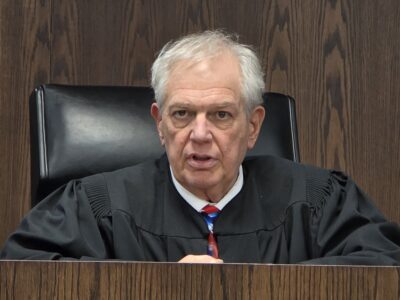
When asked how Protection from Abuse (PFA) orders could be more effective in deterring domestic violence, Common Plea Court Judge William P. Carlucci said that he sees the issue as more complex. Carlucci had attended the Hope and Remembrance vigil at the YWCA Northcentral this week and spoke after the event.
"It's important to not conflate the protection from abuse system with the problem of domestic violence," Carlucci said.
"The problem of domestic violence is multi-layered, and unfortunately, our culture has decided that the protection from abuse petition system is the answer to domestic violence. It's not even 10 percent of the answer. It's just one of the tools," he said.
Carlucci went on to say that in order to make the system more effective, the orders need to be more "meaningful."
"To make sure they're enforced, to make sure that people who violate the orders are held to account for that. Those are all the things we can do with the PFA system," he said.
Beyond that, though, Carlucci feels that there are other things that can be done to address the problem of domestic violence. A lot of which is education.
"And that's not happening in Lycoming County. Education's not happening," he said.
He feels that education needs to take place not only in the schools but also in the community.
"I'm not going to say that domestic violence is the most misunderstood, but it is among the most understood problems in our culture," he said.
"One of the things that people who are not associated with the what I'll call the domestic violence rescue community -- people who are not a part of that community -- often don't realize is that domestic violence is not only about conflict. It's about control. It's about the desire of somebody to control another human being and it's breaking down that culture of control so that people understand that relationships are about what you bring to the relationship and about cooperation. They are not about owning somebody," Carlucci said.
And, he believes that education needs to start as soon as young people are old enough to have a relationship.
"I think it needs to start as soon as students are willing to begin to understand the realities of having a relationship. That is, we'll teach young people about recycling. Yet we can't find the time to teach them about history, about the evolution of freedom and democracy, and about how we all have a shared responsibility to look after one another, and how do you participate as a member of an ordered society? If you see somebody along the road who appears to be in distress, the least you can do is pull over, say, "What can I do for you? Maybe make a phone call. Once we all accept some responsibility for one another, then the legal system will not need to solve every problem," he said.
"This is a cultural problem. It's not a legal problem. The legal system is trying to address a cultural problem, and we need to make sure that a 14-year-old boy understands that a healthy relationship is not controlling somebody; it's a partnership. I think that Julia Roberts said it best: 'You don't need a project; you need a partner.' And once we begin teaching children that this is about healthy relationships, not controlling people, will go a long way toward solving the problem," he said.
There is also the issue of abusers being able to own firearms, which in Pennsylvania, if they have been served with a PFA, they cannot have a firearm.
But, Carlucci said, judges have discretion based on specific facts.
"Judges now are permitted based upon the facts of what they are hearing to decide whether they want to order the seizure of the firearms, and if the judge decides that it's not appropriate in this individual case, then at the final hearing, if the plaintiff and defendant both agree to the entry of an order without a hearing, the judge need not order the seizure of the firearms," he explained.
"One of the things that is not understood broadly is that sometimes protection from abuse orders are intended -- I think I might say most of the time they're intended -- to address a situation which is not what we traditionally consider domestic violence. I'll give you one example out of a hundred, and that is, you have a 16-year-old girl and a 16-year-old boy who were dating. The girl decides to move on. The boy can't. That is, he can't do it. He's never owned a firearm. His father may have a firearm. They may be hunters. The fact of the matter is, this is really about a child who can't understand that a relationship is over. And what we can do in that case is just to say that. Tell you what, and we'll enter an order by agreement. We'll do it for a year, and help your son move on," he said.
He said in that case there's a situation where the dad's rifle doesn't need to be taken. Another situation where you have an abusive man in a relationship who owns a pistol and has threatened the plaintiff, Carlucci said, "We're going to pull the gun."
"What we need to do is this: we need to realize that there is no rubber stamp that solves any problem. Every case is different. Every plaintiff is different. Every defendant is different. Every family is different. Every child is different, and we can't just pass laws thinking that this law will solve all our problems because they never will. The judge really needs to fashion a solution that meets the problem, and it takes time, and we never have enough time," he said.