
Trending
Ever ride a roller coaster and wonder where the foam seat was made?
Chances are it was manufactured at Ralph S. Alberts Co. Inc., 60 Choate Circle, Montoursville.
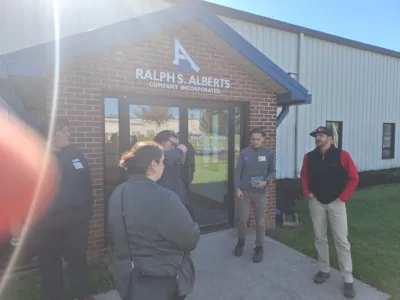
Recently, the family-owned company held an open house as part of the second manufacturing tour celebrating central Pennsylvania manufacturing sponsored by Innovative Manufacturers Center (IMC).
The tour, part of National Manufacturing Month, allowed Seth Alberts, CEO/president, to give a deep-dive explanation of how the seats and other custom molding products are made at the plant.
Ralph S. Alberts is a full-service, multifaceted custom molding and plastic fabrication business that is always looking for employees who want family-sustaining wages and want to grow with a visionary company, he said.
The company's fiberglass and foam products can be found at Universal Studios in Orlando and closer to home at Knoebels Amusement Resort among other amusement and recreation locations. They also serve industries in need of medical and military applications.
For those looking for employment, Ralph S. Alberts offers family-sustaining wage jobs for those skilled and/or willing to be trained in-house on tooling, on applications such as epoxy, urethane, and silicone, pattern making, and mechanical technicians jobs using 3D printing, routing, and machining.
On the tour, the shop floor had dozens of men and women manufacturing and finishing products. They were using tools and machinery for routing, blasting, coating, and high-tech vacuum infusion or light resin transfer molding.
Alberts noted how much of the products are for supplying custom components to the amusement, theme park, and recreation industries – including molded foam roller coaster restraints, lap bars, safety padding, flume boat seating, and vehicle bodies.
Amazing processes
"There's probably not a roller coaster or park anywhere in the world that we don't do some type of work for," Alberts said.
In a short video, Alberts showed those on the tour how the company made a seat for the "Rip Ride Rockit" at Universal Studios in Orlando.
When the order for a coaster seat is received, it begins with a basic mold, which is used as a "building block" to create the seat.
The seat color is sprayed onto the thin metal mold until it's evenly layered. A putty mixture is used to fill in the contours of the seat to keep air bubbles from forming when the fiberglass is blasted onto the mold.
While still wet the fiberglass is rolled into each edge and crevice. After the plastic is dried additional sections of the seat are glued or bolted on and another layer of fiberglass is blasted.
Once it dries the edges are sanded down until smooth. From there, the seat is sent to the foam molding department.
The fiberglass structure is then placed in a large mold set to the dimensions of the coaster -- in this case the "Rip Ride Rockit" -- mold. The mold is then sealed and filled with two chemicals -- polyurethane and isocyanate. A chemical reaction begins causing the mixture to expand inside the mold and adhere itself to the fiberglass structure. It will sit for 20 minutes to harden. Once it is pulled out of the mold, plastic flakes along the edges are delicately removed. A final coat of paint is added and finally the seat is finished and ready to be shipped to Universal Studios.
"We're injection molding some things that most injection molders would not," Alberts said. "Most injection molders want to do millions of the same thing over and over," he said.
Most recently, the company brought on ethylene-vinyl acetate (EVA) foam, which is an injection-molded foam.
EVA is the same material that Crocs (those water-proof shoes) are made of.
"We are currently the only company in North America that has EVA capabilities," he said.
Most of the EVA production takes place in Asia, he added.
RSA also makes products by use of hand-cast silicone and urethanes, which are very special items specifically made for the medical simulation industry, and injectionables and plastics -- with a lot of work done for the U.S. Armed Forces, Department of Defense, aviation and automotive and then there is the fiberglass division, which started as a support department that has blossomed into a full production department.
For Alberts and the team, it is all about added-value service, being a "one-stop-shop."
Today, RSA has 100,000 square feet of manufacturing space at its Montoursville campus, with about 114 or so employees -- a number that fluctuates -- and adding technology such as 3D scanning, rapid prototyping, and solution-driven management.
It also acquired Holland Fiberglass and Restoration in May 2025, and is contemplating another expansion project off the 2023-purchased building likely in 2027.
The tour provided a look at the internal systems operation
Digital tools for real time data
From each individual department standpoint, shipping, customer information, quality control -- all the way to finance and accounting -- at any given point in time Alberts, the executive team and managers can access information in "real time," using a digital tool helping the team to drive decisions about employee placement or labor issues.
"I can look into this very simply and understand what parts are where, and what work centers, and where they are trending ahead of schedule, where they are trending behind schedule," he said demonstrating the digital technology available on what looked like a monitor or television screen.
The system can review month-to-date, for the year, and what is behind or progressing.
The technology tool enables Alberts and management to determine critical, decision-making questions, like: "Do we have to reallocate labor resources to other areas?" or, "Do we have to push certain bottlenecks through?"
"It's a very quick tool to be able to see everything in real time and that leads to I think quicker decision making to make sure that we're staying proactive and don't fall back into a reactionary stage," he said.
Each department had these digital tools up with TV monitors in every department -- updating every 15 seconds. "Everybody on the floor can see in real time where they are trending for the day," he said.
Internal processes
A lot of the processes are very labor- intensive, however, Alberts demonstrated things on the floor being done to automate the processes.
For example, he showed where in the facility most of the fiberglass production was done.
In the resin or gel coating room efforts are made to eliminate any contamination.
"What we did with this facility is we wanted to segregate each process to eliminate contamination," Alberts said.
It allows the mold to move into an area where the blasting takes place, and then moves to an area where grinding and finishing takes place, so there is no contamination through an entire process.
Again, the computer screens showed what was rolling out and what was due "today," or what is due to ship "this week."
It updates roughly every 15 seconds and on the screen every 15 minutes.
The visitors took a look at an MRI simulator on the floor.
"We do probably four or five a year," he said.
Once it is finished it will look identical to an MRI machine as seen in hospitals but it is a simulated version for training.
The larger molds in the room include those that will be part of a contract with a company in Brookville that builds trams and, working with Disney and through Brookville, Alberts has secured a three-year contract that is just over $6 million to start replacing all of the trams that carry the patrons from the parking lot to the park entrance.
"We do a lot of work for Honeywell," he said.
Visitors looked around to see green components that are blowers that go into industrial pieces of equipment.
Also, those various components that go into the amusement side customer base and are installed on rides.
Just about every component manufactured at the plant must have some type of "glass cloth" that gets laid in the mold.
A lot of the glass cloth is cut to form or take shape of the contour of the mold.
Modern innovation in place
Two years ago, the plant had four or five individuals with electric shearers and cardboard patterns. They rolled the glass out, drew the patterns, and painstakingly cut 12 out.
Now, the components and patterns are in a 3D file and a laser is used to cut them out.
"Push a button, cut 32 out in 30 seconds and eliminate the labor and all that prep work," Alberts said.
In a traditional layout of fiberglass components, it is labor intensive.
The cure time on a lot of those components can be up to 24 hours long. With the infusion process, workers inject the resin into a silicone bag and it has the glass laid into it and the company can turn out those parts every two hours versus 24 hours.
"It's allowed us to increase input, reduce labor and increase efficiency," he said.
The workers deal with what is called "pop foam" and it literally pops out of the mold as it opens up. The ceiling in this part of the plant is covered in splattered foam as a reminder.
The challenge for the last 63 years has been to calculate shrinkage because every one of the molding processes has some shrink factor that goes into it, Alberts remarked.
Other times it is a percentage point or two and this is expansion in play. After it expands and pops out of the mold, it has a shrink factor as well, he said.
"We have to calculate the expansion of the mold and create fixtures, resting fixtures with the shrink factor added afterward," he said.
The cavity of the mold is smaller than the part that expands, almost double in size.
Environmentally-safe liners in the gas and oil industry
In 2010, Alberts tried to figure out how to get involved with the oil and natural gas industry as it was moving into the area.
"We found there was a need for a more environmentally-friendly containment liner," Alberts said.
Once drilling and fracking of a well happens and the production stages commence, at that point the drillers need to put permanent production facilities in.
If there is anything that sits on a location that holds any type of liquid materials that equipment needs to be under what is known as secondary containment, so if the vessel ruptures that spill would be contained to a specific area.
The company, uniquely, took a product used in its manufacturing process for over 30 years and developed a spray.
It's basically a geotextile fabric rolled out onto the stone well pad and the spray is applied on top of the landscaping fabric creating the liner system, he said.
For the walls, polyurethane railroad ties are used, or a 36-inch steel wall is erected and the spray is put into the walls creating containment systems.
"The liner can last the entire life of the well itself," Alberts said of what is material that is without any hazardous air pollutants or volatile organic compounds.
This year, the fiberglass division will probably end up being the second largest producer in the company. "That is where the organic growth has come from," Alberts said.
In another part of the campus, Alberts showed four Xylem tanks (for aquariums and marine habitats) that were ready to go.
That contract happened by him answering a phone call.
"A lot of our history has happened that way," he said. "We just had a tendency of things falling in our laps ... so you've got to be extremely grateful for it," he said. "If I wouldn't have picked up that phone and ran up to New York the next day, who knows?"
History and trends
Founded or established in 1963 by Ralph S. Alberts, initially focused on tooling and fixtures for aircraft and military tank helmets. It was incorporated in 1970 and transitioned into custom molding in 1972.
Purchased by Ed and Linda Alberts in 1989, it operates today as a third-generation family-led business.
The original building used to be in Eck Circle near the former TJ Maxx Plaza.
"We definitely want to be a one-stop shop for our entire customer base from design consultation, to rapid prototyping to tooling and full production," Alberts said.
RSA has a "10-year" target or goal, and has determined it needed to make some acquisitions if it wanted to achieve such a lofty achievement in the next decade.
"Our target market, our uniques, our process, our guarantee and we break it down to a three year, one year and quarterly (rate of progress)," he said.
Core values
"We've spent a lot of time with a pretty big team developing those core values," he said, pointing them out. "They drive everything done -- from decision making to hiring and firing practices, how the business aligns with vendors and customers," he said.
"It's really just kind of created a road map that's created the success that we've seen over the last few years," he said.
Those on the tour were shown how the company's core values, core focus -- creating solutions to satisfy customers and growing employees and the niche -- a competitive advantage -- are incorporated in the daily operations.
"I hate telling people 'no' and a lot of times if you make that commitment right off the bat you have no other choice but to figure it out," Alberts said.
"I love to push people in that manner."