
Trending
They came seeking information.
One parent had no services for their child with a disability. The services are there, they just didn't know how or where to access them. Other parents questioned why they couldn't travel to visit families out of state with their child. They wanted to understand the logic behind a system which seeks to integrate people with disabilities into everyday life, but denies them the ability to move freely as others do.
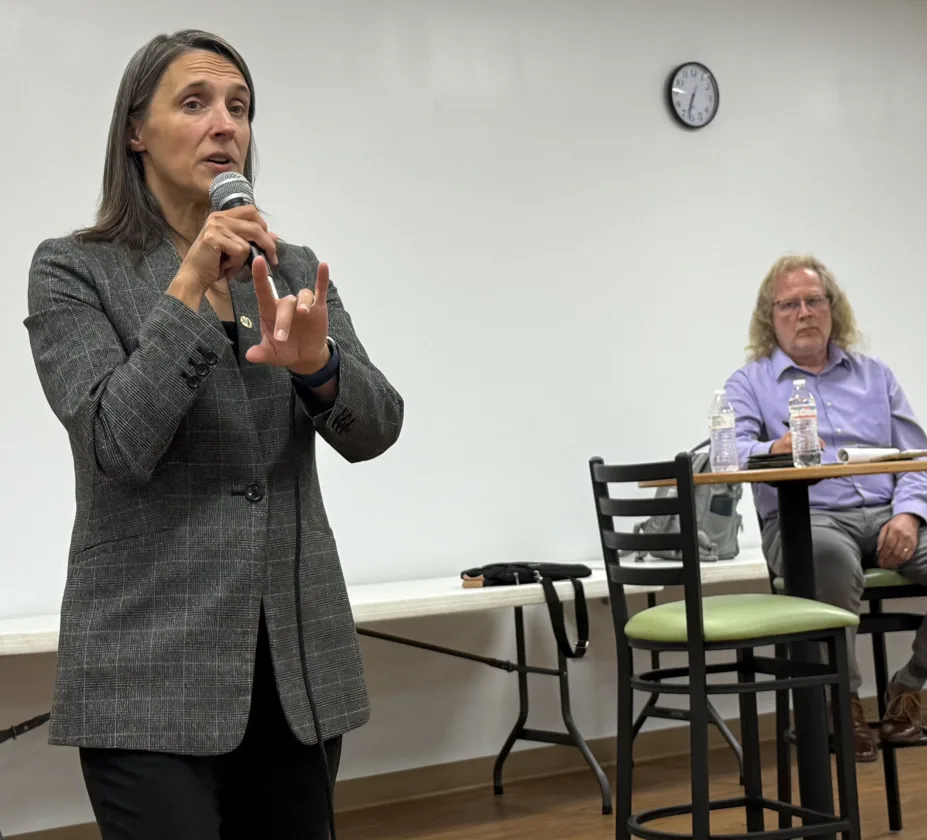
For two hours, Deputy Secretary Kristen Ahrens, of the Office of Developmental Programs (ODP) delivered that information at an informational event held at the Williamsport YMCA. She was joined by Ned Whitehead, a special education and disability advocate who works with Vision for Equality and the Pennsylvania Waiting List Campaign.
Although most of the people who attended the session already are enrolled in services, Ahrens said that it is rare to find that is the case.
"Most rooms I'm in, it's a good half or more people and part of why they're coming out is they're really struggling and they need services -- they need more services," Ahrens said.
"Since the beginning of home and community-based services back in the '90s, we have maintained a waiting list. There has literally always been a waiting list as long as there have been community-based services," she said.
She said that when the governor came into office, she was startled by the magnitude of the problem of how many people were waiting.
In order to deal with the issue, she said her department began a new strategy to make sure that there are no adults on the list who are still waiting for services.
"We should be a system in Pennsylvania where, when somebody with intellectual disabilities or autism comes to the county door and says 'I need help,' that we are doing that really timely," she said.
Because of this strategy, the list has been reduced by 40 percent.
"We still have work to do," she said.
Another area of concern, Ahrens noted, was the quality of supports coordinators for people with special needs.
Although there weren't that many of the people in the group who had indicated that they had a new supports coordinator within the last year, Ahrens said that is not the norm.
"There are rooms in which the common experience is just turnover, turnover, turnover. I didn't even know I had it, I didn't even know they left. Now I'm with the supervisor-families really expressing a lot of concern that they are always teaching the supports coordinator," she said.
"The turnover is so fast that they're just not getting what they need. You're going through high school transition or trying to figure out a long-term plan for your family, and you've got someone who is very new at the job, and their supervisor might be very new at the job, and they're going to struggle to help you because they're still trying to figure out our very, very complicated system," she said.
She said that her department has launched a program which will aim at the quality of supports coordination in order to get lower turnover. The new program is aimed at "freeing the agencies up a little so that they can think of it more like a team supporting you instead of just one person," she explained.
Ahrens addressed the situation with day centers, which had been in operation before the pandemic but were all shut down due to health concerns during that time.
"We gave retainer payments to the providers because we knew we would need them coming out of the pandemic, but because of a combination of things, we had providers that couldn't find staff," she said.
This has caused workforce issues, which Ahrens said, are not likely to go away.
"We did not have enough babies 20 years ago to take care of all of the people that need to be taken care of now, so I think we do have to think more creatively about how we're approaching services to make sure that people are getting what they need," she said.
She noted that there has been some recovery in the day programs with about 18,000 people using that service, although it might not be on a five-day a week basis.
"This is another area that has just been an absolutely slow recovery and such an area that I hear families need. You need the break. You need your loved one to go be doing something they're engaged in during the day," she said.
During the meeting, Ahrens explained some of the programs offered by the state, specifically the waivers.
Because Pennsylvania participates in Medicaid funded services, it has to
offer certain services to children, women who are pregnant, people with disabilities, what are called categorically eligible for Medicaid, and those are considered state plan services," she said.
There is a basic package the state has to provide, such as primary care physicians, transportation to medical appointments, X-rays, and hospitalization -- basic medical care. She pointed out that the state is known as having one of the most generous physical health benefit packages in the country, especially for children. The state also waives parental income, whereas that is not true for all states.
The state plan also includes behavioral or mental health services, as well as other services.
"Again, Pennsylvania goes above and beyond that," Ahrens said.
She pointed out that federal Medicaid pays for 56 cents on every dollar, which means the state's money can go twice as far. By taking federal Medicaid dollars, the state has to pay for care in nursing facilities as well as intermediate care facilities for persons with intellectual disabilities. The word waiver comes in when someone waives some of those services that they are entitled to.
"If you're waiving a bunch of things, including receiving care in an institution, that's literally what I mean. So in PA for ODP, what we did, and states get to say who gets these special services. We said people with intellectual disability, autism, birth to death. That's the reason. And what services are you going to offer for that group of people? So you know, we said transportation, employment services, day programs, companion, residential, all the therapies. We have about 40 different services that we include in our waivers to meet the specific needs of people with intellectual disabilities and autism," Ahrens explained.
"The other thing the Fed allows you to do is set financial limits on it, limits on the number, how much benefit people get. It also allows you to include a waiting list. So that that's kind of where all of that comes from in terms of the federal rules," she said.
Under ODP there are four waivers. There is one for adults with autism, 21 and up, and there are three IDA waivers.
The one most often offered to students coming out of high school is the person family directed support waiver (PFDS). The annual amount allotted for service for that waiver is $47,000 per year. This could buy day service, employment services, respite, finance and in-home care for 15 hours a week. This waiver cannot buy residential services, Ahrens noted.
Next is the community living waiver, which is capped at $97,000 per year. And last is the consolidated waiver which is for people who need a residential service.
Ahrens pointed out that there are about 21,000 people in the state that are enrolled in the consolidated waiver; about 9,400 people that are enrolled in the community living; and about 13,000 in the PFDS waiver.
"Some of how we manage the waiting list is to take the approach that it's better for an individual and a family to get something rather than nothing, and so if we can meet some of those needs and get somebody into a PFDS, get somebody into community living, let's do that now. Give the individuals, you know, the support to have some activities, have the job. Give the family a break while they continue to wait for a consolidated waiver. If that's the ultimate need," she explained.
One of the issues that parents felt needed to be addressed was the disconnect between Ahrens office and the state's Department of Education. They were concerned that they weren't aware of what programs are there for their children as they get older.
Whitehead said that he had visited 17 different school districts last year and while some were "fantastic," some were not so good at guiding parents.
"Again, it's already been mentioned -- where do we learn stuff -- from parents," he said.