
Trending
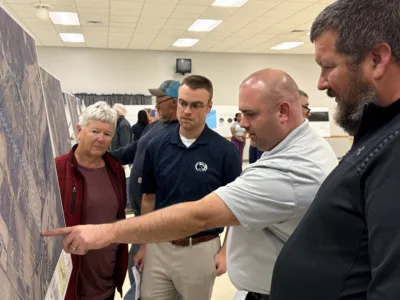
Property owners who will be impacted by proposed PPL transmission lines serving a proposed data center in Union County were able to speak with representatives on the various aspects of the project at an open house this week.
Earlier this year, the company had presented options for the placement of the line, which was met with opposition from the community, particularly farmers whose land would have been part of the right-of-way needed for the line.
This time, PPL's solution involves less impact on farmland and runs the line southeast from the Elimsport substation, across federal and state forest lands with minimal traversing of private land. However it does in places cross what PPL classifies as agricultural land.
"Initially, we came out with a list of routes, a group of routes that included some crossing of those agricultural lands, and so we've really been able to work with the state and federal government to utilize a big portion of them and completely avoid preserved farmlands," said Jonah Howe, regional affairs director for PPL.
"We do still impact some agricultural lands, but the impacts we were able to greatly minimize," he added.
About two thirds of the property that the route is proposed over state and federal properties. The remainder would be over other agricultural lands, not preserved farmland and private property, he explained.
Howe did admit that the route could change before plans are finalized.
"As we go out and have discussions with landowners, the route could change some. So we're announcing our preferred route with expectations that there will be changes that need to be made as those conversations with the landowner start to occur," he said.
The project will also use a pole which is different from the lattice towers people are used to seeing. The structures will be constructed of steel with a dark brown protective coating and are designed to be more weather resistant, according to PPL. They will range from 90 to 180 feet in height. The new poles allow farmers to till right up to the poles.
"It's a mono pole, so they're actually able to farm much closer to those structures. They're basically able to farm most of the ground within the right of way," Howe said.
Property owners are compensated for the property within the right-of-way. Information from PPL stated that the value of the easement would be determined by a fair market analysis by a certified third-party appraiser and then negotiating with property owners.
At the first open house, farmers had expressed concerns that the land around the poles would be compacted by traffic generated by maintenance of the lines. Howe said that those are things that would need to be worked out in the final agreements between land owners and PPL.
One of those farms impacted is the Jarrett farm. A portion of their arable land is dissected by the lines, which includes a 150-foot right-of-way, which is equal to 50 yards or half of a football field in width. The section affected lies between federal lands and the proposed data center site.
The Jarretts are among about 12 land owners that would be impacted by the transmission line.
The Jarrett's, Nancy and her son Nathan, are concerned about what the lines will do to the value of their property. At the moment the land is being farmed, but if, at some point, they would want to sell the land, how would the lines affect property value.
"Who wants to live next to telephone poles? And if they buy the right-of-ways, then it cuts down on what you'd be able to sell it to," he said.
"If you have that line running right next to you, a lot of people don't want to live that close," Jarrett said.
They're also concerned about the impact it could have on their ability to farm the land. He noted that the corn had just been harvested on the plot, two days before the open house.
"How is it going to affect the farming, because that's where my mom does the farming," Jarrett said.
"She and a couple other guys take care of it all. If you start dropping poles in the middle, it kind of takes from a whole lot of what you are able to farm," he said.
Jarrett said that they were told by PPL that in a few weeks they would get in touch with them to visit their property and discuss what type of compensation they will receive for the right-of-way crossing their land.
Although some people have protested the development of data centers, which is precipitating the increased need for electricity, Jarrett said he feels that's out of his control.
"They're going to put data centers in whether I like it or not, so long as they don't try to pull the eminent domain card," he said, adding that PPL has not mentioned that.
"They want to try to fairly compensate," he said.
"I haven't heard anything of eminent domain or anything like that, because if they want to pull that card, then that's two generations of my family that have been impacted by eminent domain," he added.
Although PPL has said the new transmission lines are needed because of the data center being developed, Howe believes there is a looming energy crisis across the state.
"We need more supply with the growing demand, regardless of data center growth," Howe said.
Another concern often voiced by property owners living near data centers is that their electric bills will increase due to the level of energy required for the centers. Howe contended that increases are related to the energy crisis and not specifically to the growing number of data centers.
"As far as locally, local residents will not see their energy costs go up specifically because a data center gets built nearby. That applies anywhere. They're a transmission level customer, so there are other things, and we have a bill breakdown on how that's applied in the percentages, but no, this will not raise local electricity rates," Howe said.
"I understand there's a lot of misinformation out there, and it's a complicated topic. So the more people that we can get to help educate on how that rate structure is set up, the better. And we're trying to do that," he added.
Howe pointed out that PPL wanted to have multiple open houses in order to get feedback from the community before moving forward with the project.
"I feel like we've given a good example of what we do following those first open houses. And we truly are trying to get feedback from the community, from stakeholders, so that we can plan the route to minimize impacts, especially in the most sensitive areas. You know, we understand that farming is important to this area and really across Pennsylvania," he said.
The final proposal will be submitted to the Public Utility Commission as part of the permitting process. If approved, the project is expected to be completed sometime in 2029.