
Rising fuel prices undercut promising year for crops in Lycoming County
Trending
Across Lycoming County, farmers saw increased crop yield, but now rising diesel fuel prices are hurting them.
"We had a favorable growing season, with timely rains," said Chris Ulrich, who raises beef cattle in Elimsport at Ulrich Farms, a family-owned Angus beef farm and local market, teaches agriculture to students at Montgomery Area School District and is vice president of the Lycoming Farm Bureau.
"We're looking at crops somewhere around a 15 to 20% increase in yield," he said of hay and grain, corn and soybeans.
In Lycoming County, the largest agricultural crop in terms of dollars is hay and grain planted in 21,000 acres followed by corn, 16,000 acres and 10,500 acres of soybeans.
Over summer, for those hay farmers, there was a significant increase in the number of cuttings or tons per acre, he said.
It gouges any progress made in terms of harvesting crop yield.
"Diesel fuel is essential for the American economy and for farmers.
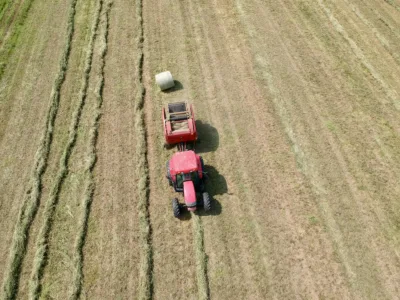
Everything on the farm, including tractors, combines, and irrigation equipment, requires the use of diesel fuel.
Diesel fuel is also essential for transporting crops and livestock.
Farmers and ranchers cannot delay harvest or stop using diesel fuel when prices rise. Equipment is what it is.
While farmers do not set the consumer prices, which is an index influenced by several hands before the products end up in stores, most farmers use diesel or pay for it.
Throughout the county, many farmers bring in custom harvesters and farmers typically get a surcharge or bill directly sent to them, Ulrich explained.
"They quoted me an increase of 15 % this year compared to last year," he said. "They take whatever the bill is and pass it onto the farmer," he said.
Diesel prices are hurting his own margins.
He said he recently filled his pickup truck that is used to haul the beef raised at his farm.
That half a tank in his vehicle cost him $150.
The costs for Ulrich and others like him who till the ground, plant the seed, raise the animals, harvest the crops and deliver the bounty is borne first and foremost on farmers.
Ulrich said farmers who hire for combining or spraying are also seeing higher surcharges on their bills.
Recently quoted equipment costs that were $70-80 an hour to run last year now costs $180-200 an hour, according to a story quoting concerns of the Pennsylvania Farm Bureau.
Ulrich said he does not see it going any lower before the midterm election on Nov. 3.
As gas prices continue to rise nationwide, officials at the Pennsylvania Farm Bureau in Camp Hill have asked the state government and President Donald Trump to provide relief to farmers as these farmers are seeing prices that have reached a national average of $6.39 per gallon.
As farmers typically have multiple pieces of machinery and other equipment that require fuel to transport crops and help with livestock, Pennsylvania Farm Bureau President Tommy Nagle has reached out to the General Assembly and the president to take steps to lower prices at the pump.
Legislation in the state Senate would temporarily suspend the state diesel tax for 60 days to provide immediate relief for businesses across the state, in a bill spearheaded by Sen. Lisa Boscola, D-Bethlehem.
"Unprecedented diesel prices are hitting farmers at harvest time, which is one of the most fuel-intensive times of the year," Nagle said.