
Trending
In May of 1907 a group of Lycoming County residents worked to prevent Tuberculosis through education, improved nutrition and better living conditions.
The Lycoming County Tuberculosis Society was the first countywide organization of its kind in Pennsylvania and the first of its kind outside of a large metropolitan area.
By 1926, the society had become a leader in tuberculosis prevention, introducing innovative health programs, establishing open-air schools, distributing milk to children and providing assistance to families affected by the disease.
Among those credited with leading the effort were Dr. W.F. Kunkle, Dr. Charles W. Youngman and Mrs. Z.H. Whiteman were the society's three living charter members by Dec. of 1926.
Their work began when tuberculosis, commonly known as the "white plague," was one of the nation's most feared diseases.
Before the society was formally organized, Whiteman and Jennie L. Simmons, a nurse with the Pennsylvania Department of Health, traveled throughout the Williamsport area providing food and other necessities to people suffering from tuberculosis.
Carrying baskets filled with oranges, milk, olive oil and eggs, the women frequently walked across the Maynard Street Bridge to DuBoistown, returning by way of Market Street. Their trips continued even during the winter.
Some families were reluctant to follow basic health recommendations, including keeping windows open to improve ventilation. Residents would open their windows when they saw the women approaching, only to close them again after they departed, according to the Grit.
Despite the resistance, the women continued their work, helping establish the foundation for an organized campaign against tuberculosis.
As early as 1907, Christmas Seals were sold to finance the work of the society.
The seals were mostly sold through churches. The first sale in 1907 netted the society $60. The 1925 campaign realized $5,500.
The group first met at the YMCA, eventually obtaining its own building at 164 Pine Street.
One of the society's most significant accomplishments came in 1908 with the establishment of an open-air school in Penn Building in Williamsport.
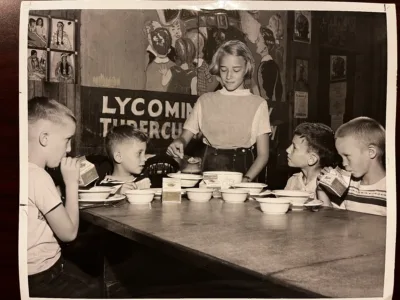
The school, among the first of its kind in a city the size of Williamsport, was designed to improve the health of children through fresh air, sunlight, proper nutrition and education.
The schools were built on the concept that ventilation, fresh air and exposure to the outside was doctor recommended and improved health, according to Wikipedia.
Miss Pedunk was the school's first teacher, later succeeded by Bertha Shirley.
A second open-air school opened in the Stevens Building in 1914, with Rebecca Brenholtz serving as its first teacher. The program eventually expanded to the Webster Building.
Students received milk and other nutritious foods while learning about personal hygiene and tuberculosis prevention.
Initially, many parents resisted sending their children to the open-air schools.
Youngman sometimes traveled by sleigh to children's homes to transport them to classes, according to the Grit.
The society maintained a policy prohibiting children with active tuberculosis from attending the open-air schools, which were intended to strengthen the health of other children.
As families began recognizing the benefits, attitudes changed.
Children who previously had been too ill to participate fully in their studies showed improvement, and demand for admission increased.
The Williamsport school board eventually assumed responsibility for operating the open-air schools, including providing food and equipment.
The society also was credited with pioneering the distribution of milk in local schools.
A relief fund sponsored by the Gazette and Bulletin newspaper raised more than $1,000 to purchase food, blankets, coal and other necessities for patients and their families.
The society also provided railroad transportation for patients who needed to reach tuberculosis treatment camps quickly.
Funding came from donations, endowments, benefit dances, entertainment events and the annual sale of Christmas seals.
The first Christmas seal campaign in 1907 raised just $60. By 1925, the annual campaign generated $5,500.
The society worked with the state department of health which guided its policies.
As the society grew, its activities expanded beyond tuberculosis prevention.
Baby clinics were introduced in 1920, along with a summer health camp.
The Modern Health Crusade was also implemented which focused on teaching healthy habits and conducting health examinations to students in Lycoming County schools outside of Williamsport.
Twenty years after its founding the tuberculosis death rate in Lycoming County had fallen from 75 to 40 per 1,000 people over the preceding 30 years.