
Red Kettle event kicks off holiday season of giving
Trending
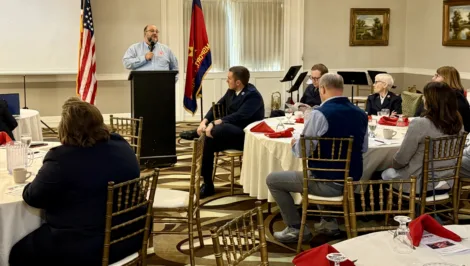
The traditional sounds of Christmas carols provided a backdrop for those arriving for the annual Red Kettle Kickoff Breakfast held by the local Salvation Army this week, as the season of giving stepped off with a generous boost from donors at the event. In all, $84,033 was raised through donations to sponsor the programs and services of the Salvation Army.
When announcing the total, Kent Bennett, a member of the board of directors, said that in recent years it has become more difficult for the non-profit to find places for bell-ringers.
In the past, the sight of someone ringing a bell next to a red kettle, marked the beginning of the holiday season for some. It was a common sight outside stores in the area.
"When I first got on the board in 2005, we had eight, maybe 10 locations," Bennett said.
"We've got four now and we've had four for the last couple of years," he added.
One reason, he cited, is the stores in the area that have closed and the online shopping trend. Plus, fewer people carry cash when shopping.
"It's been a real challenge, so we had to go to this alternative fundraising," he said.
To address that challenge, they instituted the Red Kettle Breakfast as means of securing funding for programs.
"The Williamsport Corps started the breakfast event eight years ago to kick-off our red kettle/bell ringing campaign because, with fewer kettle stand locations available to us and fewer people carrying cash, our red-kettle stands have not raised as much as in the past to support our programs for the community. The breakfast helps supplement the income garnered from our kettle stands/bell ringers. The breakfast is our second largest annual fundraising campaign,"
according to Laura L. Templeton, with the local corps' community development and resource development.
By acquiring new prospective breakfast sponsors, the Salvation Army had secured $73,025 through 60 sponsorships plus one donation towards the breakfast, Templeton said.
The kettles that served as centerpieces for the breakfast then collected another $11,008 which was added to the total donated before the event.
Bell ringing begins today at Wal-Mart, Sam's Club, Hobby Lobby and several other locations.
It remains the biggest fundraiser all year.
"Our goal for the stands this holiday season is $123,000. The breakfast income is in addition to this and makes sure our main fundraising season is off to a good start. Monies from both sources help us provide vital programs for our local neighbors in need, not just at Christmas but throughout the following year," Templeton said.
"Our Festival of Trees and Wreaths also helps boost this important holiday season fundraising," she added.
During the breakfast, Bob Myers III, emergency services director for the Salvation Army USA Eastern Territory, shared some of the ways the Salvation Army has helped in times of crisis, particularly during 9/11 in New York City.
"I've had the opportunity to share in the Army's work and what we do in this unique ministry," Myers said.
"We celebrated a couple of years ago the 125th anniversary of the Salvation Army's disaster relief work. It began in 1900 in what was then a major hurricane in Galveston, Texas," he said.
He shared that the national commander had put out a wire to all members of the corps that "comfort is needed and we have a duty to respond."
"And that's really something that's driven us over the past 127 years that we've done disaster relief and there's a who's who laundry list of any major crisis, major event that you can think of in the United States...chances are the Salvation was a part of it," he said.
He listed the various flooding events from Hurricanes across the state, including Agnes and Irene as well as the sites in Shanksville and at the Pentagon on 9/11 where the Salvation Army served those affected by the tragedies.
"Those two sometimes fall by the wayside in people's memory and connection just because the New York event was so significant and so polarizing, both at that time and to this day. In spite of that, the Army had significant work happening in New York City at that time at the World Trade Center site," he said.
"A lot of people don't know but we served for 261 days straight, 24/7 four meals a day-breakfast, lunch, dinner and a midnight meal for an overnight shift. We operated numerous comfort state sites around that location. We served those that were working at every morgue site in New York and New Jersey," he said.
He went on to explain that during a disaster the Salvation operates mobile feeding units during disasters. People can also visit their church locations to get cleaning supplies or financial assistance.
"We really offer a robust level of service when it comes to our disaster relief. It starts with the canteens on the streets and oftentimes ends with follow-up service with our ongoing emotional and spiritual care connections," he said.
During the 9/11 response, Myers said that the early response started with the typical deployment of canteens and personnel.
"They came from all across the Northeast and through the overwhelming support of the general public, we received truckloads and truckloads of supplies-some of them essential items that were needed, things like boots, shovels, rakes, gloves, bandages," he said.
"As time went on, it quickly became apparent that we were going to be in here for the long haul, and so some things changed at the site. We were able to set up a more permanent structure, so we sort of moved from having our mobile units in place to having what became affectionately known as the Taj Mahal. The Environmental Protection Agency donated what they called their portable facility to us. It was a 35,000 square foot tent. It provided a sort of a safe space, quiet space, right off the West Side Highway in New York. We served four meals a day there, provided a dining hall, provided supply distribution to folks and one of the most important aspects is the emotional and spiritual care support," he said.
He said that people often equate emotional and spiritual care with pastoral care, which is not always true.
"It certainly can be when the situation warrants it, but more often than not, it’s simply a listening ear. It’s listening to somebody tell their story, somebody to be heard, providing a ministry of presence. It can end in prayer. Sometimes it ends with more formal counseling," he said.
"For nearly 10 months on site, we had dozens of folks providing emotional and spiritual care service round the clock to those that were the response and recovery efforts, as well as family members," he said.
"Oftentimes, what people forget about is that family members daily came to the site looking for loved ones, looking to hear just some new level of information that they might not have seen on the news. As time goes on, the news system starts to fade. You hear less and less, and so folks still looking for answers were coming, and oftentimes would make regular connections with our emotional and spiritual care workers that were on the site there," he said.
The year after the attack on the World Trade Center, the Salvation Army began disaster case management services because many people had lost their livelihoods because of the event and some had lost their housing. Those needs existed for years, he noted.
"You are still hearing the news about some of the health impacts of folks that serve as responders on that site during that particular time. When it was all said and done, the Salvation Army provided $96 million in support to the 9/11 disaster. Probably the most significant portion of that, obviously in New York, but just as well in Pennsylvania and in the Pentagon response as well," Myers said.
He shared that the Army's service extended in 2001 and 2002 and that the last case for that disaster wasn't closed until the summer of 2007.
"We had more than 39,000 registered volunteers, officers, and staff that would support the efforts. Folks coming from all 50 states, Canada, Bermuda, multiple Caribbean island countries, as well as Mexico, before it would all all be said and done. Most of them serving for a week to 10 days at a time. Some for some for as long as two weeks in those early days. In total, more than a million hours of volunteer service would be logged. Still, one of the records for Salvation Army service in disaster relief," he said.
He shared that they had provided more than 3.2 million meals, largely to the police, fire, medical examiners, and construction workers and officials that were working the site day after day, and to family members, to folks that were from the Wall Street community that were impacted by the disaster, while their livelihoods were displaced.
"More than 110,000 emotional and spiritual care contacts were logged simply by listening to people’s stories, hearing their experiences, talking and discussing memories with family members, and then providing that day-to-day prayer, as it was requested on site, and then certainly lots of tears, both tears of joy and tears of sadness, as folks walk through that grieving process," he said.
He pointed out that many described the Salvation Army's work as "a bright spot, one of the rare bright spots in this otherwise dark time and place.
"We see it as a moment where we were able to rise to the occasion and provide a ministry of presence and a little bit of hope for those that we served. They might not see the good in the situation, but hopefully they see the good in the work that we’re trying to do in spite of a bad set of circumstances, and that’s really what the army is about. We don’t do what we do because of professional obligation. We do what we do out of an opportunity to serve," he said.