
Trending
A Republican state senator says he is hopeful there may be more common legislative goals for Pennsylvania despite his party now in the minority in both chambers and with the reelection of Gov. Josh Shapiro.
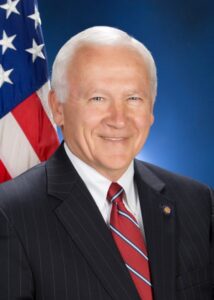
"I don't feel that just because it's a Democrat idea that I'm going to sit there and oppose it," said state Sen. Gene Yaw, R-Loyalsock, who serves the 23rd Senatorial District. That is Lycoming, Bradford, Sullivan, Tioga and Union counties. He took time out during a break at a breakfast meeting on agriculture Thursday at the Today Farm and Market in Muncy to discuss the post-election unofficial results and go over three of his priorities.
Yaw has held the seat since being elected in 2008, and sworn in January 2009. He was sworn into his fifth term in January 2025.
"I think there are a lot of things where we can work across the aisle and work together and since it is going to be so close with the vote, we have to work together," Yaw said.
Tuesday was a big night for Democrats in Harrisburg.
It remains unofficial, but the AP has projected both chambers. The former GOP Pennsylvania Senate – flipped and is controlled by Democrats. Republicans took back one, so the net gain was three.
That's the first Democratic Senate majority since 1993.
The Democrat majority in the House held and expanded.
Democrats entered with a narrow 103-100 edge and are projected to have at least 111 of the 203 seats, with a few races still uncalled. One Democratic count puts it at 113-90, so the final number may change. New members get sworn in on Jan. 5.
Asked to name three top priorities, Yaw led off with recreational marijuana.
"I've been a supporter of that idea for years," Yaw said, clarifying – "I am not an advocate for using marijuana,
I am an advocate for making money for the Commonwealth of Pennsylvania."
"All we are doing is importing the problem and we are exporting money," Yaw said, referencing states surrounding Pennsylvania that have approved recreational marijuana.
"To say that we're an island where it doesn't exist is foolish," Yaw said.
Yaw noted there may be chatter about other states repealing recreational marinjuana but he said he has not seen evidence of that happening.
"Also, we should be smart enough to learn from other states of where the problems are and fix it," he said. "I think we could do it, and it would be reasonable."
A second priority for Yaw is energy production.
"We could be producing a lot more natural gas but we don't have the capacity to transport it," he said.
"We don't have the infrastructure," he added.
"The gas is here, and we have the wherewithal to drill for it but once we drill for it, we don't have the infrastructure to get it to the right place," he said.
"I hope that the environmental regulations don't kill the infrastructure and it's one of my concerns," he said.
At one time, there were 10 to 15 large gas companies at one time, but Yaw says that number has been winnowed down to about three to five big ones.
"I hope that we don't tinker with it to the point where we destroy the industry," he said, citing how gas impact fees have had positive affect on rural communities.
Yaw said these communities use the impact fees, and would not use the word depend, but rather said "they really look forward to that money to do projects, which they otherwise could not afford to do."
Thirdly, Yaw said in terms of skill games, ruled to be the same as slot machines by the state Supreme Court, that decision has affected 40,000 people across the Commonwealth.
These 40,000 people either had their income reduced or were laid off and a large part of them lost their jobs, he remarked.
"When I look back at the election there I see there's 40,000 people that were really upset," he said.
Yaw had bipartisan support on bills regarding skill games and vowed to reach out again to Democratic Sen. Anthony Williams of Philadelphia.
Williams co-sponsored the skill games bill with Yaw.
The bill, SB 1079, and it's the flat-fee route, not a tax:
It calls for a $500 a month per terminal, instead of a percentage tax on revenue
Also, it has a statewide cap of 50,000 machines and sponsors put the yield at about $300 million a year, aimed largely at roads, bridges, and public transit, plus the Clean Streams Fund
It also requires a valid ID to play, limits machines per establishment, ties games into a state monitoring system like the lottery, and cracks down on unlicensed games and "stop-and-go" stores.
Its House companion is HB 2046 and neither bill passed. SB 1079 stalled and enforcement under the Supreme Court's ruling began Oct. 14.
Yaw said he'd like to try for a resurgence of the skill games legislation, and said he would be willing to go back to Williams, and say, 'You can put your name on the bill first,' but let's see if we can get it done."