
Czech looking to battle back in losers’ bracket at Series
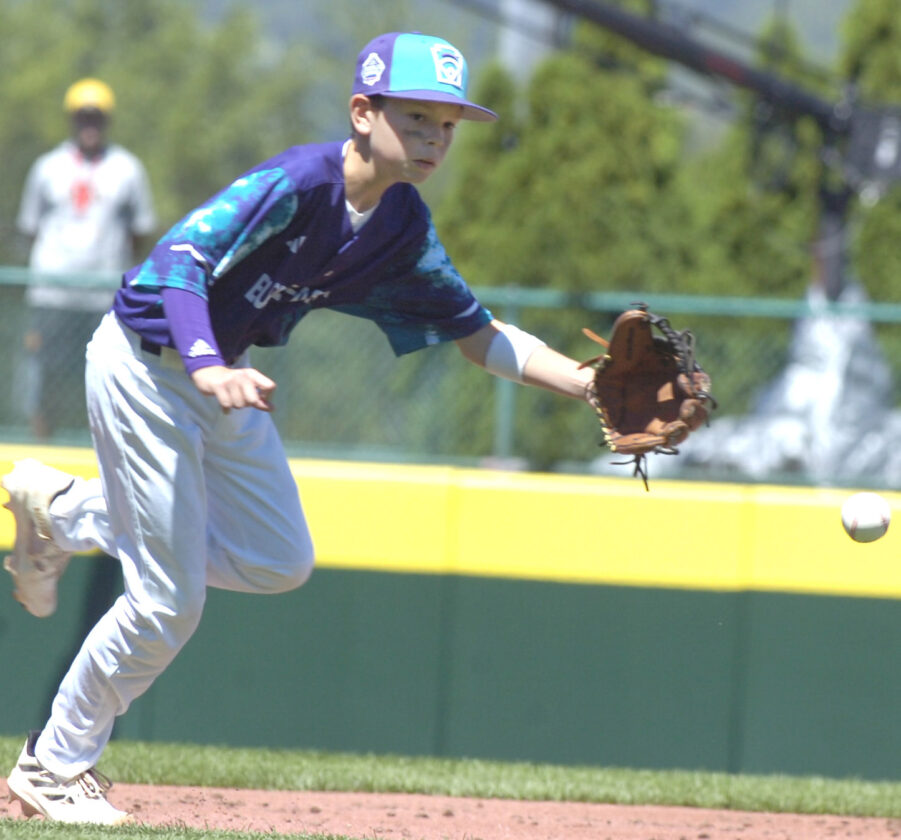
MARK NANCE/Sun-Gazette Correspondent Europe-Africa third basemanVaclav Mensik comes up empty on a single by Panama's Francesc Rodriguez in the first inning.

MARK NANCE/Sun-Gazette Correspondent Europe-Africa shortstop Denis Ondrousek comes up empty on a single by Panama Iker Snachez in the second inning.
MARK NANCE/Sun-Gazette Correspondent Europe-Africa third basemanVaclav Mensik comes up empty on a single by Panama's Francesc Rodriguez in the first inning.
MARK NANCE/Sun-Gazette Correspondent Europe-Africa shortstop Denis Ondrousek comes up empty on a single by Panama Iker Snachez in the second inning.
Trending
Last year, Emilia Romagna Little League from Italy advanced to the second round of the Little League World Series, just the second time a team from the Europe-Africa league had advanced past the first since its formation in 2013. Historically, Little League hasn't been Europe's strong suit, with its best appearances coming in 1993 and 1994 when it placed third in back-to-back tournaments.
Czech Republic is looking to change that, but it has a tough road ahead and is at a disadvantage. Of the teams in attendance, it has had the shortest amount of time together.
"It's a completely different system in Europe," said Czech Republic manager Arnost Nesnal. "They we not playing together in the season. We just had one little tournament in the Czech Republic that we won, and it qualified us to play in Poland."
Despite that, the team mostly cruised through the Europe-Africa regional tournament, winning all five of its games by a combined score of 49-11. Its biggest challenge came in the tourney's title game, where the team entered the bottom of the last inning trailing.
With the bases loaded, it pulled off a vastly important double, securing the tournament by way of walk off. Finishing a regional off like that is bound to lift the spirit of the players and boost their confidence, especially with the team finishing the tournament without a loss.
"This was the biggest moment," said Nesnal. "The qualification tournament in Poland was a very good level of competition, and we won it by walk-off."
Still, the Little League World Series would be a step up in terms of competition.
Going into the tournament, it had grown used to facing teams that couldn't match the pitching speed of some of these other international squads. According to Krasny, most of its team's pitchers averaged around 60 miles per hour on their fastest pitches.
This proved the be a problem in its opening game against Panama, who's starting pitcher on the day, Omar Vargas, was hitting around 75 miles per hour. Though its defense managed to keep things interesting through most of the game, its offense couldn't keep up.
"I will diplomatically say that the game was too short, we needed maybe like 30 more at bats facing this kind of pitching so we don't swing so many balls in the dirt," said Nesnal after the game. "Our average pitching is 55 miles per hour, fast pitching is 60. They're a bit faster."
The team still managed to keep things close however and didn't let up even after a Panama grand slam in the fourth inning put its chances in jeopardy. That reflected what Nesnal said about his team prior to the game, where he complimented his team's ability to fight no matter what the game situation was, and that fight is what made him most proud during the game.
"That is one thing that I am very proud of with my team, that like they didn't let it down after giving up the grand slam," said Nesnal. "After they gave up the Grand Slam, the pitcher threw strikes, and we finished the inning. Then we put the picture we were facing in a very, very tough situation with runners at first and second."
Though it ultimately failed to get back into the game, that fight gave it a fighting chance down the stretch. Its defense reestablished itself and didn't allow another run for the rest of the game, and its offense got multiple runners on base before Panama produced the final strikeout.
That fight could be what helps it advance in the losers' bracket as Czech Republic looks to continue its summer with a game at Volunteer Stadium against either Chinese Taipei or Canada.