
Singled out: Pit bulls troubled by negative perceptions
Trending

PHOTO PROVIDED
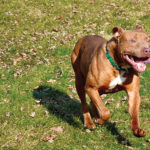
Maxwell plays in a yard at the Lycoming SPCA.
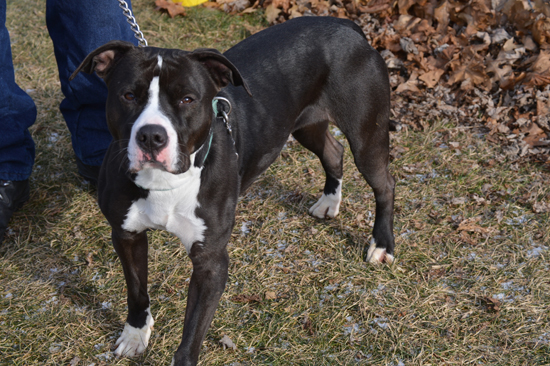
PHOTO PROVIDED
Pit bull-type dogs in a variety of colors and sizes are awaiting good homes at the Lycoming County SPCA.
(EDITOR'S NOTE: Today is the first part of a series about pit bull-type dogs, animals that often are portrayed as vicious and aggressive. For the next few weeks, learn more about these dogs from the people who deal directly with them.)
Shelter dogs have it rough.
In those cages, pit bulls have it worse. Surrendered by their owners or evicted from their homes to wander as strays, the dogs face an uncertain future, one that could end with a prolonged stay at any area shelter -- or euthanized.
Some dogs at the Lycoming County branch of the Society for the Prevention of Cruelty to Animals have been waiting for a safe, permanent home for much longer than a year -- a couple for more than two years.
Dogs identified as pit bulls "are more challenging to adopt out," said Victoria Stryker, executive director of the Lycoming SPCA.
The key, she said, lies in matching a family's dynamics with the instincts of a breed that was designed to protect and hunt.
A real purpose
Pit bull is the name commonly given to a type of dog that shares similar physical characteristics -- a square head; short, muscular body; strong jaws; and well-developed facial muscles.
These attributes served well the breeds that founded the pit bull type -- bulldogs and terriers -- which were used centuries ago in bloodsports to harass bulls and bears or to catch, corner and immobilize animals such as wild hogs for hunters. Terriers were bred to hunt and kill smaller animals such as foxes, badgers and rodents.
It is this instinct that may cause modern pit bull-type dogs to chase, attack and/or kill cats, wildlife or even other dogs.
"With terriers, it's in their genetics to hunt. They have high prey drives," Stryker said.
Several breeds recognized by the American Kennel Club are lumped together to fit the nickname of pit bull or "bully breeds" -- American Staffordshire terrier, Staffordshire bull terrier, rottweiler, American and English bulldog, and bull terrier. Another breed, the American pitbull terrier, is not recognized by the AKC but is by the UKC, the United Kennel Club, which is the second oldest kennel club in the U.S.
As of last Monday, 17 of the 25 dogs on the Lycoming SPCA website were identified as at least part of one of these breeds.
According to the AKC, typical traits of these breeds may include being affectionate, brave, smart, stubborn, strong and devoted.
"They are very friendly, loving and loyal dogs," Stryker said.
Bad rap
Still, there's no denying that pit bull-type dogs are cast as aggressive and vicious.
They often are the subject of breed-specific legislation that is used to ban them from states or municipalities. Last September, the city of Montreal banned dog owners from having pit bull-type dogs. The ruling was made in the wake of the mauling death of a woman by a canine suspected to be a pit bull-type dog.
Strolling down the corridors of the local SPCA's kennels, a visitor might be greeting with barking dogs crowding the cage doors or leaping wildly.
But, give them a chance, Stryker urged.
"Get to know a dog. Technically they are trapped in a cage," she said, "and they are protecting themselves. They behave totally different outside of their kennel.
"You can't judge a dog by its immediate situation," Stryker added.
The correct training
The dogs at the shelter are there for any number of reasons -- perhaps they were strays picked up by dog warden Scott Shurer or local police. Some are surrendered by their owners because of a "change in lifestyle," or due to an owner's illness or because he is moving and can't have pets in his new residence. Sometimes an owner gives it up because it barks too much, chews the furniture or needs more attention than they can give it.
"All dogs are work," Stryker said. "It takes awhile to develop that perfect dog."
For instance, she continues to work every day with her own dog, which is part Dachshund, a breed that originally was used to pull badgers out of holes.
"She's also part German shepherd," Stryker said, "that's why she guards me and barks.
"I reward her when she doesn't lunge or bark, but I don't want to stifle her either," she said.
Lunging and barking can be warnings a dog may issue before it takes further action, such as biting. Stifling those warning moves can result in a dog biting without warning, she said.
There are plenty of other warnings, but most people might not recognize them. For instance, when the hair raises on a dog's neck or along its spine, the animal stands in a stiff posture, feints or lunges, or carries its tail straight out or between its legs, all are signs that the dog is not relaxed, Stryker said.
Other warnings are not as obvious.
"Whale eye -- that's when a dog looks at you from the side of its eye," Stryker said. "If it's backing away while wagging its tail, or if its ears are flat and back … If a dog's been beaten, it may shy away from the touch of a hand, and growl.
"Each body part in relation to others tells you something. (A dog's body language) is really a science that you don't pick up overnight."
A dog also may growl, snap or bite in response to pain. Stryker mentioned a family who adopted a dog that bit someone who tried to hug it. The dog later was found to be suffering from arthritis in its neck.
In other cases, the "criminal element" has ruined the public perception of terrier breeds.
"Because these dogs are so powerful, they can do damage -- if they are trained to," Stryker said. "But they aren't inherently aggressive."