
Trending
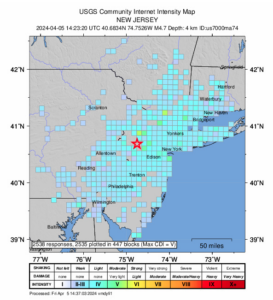
An earthquake with a preliminary magnitude of 4.8, centered near Lebanon, New Jersey, rocked several northeastern states Friday morning just after 10 a.m., according to the United States Geological Survey.
The epicenter of the quake was about 45 miles west of New York City and 50 miles north of Philadelphia, according to the agency, which estimated the quake might have been felt by more than 42 million people.
People as far as Baltimore to Connecticut and other areas of the Northeast reported the shaking, with tremors lasting for several seconds felt over 200 miles away near the Massachusetts-New Hampshire border.
"Our region just experienced an earthquake with a preliminary magnitude of 4.8, with an epicenter near Readington in Hunterdon County," New Jersey Gov. Phil Murphy wrote on X, formerly known as Twitter. "We have activated our State Emergency Operations Center. Please do not call 911 unless you have an actual emergency."
Christiann Thompson, a volunteer at the local public library in Whitehouse Station, New Jersey, said she and her co-workers at first wondered whether the rumbling was from something falling or from a train, according to the Associated Press.
"One little light cover fell down but we didn't even notice it until the guy came in to replace the water and he found it on the floor," she said.
"Pictures fell off the wall, plates fell off the wall" at Thompson's home, her husband told her. "The dogs lost their minds and got very terrified and ran around."
Closer to home, many reported feeling the effects of the quake, including several Sun-Gazette employees.
The sister of a staff member residing in Newark, New Jersey, reported that she felt her house rumbling for over four minutes.
"A 4.8 magnitude earthquake hit New Jersey and was felt in parts of Pennsylvania," state Gov. Josh Shapiro posted on X. "My team and @PEMAHQ are actively monitoring the situation and in contact with counties on any damage. We will keep Pennsylvanians updated."
While many in the area were unnerved by the uncommon occurrence, some took it in stride.
“It felt like a couple waves under my feet. It was groovy,” said Jessalee Kline, of South Williamsport, who was in her office at STEP Inc. in Newberry at the time of the quake.
“It felt like a rumble under my feet, and I thought maybe I was losing it because no one else felt it,” said Amanda Long, of Watsontown, another STEP employee.
The Sun-Gazette’s Facebook page was abuzz with many commenting on their experience with the earthquake.
"I was on the phone with someone near Scranton. He felt it and we laughed and said it was a truck going by…then about 15 seconds later..I felt it in Williamsport," Barbara Bolink Brumbaugh said.
"Definitely felt it! My dogs must have too. They barked and ran around," Kim Harvey posted.
"I didn’t 'feel' it…but a few decor items on my shelves shook…I wondered why,” Jamie Pike shared.
"Shook my office in Montoursville," Scott Wertz posted.
No damage was reported in the area and call volumes remained normal following the tremor, an official with the Lycoming County 911 Communications Center said.
While east coast earthquakes are rare compared to those experienced on the west coast, they can and do occur, according to Dr. Charles Ammon, Ph.D., Department of Geosciences professor and associate head for undergraduate programs at Penn State University. "We might have a magnitude 4 to 5 every 15 to 20 years."
"The 2011 Virginia earthquake was felt pretty widely up the sort-of corridor from DC through New York City, Philadelphia and Harrisburg, and that’s partly to do with the difference in geology between the eastern United States and the Western," Ammon said. "The eastern United States propagates those waves more efficiently, so they go farther."
"The most recent one was in Delaware in November of 2017, and it was a 4.1," he added.
The cause of northeast earthquakes is a system of faults that runs through eastern Pennsylvania into New Jersey, what Ammon calls "sort of a band of seismicity."
"We’re pretty far from a plate boundary. The closest one to us is in the middle of the Atlantic, and the other is up the West Coast, so we’re in the middle of the North American plate more or less," Ammon explained.
"Those earthquakes tend to be more sporadic and more the results of old geologic features that are responding to the modern stresses," he added.
The immediate area near the epicenter will likely experience aftershocks, however they are far less likely to be felt in the central Pennsylvania region, Ammon said.
While unexpected and relatively minor, today's incident can serve as a reminder that natural disasters can strike at any time.
"There are earthquakes in the East. We do have to worry about them. We should think about them," Ammon said. "Any earthquake is a good reminder to check your disaster kits."
"Being prepared for any kind of severe weather -- flooding, earthquakes, any of those things -- a lot of the sort of low hanging fruit that you use to prepare for one disaster is valuable for another disaster," he said.