Restorative Justice Week highlights importance of empathy at Penn College
Pennsylvania College of Technology recently wrapped up Restorative Justice Week, which aimed to highlight the importance of understanding the expansive impact of crime on a community and the most effective response for both the offender and the victim.
Susan M. Alberti, human services and restorative justice instructor, described restorative justice — once known as the “criminal justice” major — as taking a three-pronged approach that includes treatment and accountability for the offender and a voice for the victim.
“It’s all about understanding why people do what they do,” Alberti said. “We start to understand how similar each one of us is. It’s about improving empathy and trying to understand people a little more. It’s not just at Penn College or in Lycoming County or in Pennsylvania. We’re really good at finding differences, but when we start closing those gaps and connect with people, even those who have done very bad things, we start to understand. Our job, as educators, is to make people see things that might be right in front of their faces. We want them to ask: ‘How can I do or be better than I was yesterday?’ And ‘How can I help reshape what’s going on in my Penn College world, my family world and in my community?'”
As part of Restorative Justice Week, the human services & restorative justice program welcomed Liana Cole, prison education program manager for Penn State University’s Restorative Justice Initiative. Forty-two students explored theoretical foundations of restorative and transformative justice and participated in a small group hands-on activity.
“Students were challenged to rethink traditional notions of punishment and instead consider how to support accountability through education, skill-building and increased awareness for those who have caused harm,” said Sarah S. Moore, human services and restorative justice instructor.
Participants then developed thoughtful approaches for addressing the needs of victims, communities and relationships impacted by harm, ensuring that reintegration is not only possible, but also meaningful and just.
“We look at trends of the future with our majors,” Alberti said. “We’re always looking at how we can do better. Students, when they graduate, get involved in so many different areas. They do research, they’re working in the prison system, they’re case workers and case managers, and they’re in private practice. We really want them to see all the things they could be doing if they wanted to. Right now, we’re gearing kids toward jobs in prison and human service positions. They need to put themselves in the victim’s shoes to understand that empathy is key.”
Through the program, Adison M. Maggs, of Williamsport, a human services & restorative justice student, has learned the importance of empathy when it comes to effectively approaching both the victim and the offender.
“Not all crimes can be approached in the same way, and sometimes all parties may not agree with a specific approach,” Maggs said.
For example, when dealing with a robbery, she suggested a moderated peace circle may be an effective way to involve those directly impacted, as well as the community. This approach, however, would not be effective in a domestic violence charge.
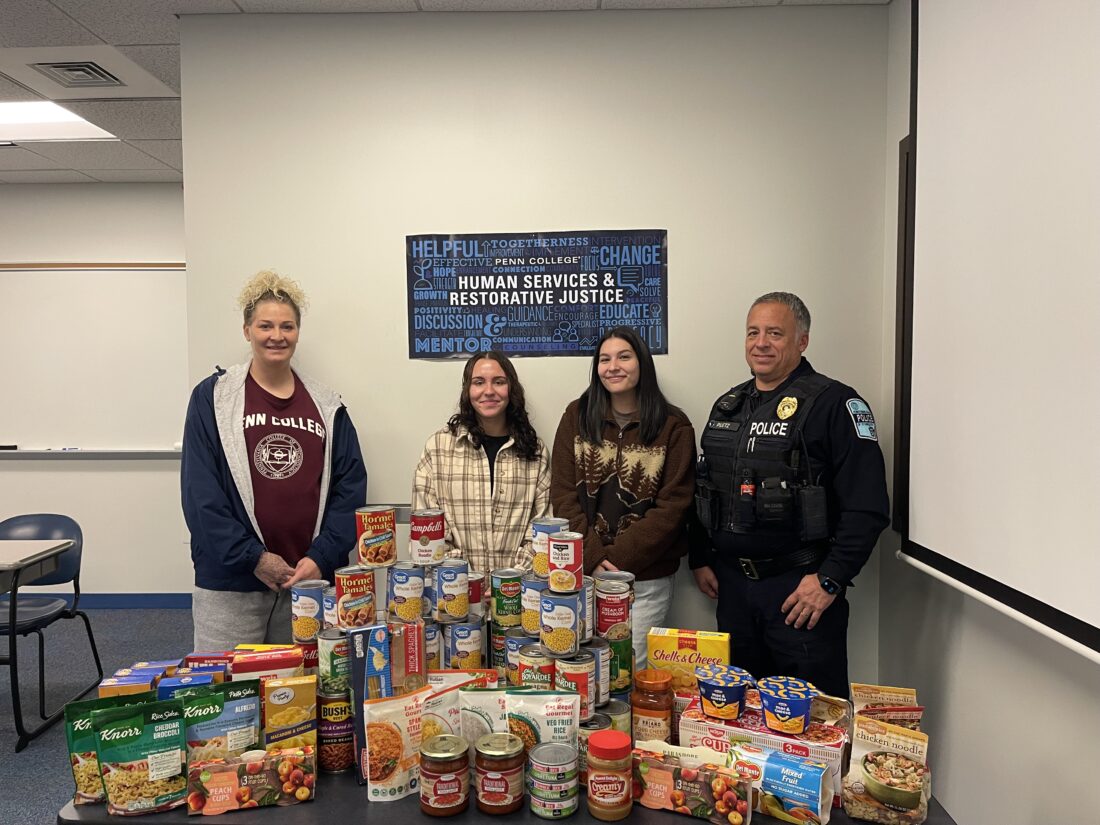
Human Services & Restorative Justice Club members and first-year students of the program also accepted “Food4Fines.” With the support of Penn College Police Chief David C. Pletz, Penn College parking tickets were cleared for those who donated five non-perishable food items.
Alberti said the activity was a way for offenders to turn a poor choice into something good.
Through the activity, 60 food items were collected for The Cupboard, an on-campus food pantry located outside The Wildcat Express in the Bush Campus Center.
“Restorative Justice Week is a great opportunity to acknowledge the efforts of individuals and communities who foster healing and understanding within the justice system,” Maggs said. “Our faculty and professors, especially Professor Alberti, do an excellent job of emphasizing how we offer services and give back to our community during this week.”
To learn more about Penn College’s human services & restorative justice program, call 570-327-4761 or visit www.pct.edu/humanServices.
Education
Restorative Justice Week highlights importance of empathy at Penn College

Jersey Shore High School, Lions Club announce students of the month

WAHS holds 36th annual Holiday Concert
Williamsport High School’s soccer and volleyball teams give to UPMC
Montoursville takes second place at first Scholastic Decathlon of the year