
Trending
"Pretty damn frightening."
That's how Peter Staley described the time period between his HIV diagnosis in late 1985 and joining the AIDS Coalition to Unleash Power (ACT UP) in 1987.
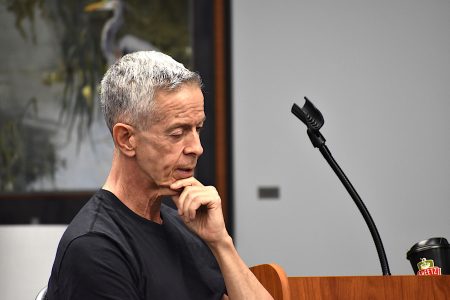
Hosted by AIDS Resource at Penn College to talk about his new memoir, "Never Silent," Staley fielded questions from Wes Chicko, the practice/outreach manager and testing specialist at AIDS Resource's State College office. The event was held at Penn College's Professional Development Center.
As a 24-year-old "deeply closeted bond trader," Staley "was pretty unaware of the risks" associated with HIV, he said.
It wasn't until he watched the 1985 TV movie "An Early Frost," and his boyfriend at the time mentioned that his coughing sounded like that of the main character with HIV, that Staley went to his "gay doctor."
The HIV test was brand-new at the time and took about two weeks to return a result, so Staley's doctor had a trick: Most of his patients with HIV had low white blood cell counts. Sure enough, Staley had a low white blood cell count.
He received the phone call while at work in the JP Morgan building.
So, what did Staley do after receiving the news? He went to Disney World with his Dutch boyfriend. Granted, the vacation had already been planned, but Staley said that he likes to joke about it.
Just a few days later, Staley came out to his family -- during Thanksgiving, no less. Staley said his family was very supportive of him.
Fast-forward about a year and a half, Staley first heard of ACT UP after having a flyer shoved into his hands on the way to work. It seemed that everyone in his office received such flyers, and it was the talk of the trading floor until the head bond trader made a startling remark about how he felt gay men with HIV, which made a hush fall over the floor.
Staley soon joined ACT UP and didn't look back.
He emphasized that, while ACT UP realized that the systems at play in America would need to change drastically in the future, the activists focused more on working within the current systems so they wouldn't die.
As Staley put it, it would be kind of difficult to "overthrow capitalism" when you're dead from lack of treatment for a deadly disease.
The short horizon everyone faced forced ACT UP to be "intensely practical," Staley said.
One of ACT UP's biggest goals was to petition Congress and the president to increase funding for the FDA -- more funding meant more research into the virus itself and into drugs to combat it.
ACT UP worked on both the "outside" and the "inside": Activists would pull stunts and organize protests outside of high-profile locations, like the FDA headquarters, while simultaneously organizing small group meetings with researchers and other "power brokers."
One researcher ACT UP worked particularly closely with was Dr. Anthony Fauci, currently serving as President Joe Biden's chief medical adviser.
In just his second year in ACT UP, Staley sat down with the then-director of the FDA at the FDA headquarters -- before he got arrested for essentially being catapulted onto the roof of the National Institutes of Health building in 1990, of course.
Though, things were not all peaches and cream in ACT UP.
Staley said that different "camps" of ACT UP eventually "went to war." Though Staley stressed that no act by any particular camp was done out of intentional malice, some groups "didn't do their homework" and instead started actively harming the movement.
This prompted Staley to start the Treatment Action Group (TAG) to continue the inside work while ACT UP continued its outside work.
Nowadays, with HIV drugs that actually work, Staley has his eyes set on a new target: prescription drug manufacturers and their sky-high prices.
He is the secretary of PrEP4All, an organization focused on providing HIV prevention and treatment to anyone who needs it.
Staley is in the middle of a lawsuit launched against drugmaker Gilead Sciences, and his team even convinced the former Trump administration to launch its own lawsuit against Gilead for its HIV drug prices.
When asked by Chicko if seeing "Staley v. Gilead" is daunting, he laughed and said, "Nah, that's cool."
Staley said that he uses the print media today to further push Congress to act on drug pricing. He said that bombshell reporting from The New York Times and Washington Post on drug prices helps bring HIV treatment back into the spotlight.
"If AIDS activists have you in their sights, don't ignore them," Staley said.