
Trending
Honoring the life's work of a fellow nurse as they near the end of their time on earth is the purpose behind the Nightingale Tribute ceremony.
Named after Florence Nightingale, who is considered to be the founder of modern nursing, the ceremony is offered in "honor and recognition of an individual's commitment and dedication to science and the practice of nursing."
"The Nightingale Tribute is a nurse Honor Guard to help honor nurses who are on hospice services," said Alexandria Eck, RN, with the Hillman Cancer Treatment Center at UPMC.
When it originated in Kansas, the ceremony, which included reciting the Nightingale Tribute poem and presenting a white rose, was performed after someone passed and usually in a funeral home setting.
"It was out in Family Hospice out in Lawrenceville, they started a Nightingale honors where they would honor someone at the bedside. So they were still alive, and it's not just at a funeral home," Eck said.
"When they put this on Facebook in February, we saw it and one of our nurse colleagues, Nancy Patchen, brought the idea to the table for us to have this here. We all jumped on board and started the committee and got this initiative," Eck said.
While other tribute or honor guards might get financial support from funeral homes, funding for the program at UPMC comes from the Susquehanna Health Foundation.
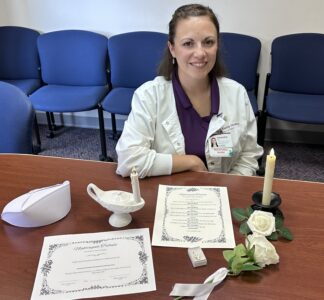
"This is just for our hospice patients who are RNs or LPN, someone with a license. We ask if they're interested, and we've mirrored this ceremony after our veterans pinnings. We wanted to give nurses a similar honor.
"We award them with a pin, we get dressed in our whites, which is traditional, and we even broke out the nursing caps. We use the Nightingale Lamp just as a symbol. It's a symbol during graduation ceremonies. And we present them with a certificate thanking them for their years in the profession. We recite the poem, and just kind of connect with the patient or the family and give them the opportunity to share some stories such as how long they were a nurse or any memorable experiences, their favorite part of nursing or whatever," Eck said.
A lantern is also placed in the patient's window and a white ribbon on their door frame to distinguish them as a nurse.
The nurses to be honored can be in hospice either at the Gatehouse, the in-house hospice care offered at the UPMC Williamsport Divine Providence campus or in hospice care in the community. Since they began the initiative this summer, they have had one ceremony at the Gatehouse, but two more nurses have been identified on hospice services.
"The nurses were all brought to tears -- all of us standing there. It touched all of us just to say thank you, for someone that had 20 years experience in the field," she said.
"This particular person didn't have children of her own, but she raised a nephew and really cared for her family and her younger siblings. So they shared a lot of those stories. The patient herself was unresponsive. So she wasn't able to participate in the conversation, but we always know that they're listening and aware. I think I saw her crack a smile at some of the stories. They were so appreciative. I read the poem. They video-taped the whole thing and just thought it was very special that we could honor her in that way," Eck shared.
A patient enters hospice care, which is a benefit through the insurance company that allows patients supportive care through end of life, Eck explained.
"Doctors have identified that given their health circumstances, they may not live beyond six months. It's not a deadline, people can live a lot longer on hospice. Sometimes we anticipate but we're just providing supportive care symptom management to someone either in their home, at the nursing home, or if symptoms are unmanageable, then they would come into the Gatehouse where we can provide more around-the-clock care," she said,
Having spent their life in the nursing profession often gives a person a different perspective when they are given a terminal diagnosis.
"I think so. A lot more compassion and understanding, you know, for the unit or acuity, things like that. But oftentimes, it isn't always brought up in the forefront that they were a nurse. Sometimes it comes up in conversation, but not always. We always like to give the heads up like, oh, she's a nurse. Definitely just be aware," she said.
During the ceremony, the traditional Nightingale lamp is displayed -- a symbol of the work of Florence Nightingale who was known as the "Lady with the Lamp" for the nursing care she provided soldiers during the Crimean War, guided by lamplight.
Right now as the world looks at the work done by health care professionals during the pandemic, reaching out to thank nurses, Eck sees this tribute at the end of a nurse's life as another way of showing appreciation.
"I think that this is just one more way to bring to the forefront the dedication and years of service and just how hard it is to get through nursing school … Not just an every-day thank-you for the work you do, but thank you for the years of dedicated service to the profession," she said.