
Throughout central Pennsylvania, bird migration is underway

PHOTO PROVIDED Canvasback and scaup are shown in this photo by Bill Tyler of Seven Mountains Audubon.
The annual spectacle of bird migration is underway. Large flocks of waterfowl such as swans, geese, and ducks are winging their way through central Pennsylvania, spurred on by increasing day length and warming trends of March.
The distinguishing feature of birds is their feathers. With their light and buoyant covering, birds fly. Flight gives birds the extraordinary ability to move across the landscape to exploit changing food resources and environmental conditions throughout the year. And we bird watchers enjoy those patterns. The annual cycle of bird activity can mark and even anticipate the regular cycle of summer, winter, spring-time, and harvest.
The marvelous variety, dramatic changes, and even predictability of migratory cycles add to our appreciation of the feathered creatures around us.
Seasonal changes affect more than just food. Waterfowl are physically excluded from their environment by the freezing temperatures and the resulting ice during the short days of winter. Ice physically blocks access to habitats that hold their food resources.
The remarkable attributes of the water molecule are perfectly designed to make aquatic life possible in so many ways. Water is less dense in its solid form (ice) than as a liquid! We take this for granted with ice cubes floating in our summer drinks. If pond water froze from the bottom, living things would be choked out as the pond froze solid.
Instead, the skim of ice across a pond protects the aquatic life below. Fish and invertebrates are inaccessible under the ice, so the vast majority of water birds are forced to leave our frozen landscape. Then, swans, geese, and ducks move back north as the melting ice sheets unveil the rich life locked away all winter.
This pattern varies with the severity of winter and not all water freezes over. Moving water of larger rivers, like the Susquehanna, remain open during all but the harshest winters, supporting fish-eating Common Mergansers year-round. The mild winter this year illustrates the adaptability of waterfowl to local conditions. Snow Geese and swans were on the move early.
A delightful variety of waterfowl occupied open water on local lakes and the Susquehanna River in February.
Normally, the earliest arrivals are clouds of Snow Geese; large, aptly-named white birds that winter along the Atlantic Coast and the Chesapeake. Snow Geese seem to follow the main stem of the Susquehanna River in February and March, jumping up to the Finger Lakes of central New York and then the Great Lakes. The larger, elegant Tundra Swan often winters with them, adding its elegant silhouette and bugling notes.
These large waterfowl are a delight to encounter as winter fades, and may be heard in night flights buoyed by southerly winds. Arctic-bound Canada Geese join these migrants, with boisterous flocks continuing through March.
Declines in waterfowl numbers more than a century ago spurred a variety of conservation initiatives. Teddy Roosevelt responded by creating the National Wildlife Refuge system in 1903. Encouraged by both hunters and environmental interests, wetland protection and water quality regulations gained steam in the 1970s which turned the tide of a century of wetland losses. The value of wetlands was reinforced by floods that impacted local riverside communities.
The long result over the past five decades has been recovering populations of waterfowl, in contrast to declines seen in other bird groups. Habitat protection, environmental quality focused on water, and careful management of populations supported by the sale of Duck Stamps and environmental regulations are now sustaining waterfowl populations, even in the face of recent avian influenza outbreaks.
We enjoy the variety and abundance of waterfowl today because of past and current conservation efforts.
About 30 species of waterfowl regularly occur in central Pennsylvania this month. The above-mentioned geese and swans are the largest of this group. Ducks range in size down to the diminutive Green-winged Teal, about the size of a crow. Ducks are generally divided behaviorally into dabblers and divers. Divers are usually found in open water where they pursue fish or vegetation and invertebrates on the bottom.
Common Mergansers are the most obvious example of this group. The common and distinctly-marked Bufflehead provides another example. Other divers found locally include two species of scaup, the fairly common ring-necked duck, and less common species such as the long-tailed duck and common goldeneye. Hundreds, and sometimes thousands, of redheads, canvasbacks, and scaup can be found all winter in large rafts on the finger lakes in New York, and smaller numbers are seen along the river locally. Other members of this group, like white-winged scoters, only drop into local lakes when storms or ice force migrants to settle onto larger water bodies. It is helpful to first become familiar with the most common species before looking out for such rare vagrants.
While ducks can adapt to people, as we see at local “duck ponds”, wild waterfowl are often skittish around people, so good optics are necessary to spot them on the far side of a lake or pond, often hidden in vegetation.
The most common dabbler, or puddle duck, found on ponds in most parks is the mallard. Most dabblers are at home in ponds and marshes or along the shoreline of open water where they glean food on the surface or reach down to the bottom to browse. Some species have descriptive names like northern pintail and blue-winged teal.
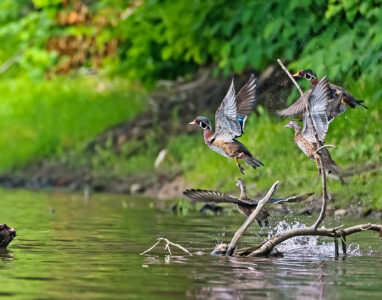
The northern shoveler is aptly named for its shovel-like bill designed to filter invertebrates and plankton from the water. The blandly named wood duck is the gaudiest of our local ducks. Conservation efforts over the past century restored this beautiful species from near extinction to its place as a common and widespread nesting bird across the eastern United States, providing another example of successful conservation, and emblematic of the benefits of water quality and wetland management.
As we welcome more hours of sunlight each day and celebrate the advancing spring, birds of all types are moving into Pennsylvania. A diversity of waterfowl are present this month, and most species linger into early April or remain until May before moving to nesting grounds in Canada.
A field guide is useful to distinguish each species’ features, as well as highlight the type of water in which they are most likely found.
Dan Brauning started his career as Project Coordinator of Pennsylvania’s first Atlas of Breeding Birds in Pennsylvania. He joined the Pennsylvania Game Commission as Ornithologist in 1990 and continued with the agency until he retired in 2021. During this tenure, he co-authored The Birds of Pennsylvania with Gerald McWilliams in 1992, served as Director of the Second Pennsylvania Breeding Bird Atlas, and co-editor of the resulting book in 2012. Dan is a member of Lycoming Audubon Society.
Outdoors
Migration season on Susquehanna River is here
The importance of a good leader when it comes to fishing
From the boardroom to the battlefield, the leader can be the difference between winning and losing. The same can be ...
Redmond named new manager for Little Pine State Park Complex
HARRISBURG — Department of Conservation and Natural Resources secretary Cindy Adams Dunn announced the ...
Outdoors community calendar for week of March 17
VIRTUAL CCC OF CLINTON COUNTY WHERE: Virtually online via Microsoft Teams WHEN: Tuesday, March 24 from ...
Reflections in Nature: Sighting of herons means spring’s arrival is on schedule
By now, most of us have seen our first robin of the year and also have seen and heard the flocks of geese heading ...
Pine Creek Rail Trail selected as Pennsylvania’s 2026 Trail of the Year
HARRISBURG — The Pine Creek Rail Trail, a 62-mile scenic journey through the Appalachian Mountains in Lycoming ...