
Reflections in Nature: A look at a meadow jumping mouse
Trending
Many years ago, I received a call from a gentleman that wanted to know if we have kangaroo mice here in Pennsylvania. I told him that we do not.
Well, the caller was not satisfied with my reply and proceeded to tell me that he was positive that he saw a kangaroo mouse crossing the road in front of his car. This led me to do some research. I found that there are only two species of kangaroo mice in North America, and both species live in the desert of southwestern United States with most found in Nevada.
The name kangaroo mouse refers to the species' extraordinary jumping ability. However, I also read that we do have two species of mice, here in Pennsylvania, which jump like a kangaroo. One is the meadow jumping mouse, which is adapted for jumping and often referred to as a kangaroo mouse. However, that's as far as the relationship goes.
The usual gait of the jumping mouse is a normal four-legged scamper, but if either frightened or in a hurry, this mouse takes off in high arching leaps that could propel it from six to eight feet. Although these leaps give the mouse amazing speed, one great disadvantage is that the mouse cannot choose its landing place and will often fall into holes, ditches, etc.
These jumping meadow mice, which are primarily seed eaters, do not store their food. The meadow jumping mouse along with its close relative the woodland jumping mouse are Pennsylvania's only hibernating mice. Just as the bear store up fat the jumping mice also store up an enormous amount of fat each fall, and by October, the mice will have entered their long winter's sleep.
At this time, the body temperature drops, circulation slows down, and breathing is slight compared to their 145 breaths per minute during the summer months. These mice remain in hibernation until the end of April. The exact dates of hibernation are not set by day-to-day weather conditions but by the readiness of the animal. The jumping mice seen out and about later than normal are those that have not put on enough fat to go into hibernation. In one book, I read that many jumping mice do not survive the torpor state because of insufficient fat reserves.
The young are born in nests below ground. The nests are usually lined with grasses. The gestation period is approximately eighteen days. An average litter size is between five and eight, and the female usually has two litters per year. The young are born hairless and blind, with their eyes opening at two weeks. The young will nurse approximately 28 days, and shortly after weaning, the young disperse and a second litter will be born.
Some young in the first litter will breed during that summer, but those of the second litter do not breed until the following spring.
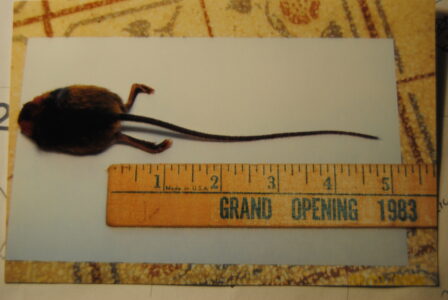
A full-grown jumping mouse will measure 8-9 inches in length, with 5-6 inches of this tail.
At night, these mice are prey for owls and during the day, snakes, weasels, foxes, bobcats, minks and hawks feed upon the jumping mice. Their kangaroo leaps are an aid in escaping, however the fact that the mice are unavailable during their hibernation is the main reason the mice exist. In the wild, their average life span is less than one year.
The habitats for the meadow jumping mouse and the woodland jumping mouse are indicative of their names. Although the two species are colored similarly, the woodland jumping mouse is lighter in color. The main field identification is a white tipped tail in the woodland jumping mouse, and a brown tipped tail for the meadow jumping mouse. Also, the woodland jumping mouse is larger than the meadow jumping mouse.
These mice are most active at night but can be seen during the day, especially on either a cloudy or rainy day.
The meadow jumping mouse is found throughout the state, while the woodland jumping mouse is more common in the northern counties but absent from the south-central and southeastern sections of the state. The population of both species varies from year to year.
In some years, these mice seem to be everywhere and uncommon during the next year.
I feel cheated that I have never seen either of these jumping mice. Seeing one of these mice would probably be (to me) as exciting as seeing a bear, big buck or bobcat.
I am thankful to the gentleman caller that prompted me to do the research.
Bill Bower is a retired Pennsylvania Game Commission Wildlife Officer. Read his blog and listen to his podcasts on the outdoors at www.onemaningreen.com.