SCI Muncy working to rehabilitate
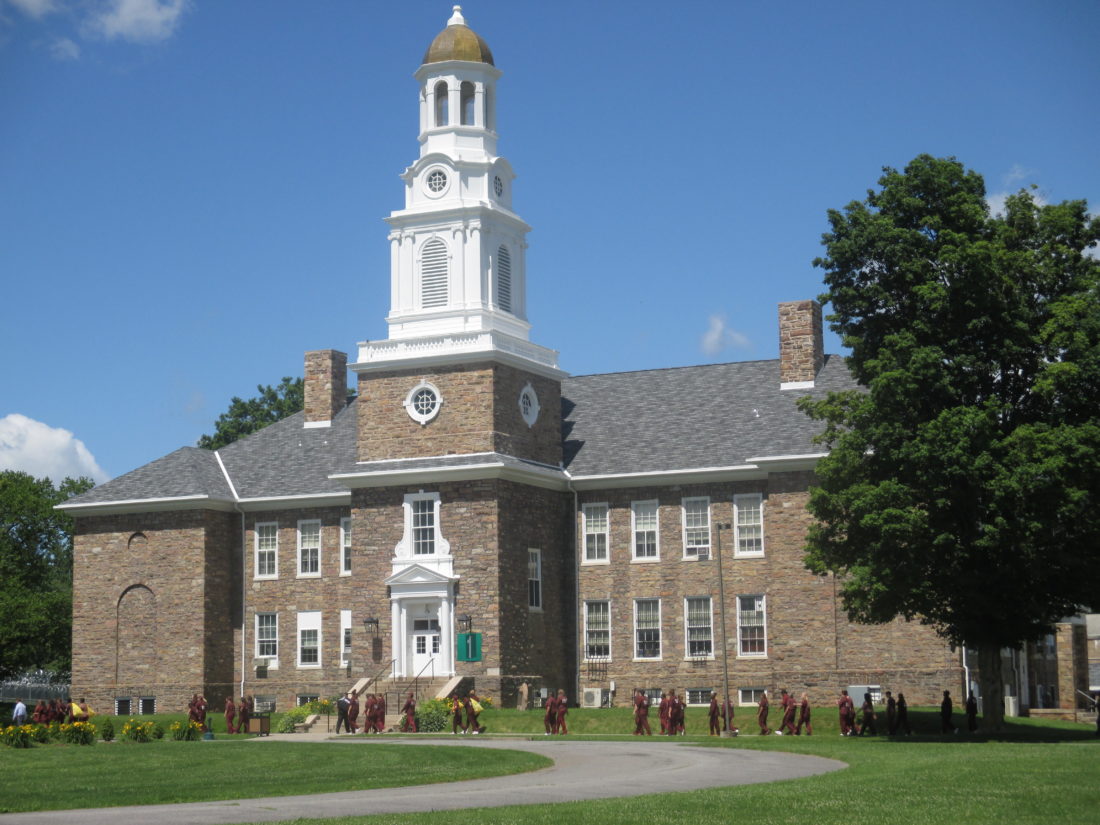
SETH NOLAN/Sun-Gazette The main building of the State Correctional Institute at Muncy, a 30-acres prison facility.
(EDITOR’S NOTE: Upon invitation of the state Department of Corrections, Sun-Gazette court reporter Seth Nolan spent half a day inside the walls of the State Correctional Institution at Muncy.)
MUNCY — Encased in a perimeter fence topped with spirals of barbed wire and surrounded by the erratic cracks of distant target practice, many inmates out for work casually stopped to ask Nicole McKee a quick question recently or just to say hello during her walk from one end of the prison to the other.
She greeted each one with a personalized, “How are you doing today?”
As the State Correctional Institution at Muncy’s correctional classification program manager, McKee knows many of the inmates because she is responsible for overseeing all of the programs provided to them. Issues such as religious services, inmate activities, employment, parenting needs, treatment programs and drug and alcohol counseling all fall under McKee’s guidance.
Knowing just about everything that’s going on in the prison comes with a lot of responsibility. McKee was proud to share with the Sun-Gazette the rehabilitative work the institution has been doing.
McKee was educated in criminal justice and psychology, beginning with the state Department of Corrections as a corrections counselor.
She transferred to Muncy to be closer to home and was promoted to her current job last year.
“I’ve always been interested and fascinated by psychology and the mind,” McKee explained.
Trying to understand how some people make criminal choices and others don’t is another tier to her interest in the complicated process of psychological human behavior.
‘Theft to homicide’
Before SCI Muncy became a part of the state Department of Corrections, it was the Industrial Home for Women.
There wasn’t a perimeter fence until the 1980s and many of the older buildings still are on the grounds as housing units, said Susan McNaughton, communications director of the department’s central office.
SCI Muncy is one of only two all-female prisons in the department.
There are between 1,350 to 1,400 inmates at the prison. They are serving sentences from two years to life for crimes ranging from theft to homicide, McKee said.
With housing, a chapel and educational, occupational and services buildings, the prison is like a city within a city.
After speaking to an inmate walking out of her housing unit, McKee explained that the personalized feel isn’t by accident.
“Some members of the administrative staff are required to visit each housing unit each week,” she said.
The six of them also have to take a longer tour once a month to other areas of the prison.
90 percent say trauma
Because SCI Muncy is the larger of the two all-female prisons, it gets to pilot a lot of the new programs offered to inmates and employees.
Despite the research showing differences between male and female inmates, programming in prison used to be similar.
“Unique to Muncy is the transitioning into a program to make that process more gender-responsive,” McKee said.
The Living Safely and Without Violence program was designed in response to the many complex risk factors unique to women.
“Men, generally, tend to act out violently when confronted with trauma or complicated emotions, but female inmates tend to bury that emotion,” McKee said. “A significant amount of these inmates also have co-defendants that are male … and 90 percent of them have reported experiencing some sort of trauma that led to them being incarcerated.”
Much of the programming McKee oversees explores these complicated risk factors and tries to help treat them.
“Everything we do is to drive down recidivism,” McKee said.
SCI Muncy’s House of Hope is an inpatient substance abuse program for victims of domestic violence and sexual assault.
With more than half of the inmates at the prison being there for drug or theft charges, it’s an important program to help treat addiction, the trauma that led to the addiction and the crime that’s likely linked to all of it.
To help with progress they’ve made through the prison’s programs, the entire state system also offers inmates Vivitrol treatment.
The drug blocks opioid receptors so a person can’t get high while also reducing their cravings to use, giving them the clean time they need back in the real world, according to the drug brand’s site.
“Studies show medically assisted treatment has become more and more successful in helping integrate those inmates back into society,” McKee said. “And to help them remain clean while they are doing it.”
It’s all voluntary, but if inmates want to participate in the department’s Vivitrol program, they are given the first of a dozen injections while at the institution.
They then are set up with a provider within the community into which they will be released.
Treating staff
Each institution had its own response to a recent noted increase in staff suicides within the department — all of them trying to figure out what the catalyst was and how to reverse it.
In addition to all the work she does for inmates, McKee is a chairwoman on the staff and wellness committee at SCI Muncy tasked with finding answers and improving conditions.
“This is a statewide initiative, but we here have really taken it to heart,” McKee said.
The committee here looks at all aspects of wellness and expands it to improving overall morale in a place that sometimes is all too surreal.
What the committee found is that there’s a lot about working in a prison that could trigger lingering trauma in military veterans.
“And, we have a lot of veterans on staff,” McKee said.
Research shows some things that could be experienced in a prison may be triggers for traumas formed in combat, especially sounds, she said.
Even for non-veteran staff working in a prison, seeing and experiencing some of the things that can happen are enough to cause post-traumatic stress disorder, McNaughton said.
Shared space
Alarming revelations such as these seed innovative new strategies within the prison system to make the space staff and inmates share simply better to be in every day.
The staff follows new correctional trends and pilot programs based on actual evidence before a trial run, McNaughton said.
Walking through the different units — most of them transformed to serve a much different purpose than when they were built — McKee and McNaughton both pointed out expansive mural projects on walls that normally would have been an oppressive gray concrete.
“Two inmates are working on this one,” McKee said, walking through a stairwell that’s covered in the colorful interpretation of the stages of a butterfly.
The five stages match a five-step program of treatment, she said.
Murals like these are being created on walls in prisons all over the state. SCI Muncy began its standalone mural initiative this past fall.
The mural in its visiting room covers the majority of the wall to the ceiling and is the biggest at the prison.
Before heading to another meeting, McKee pointed to an evolution in the prison system in the way of thinking about incarceration that seems to be prevalent here.
“Their punishment is being sent here,” she explained. “It’s our job to give them the help they need so they don’t come back.”
Top News

Real estate transactions

Williamsport city council accepts grant to digitize records, documents

Fellow firefighters take in Muncy Township crew while firehall is uninhabitable

Muncy Township firefighters relocate to Muncy Creek after supervisors refuse to authorize for company to decontaminate fire hall

Woodward Township supervisors initiate early defenses against possible data centers