
Commissioners asking Lycoming County to ‘please reduce’ spending
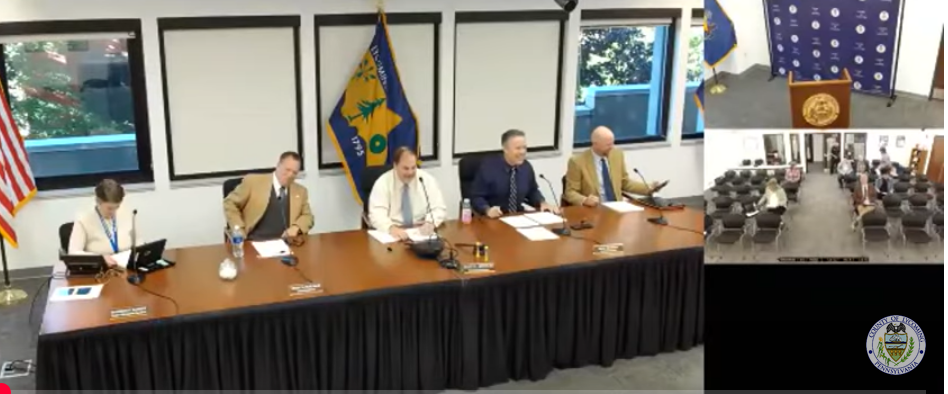
Although the commissioners have been taking a lot of heat following the release of Lycoming County’s 2026 budget, they point to a 20-year pattern of mismanagement at different levels of the government as a source of the reckoning that is occurring now.
“We’re not really sure who was the watchdog for the last 20 years,” said County Commissioner Marc Sortman during a visit with Commissioner Scott Metzger to the Sun-Gazette’s offices, adding, “but there are new watchdogs that are actually watching.”
Evidence that something was happening started appearing this year as at almost every weekly meeting, the commissioners, Metzger, Sortman and Mark Mussina, acting as the Salary Board with acting Controller Nikki Gottschall, voted to delete positions from the TDA (Table of Distribution and Allowance) and to down grade pay grades for other positions in an effort to reduce costs.
Then there were comments from the commissioners that the landfill, which for years had been touted as at least self-sufficient if not a cash cow for the county, was in financial trouble with over $27 million in bonds that would not be paid off at the current rate and scope of operation.
The commissioners also admitted that the proposed balanced budget for next year was the first in that 20-year period that will not dip into the fund balance in order to equalize expenditures and income.
Behind the scenes, county employees were being asked to take voluntary retirements in order to reduce staffing, which Metzger had noted at one meeting, had grown to over 500 employees, a number the commissioners say is way too high.
“We’re trying to look at every possible way to save money. We don’t want to do mandatory layoffs. That’s the last thing you want to do along with a tax increase,” Metzger said.
“Anybody who wants to take a voluntary layoff or voluntary retirement? Voluntary retirement-we’ll give you an incentive. We’ll make it, the incentive, payable on or before the end of March, because we had our tax dollars in March and we had a handful of people. Same thing with the voluntary layoffs, but we didn’t want to do anything mandatory,” he said.
He said that although this helps to achieve a balanced budget, it certainly is not the only thing that needs to happen.
“It’s just a way to help with the budget. It’s not going to ever balance this. You can’t balance a budget on police backs and salaries, that’s impossible, and we have to be careful what departments (because) you get down into a public safety issue. We don’t want to jeopardize any public safety,” Metzger said.
“But there are departments over there that have drastically increased over the years. You have two people doing one job, and we’re identifying that. We’ve had employees actually leave for maybe another line of work, and they’ll tell HR, I wasn’t busy. You really don’t need this job. I’ve heard that more than once…That’s somebody who left and went to another occupation. So that’s alarming,” he said.
“So then we go back to the department head and say, do you really need this position? Or if a position sits open for six to nine months, do you really need it because everybody else is doing the work,” he said.
“That’s what we have to do. We have to do more with less,” he added.
So far with the voluntary layoffs and retirements, the number of employees has been reduced by about 12 to 15.
“Every 20 employees with their salaries and benefits is an average of a million dollars in payroll,” Metzger said.
Sortman pointed out that there was no set number of positions that had to be eliminated.
“There’s people around here that would retire if they had a way out? So we gave them the way out, and then we took another group and just said, ‘Hey, who would take a layoff,'” Sortman said. “And now where that came into play and again, there may be one or two here that actually just took a layoff, but some of them were in the same position where they said, well, I need six months to hit retirement. So can I take the layoff and get my retirement? So we made it easy for those who choose to take that layoff… But we have no set number we want to get to at this point,” he added.
They both admitted that there was some pushback from some departments, particularly elected officials.
“We’ve asked everybody to please reduce. They’ve been good…We’ve had a couple pushbacks…the elected officials kind of seem like they see one elected official get this and they want the same thing, and we’re like,’Hey, we’re all in this together. We’re working for the taxpayers,'” Metzger said.
The commissioners are anticipating re-evaluating staffing in six months to see if positions still can be eliminated or if any need re-instated.
“Whether it’s the people or the budget. I mean, we’re just trying to be more cost effective,” Sortman said.
“I felt that my role, and I know Scott and the other Mark feel the same way. The people elected us, elected us to cut the cost, not to just raise taxes, and we all argued amongst each other. The three of us had different plans on that tax increase,” he said.
The 2026 budget at this point also includes a 0.5 mill tax increase for county property owners, which means that real estate taxes at the county level will increase by $50 for every $100,000 of a property’s value.
“We were recommended to do as high as two mill by the financial people. We said we’re not going up that high. We’re just not doing it. We didn’t want to go to a mill, and then we went back and forth, and because we haven’t raised them in eight years-we did basically a 7% increase,” Metzger said.
If this tax increase holds for 2026, that would be just the third in 21 years.
The pot that was raided to balance the budgets in many years was the fund balance, which is a reserve that governmental bodies are required to have on hand to cover operating costs for about two to three months in case of any emergency.
“The fund balance was being used to pay the bills. Plus, at the same time, when you had big expenses, capital expenses, they were using the fund balance to pay those expenses because they didn’t like to go on bonds for other things,” Metzger said.
Bonds did fund bridge bundling and costs at the landfill, but since they didn’t want to accrue more debt, they used the fund balance.
“It’s kind of like you have a savings and you’re paying stuff to take care of generational projects when you normally would probably do a home equity loan or something like that to take care of those generational projects. Now you’re using your savings and at the same time you’re paying everything that’s over and above,” Metzger said.
” Another thing, you have a lot of things in county government over the years that have been state and federally funded positions, programs, and those monies have dried up, or they’ve been reduced,” he said.
“You see those expenses increasing when you don’t have that same revenue coming in. So that’s another contributing factor, because you don’t have the same state, federal (and) instead of eliminating it or reducing it, either staff or the program, you still have the expense, which has grown. You have rising costs on utilities, especially electric and things like that. So everything’s gone up in price, and you’re not getting the same amount of revenue, and you’re not raising taxes. So this continues and the fund balance (gets) smaller and smaller and smaller,” he said.
Both commissioners admitted that at this point, there are no clear cut figures for how much remains in the fund balance. It could be $20 million or it could be $4 million, Sortman said.
“We can’t run that to zero,” he said.
He shared that his wife has told him that the commissioners are moving too fast for government with all the changes they have made this year and that they run the risk of being voted out when they come up for re-election.
“You know, my daughter’s not staying here, but my son is. This county’s got to be financially secure when the two of us leave whether we get voted out at the end of two years from there, four years after that, whatever it is. But we got to get it right? And we had to move fast this year. We had to move fast on the employee changes and the cost reductions,” Sortman said.
“I had a constituent say the other day to somebody else, they’re lying. It’s smoke and mirrors. There’s plenty of money. There’s not plenty of money. But we’re not desolate, you know, we’re somewhere in between. We’re going to have a fix, I think six months into this year, and we see the changes that we made in 2025 and what they reflected, I think we will see ourselves on good financial standing, but then we have to address the debt,” Sortman said.
Top News
Lycoming County spent $74,000 on Right to Know requests in 2025
Identity of man pulled from Muncy Creek Township pond released
The identity of a man pulled from a pond along Musser Lane in Muncy Creek Township Thursday evening has been ...
Mail ballot dating rules in flux for years
(EDITOR’S NOTE: Spotlight PA is an independent, nonpartisan, and nonprofit newsroom producing investigative and ...
Motorists ‘stressed,’ ‘struggling’ as average gas price hits $4.64
(The Center Square) - A 39% rise in gasoline prices and a 51% increase in diesel fuel prices during the past year ...
Jersey Shore middle school paraprofessional charged with rape, related counts
An ISS paraprofessional employee with Jersey Shore Area Middle School was arraigned on rape and other related ...
Former owners of Bush House drop lawsuit against FAMVEST
The former owners of the Bush House Estate in Muncy Township have withdrawn their lawsuit against the State ...