
Specialist: Muncy solar array could confuse local bats
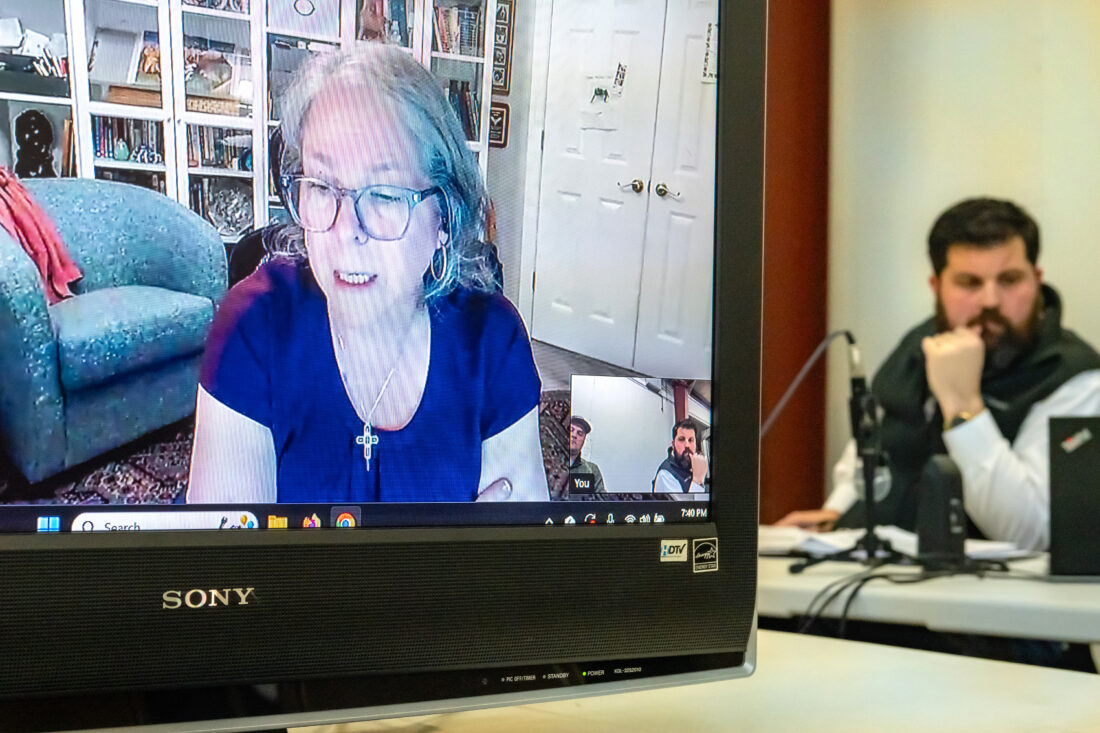
A bat specialist suggested during a conditional use hearing for a proposed large solar farm array targeted in Muncy Creek Township that the panels and equipment could throw off patterns normally associated with the furry, winged insect devourers among other endangered species.
When asked by attorney Zachary DuGan, representing the legal needs of the Muncy Area Neighborhood Preservation Coalition, a main opponent of this proposed project, if 55,000-plus solar panels would be enough to attract or confuse bats, Dr. DeeAnn Reeder did not hesitate to answer.
“Yes, I think it’s going to confuse the hell out of them,” Reeder said.
Her answer, she explained, was in the context of the echo-location frequency, where the panels alter the nature of the echoes that return from their echo-location call and bats may view solid panels as bodies of water.
“Eighty percent of my work is with bats,” Reeder said, clarifying her expertise for the board of supervisors (Eric Newcomer, chair, and Harley Fry II), and attorneys present, including Samuel E. Wiser Jr., legal counsel for Bollinger Solar LLC of Lancaster and J. Michael Wiley, solicitor for the township.
Reeder, who spoke remotely from Florida, also submitted a written report as of May 28 on the effect of solar arrays on bats that included a review of bat studies relative to this proposed project, DuGan said.
Her experience, however, is extensive, and she provided the parties with a four-page resume.
Reeder teaches in the Department of Biology and the Animal Behavior Program at Bucknell University in Lewisburg. She offers a course in Wildlife and Emerging Infectious Diseases and a field/laboratory course in Mammalogy. She is an ecophysiologist, biodiversity specialist, and conservationist working in both Africa and North America. Students are heavily involved in her research program, which has received funding from multiple sources, including National Science Foundation, National Institutes of Health, National Geographic, U.S. Fish & Wildlife Service, and the Woodtiger Fund.
It was about two-and-a-half hours of bat-related testimony that kept those at the township hearing mesmerized with her deep volume of empirical knowledge gained from years of study and research.
The Green-Green Dilemma
As part of this proposed alternative energy project, Bollinger Solar would situate 11 separate solar array sites, generating 33-megawatts of electricity, spread throughout the 165-acre farm along Clarkstown Road, between Fogelman and Muncy Exchange roads.
It is a unique project in that it is considered an agrivoltaic project, because the site also is proposed as an industrial-sized (although that industrial-size phrase as been refuted as inaccurate by the applicant) chicken farm of 350,000 birds called Sunny Side Up Farms LLC, a concentrated animal feeding operation (CAFO) consisting of five barns, each 88 feet wide and 616 feet long, spanning nearly 3,000 feet total, each housing 70,000 free-range chickens for egg production.
Among the discussion by Reeder was how such alternative energy projects present the following conundrum: Can alternative sources of energy, such as solar farms be constructed while also conserving various animal species, including endangered species of bats? It is a question known in the research field as the “Green-Green Dilemma.”
“Sometimes these two things conflict,” Reeder said. “Sometimes, they damage the species we’re trying to conserve.”
Little brown bat nearly wiped out
Today, for example, one of the most endangered bat species, the little brown bat, is nearly gone. About 90 % of the species has died in Pennsylvania due to the disease known as white nose syndrome, Reeder remarked.
DuGan probed Reeder’s knowledge on the subject by asking a series of questions about the solar farm’s potential for causing habitat loss and fragmentation, where the construction of the development would fragment species of animals.
In her report she identified 16 endangered species that could be on the parcel itself that included six species of bats, DuGan confirmed. Most of her testimony was geared toward bats but included other species of birds and reptiles.
Bats, naturally, provide insect control, although certain insects bats won’t eat, Reeder said.
“Saves us on pesticides,” Reeder said.
Additionally, DuGan asked Reeder about any potential impacts from solar arrays changing behavior in bats.
Bats’ calculations are done in milliseconds as they send high frequency calls and interpret the shapes of the returning echoes. “They would fly close to whatever object is prey and use the echo-location to hone in,” DuGan said in a follow up of Reeder’s discussion.
It was learned in Reeder’s discourse that some species of bats may fly fast by the solar arrays and some may avoid the area altogether. Some bat species prefer to fly to the edge of a forest. Some in wide open spaces, as she noted.
This project is in agricultural conservation-residential zoned area that is a combination of open fields, Christmas/holiday trees and arborvitae.
Wiser, on cross examination, asked questions related to the reports Reeder referenced. Research indicated a differing view, according to Wiser who asked the professor if it were possible that a solar array project might benefit some bat species and not others.
“It is the more rare species we’re more worried about,” Reeder said.
Also, specific data is not available at this site because, as Reeder explained – “We don’t know what bats are flying there right now . . . “We have four studies on bat-solar interactions that provide guidance of what we expect will occur,” she said, adding it is an emerging field and information can be gained from studies at the other solar sites. “We don’t have the information needed to address the impact on this site,” she said.
“The reason there is no information on this particular site is that the previous owner or applicant has not completed an environmental impact study, which is what the objectors were hoping to convince the supervisors to require,” DuGan said.
High level of generalization in studies
Wiser, further questioning her about the studies, asked Reeder to explain about what he said basically were “high levels of generalization that can’t be translated into scientific certainty.”
Reeder said scientific certainty was not possible and also countered the assertion made through the question saying these were “robust study designs with powerful statistical analysis that all come to the conclusion that while some common bat species may visit solar farm areas more frequently at certain times of the year, the less common species, which may be threatened or endangered will be negatively impacted, with lower activity levels at these sites.”
Wiser also established through a question that Reeder once lived close to the proposed Sunny Side Up Farms.
“I did,” she said, adding that property was sold in 2015.
It was established that Reeder did not do an on-site visit but was familiar with the location from her past residency in the area.
Howard Williams, a resident of Muncy, asked Reeder what the precautionary principle is regarding this site.
“It is to do no harm,” Reeder said.
Williams asked if it is known what species would be using this space.
“In terms of certitude, that data is not available,” Reeder said, adding how there were the four studies on bats and solar arrays published to date from around the world.
She also then recommended that the applicant complete an assessment on utilization, a one-year study on animal species that are using the area as part of the environmental impact study.
Reeder acknowledged that she was not as familiar with regulatory processes as those who are with the state Department of Environmental Protection, state Department of Conservation and Natural Resources, state Game Commission, state Fish and Boat Commission, and U.S. Department of Fish and Wildlife Service.
“I don’t work in the regulatory world,” Reeder said, clarifying that she was familiar with the regulations.
“Dr. Reeder’s experience included working with environmental regulations but stated she was not in charge of implementing plans in accordance with federal or state regulations,” DuGan said.
“Dr. Reeder is clearly very well studied on the topic and offered a different position from the typical testimony the public has been hearing for the proposed CAFO and solar farm,” DuGan said.
When asked why the coalition brought in a bat expert, DuGan explained that premise.
A lot of the testimony and evidence presented by witnesses testifying on behalf of the coalition has focused on hydrogeology, solar array, housing prices and residential concerns about pathogens and nuisances associated with a large CAFO and solar farm, he said.
“Residents and the supervisors have not been presented with such a deep dive on conservation, and Reeder provided the last bit of detail to make everything come full circle,” he said.
Following Reeder, Muncy Area Volunteer Fire Co. Chief Scott Delany testified. The coalition witnesses have finished their testimony, DuGan noted.
The next conditional use hearing for the proposed solar panel project is continued to 7 p.m. Jan. 21 at the township building along Route 442. The next CAFO hearing is 7 p.m. on Dec. 17 at the Muncy Area Volunteer Fire Co. The CAFO hearings are generally larger attended because of the subject matter. It may be in the future that the hearings are combined with solar and CAFO, but that will be a decision by the two supervisors taking part in these proceedings.
Top News
Specialist: Muncy solar array could confuse local bats
‘The need is there’: Hundreds volunteer at mobile food packing event in downtown Williamsport
New attorneys welcomed to Lycoming Law Association
City of Williamsport to sell Pullman railroad car

‘As accurate as possible’: Data collectors take to Lycoming County’s backroads to assist with reassessment
