
Meet Poppy, Penn College’s ‘director of good vibes’
-
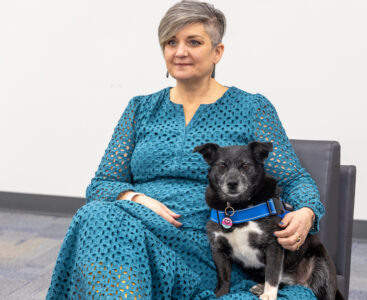
- KAREN VIBERT-KENNEDY/Sun-Gazette Tanya Berfield of Penn College, sits with Poppy, who recently became a faculty dog at the college in Williamsport.
-
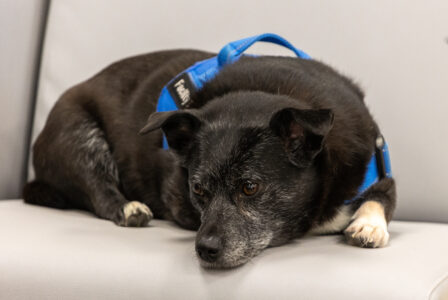
- KAREN VIBERT-KENNEDY/Sun-Gazette Poppy, who recently became a faculty dog at the college in Williamsport.
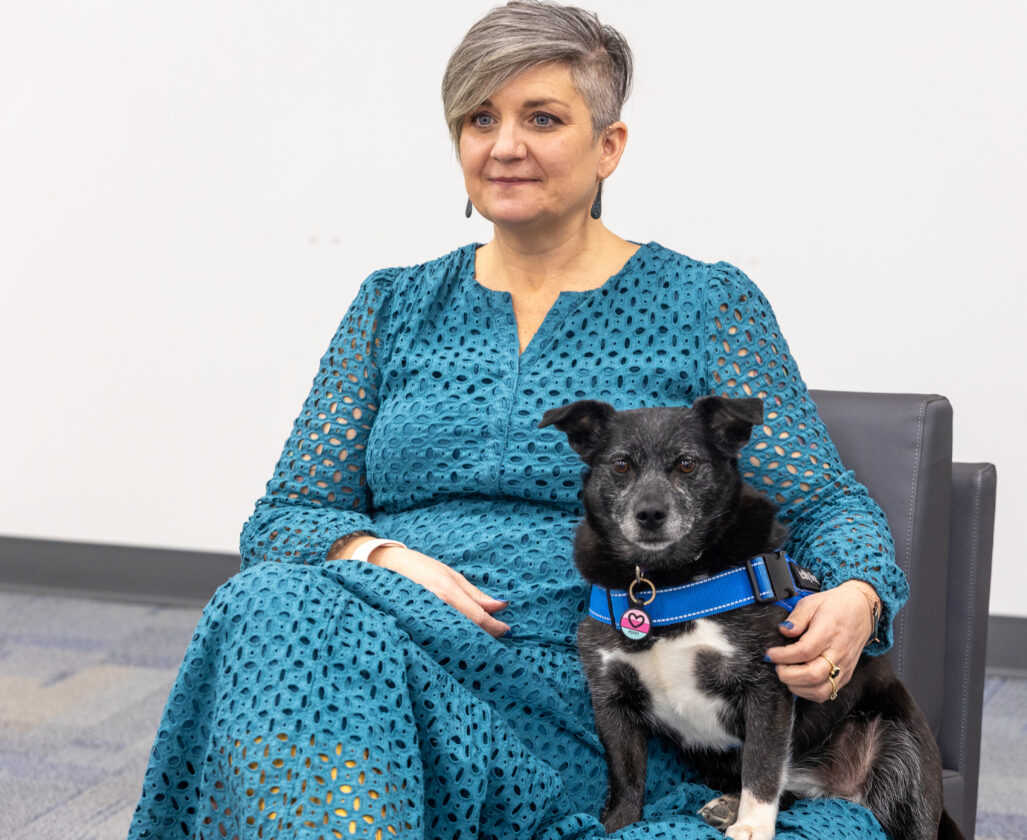
KAREN VIBERT-KENNEDY/Sun-Gazette Tanya Berfield of Penn College, sits with Poppy, who recently became a faculty dog at the college in Williamsport.
For Poppy, the “director of good vibes” at Penn College, finals week can be stressful with students feeling the pressure of those important exams and the end of a semester before they head home for break. Maybe they need Poppy’s calm presence or maybe they need to take a break from studying and play a little game of catch. Whatever-Poppy’s got it covered. She’s just doing her job as a facility dog at the Hudock Center.
The six-year-old mixed breed rescue dog seems to sense when students need that extra attention, according to her owner and handler, Dr. Tanya Berfield, director of student advocacy and the Title IX coordinator at the college.
Poppy’s journey began about a few years ago when the college did a reorganization and Berfield was appointed to her current position.
“Within those two areas, things that happen within our space can be really challenging for students,” Berfield said.
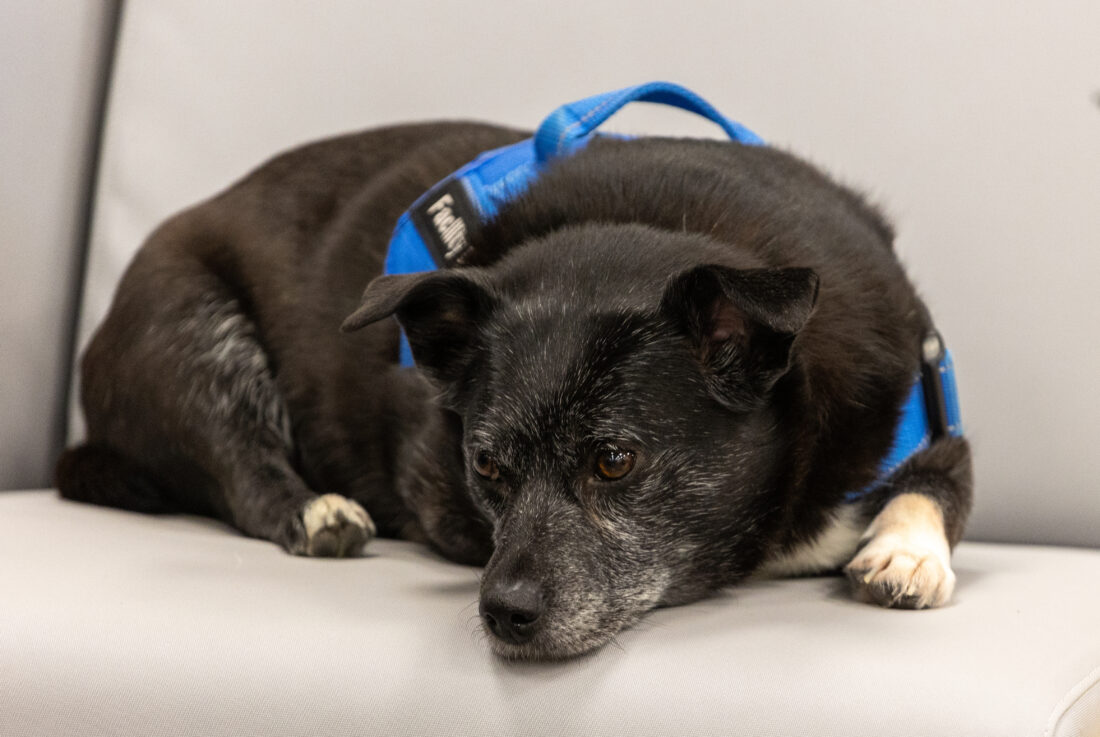
KAREN VIBERT-KENNEDY/Sun-Gazette Poppy, who recently became a faculty dog at the college in Williamsport.
“The Hudock Center itself is about helping students be successful in the academics. So we’ve got a group that focuses on the academics, but then there’s also a group in advocacy and Title IX that focus on the challenges and the barriers that are not academic related, but are stopping them from being successful within their academics. And those barriers can be pretty intense, if you’re thinking about things like homelessness, food insecurity, dating and domestic violence, healthy relationships, that kind of thing,” she said.
When she started her job, she started thinking that something was needed that she said was “a little bit positive”–something that could help students feel a “little bit more comfortable.”
Berfield, who has three dogs and has raised her family-three boys-rrecognized that Poppy was really good at comforting people.
“She doesn’t love big crowds or hanging out like that, but she will notice when somebody is upset and will comfort them,” she said.
“And so I said to my boss, I really think we should consider this. And then next thing I know, we were like, how do we get her certified to do this? Because she’s also easy to get along with, and listens very well,” she said.
First, Poppy had to go through a period of training to make sure that fit the profile in order to be certified as a facility dog.
Berfield explained the various levels Poppy had to complete in order to work with the students.
“There are several tests you have to pass. There’s a Canine Good Citizen that lots of dogs will go and do. So we did that first, and then for a facility dog, there are a bunch of things that you have to, like, hoops, you have to jump through to do this,” she said.
Then she was tested at the training site before coming to campus to be tested again, Berfield said.
“You have to get in and out of the car and sit appropriately. She has to stay with me on and off leash in certain situations. She has to stay with the person testing her and let me walk away and out of sight for a period — it was like three minutes,” she said.
“The challenge for her was we had to walk through a dining unit and not pick the french fries up. French fries are her favorite snack, her favorite treat. So I had promised her before we took the test, if you pass this test, you get your own Joe’s french fries. And so she did…really the most challenging thing for her, was to not pick up the food. You have to leave it there and then walk away from it. So unless you’re given permission. So that was the hardest part. She always has been easily trainable,” she said.
Students were polled and came up with Poppy’s title of “director of good vibes.”
“She has an official staff photograph. She’s got a nameplate on the wall and she does amazing work,” Berfield said.
Poppy’s role may seem lighthearted, but the work that she does is invaluable.
“So when we are in this space and students are uncomfortable, just when you see her, you feel a little bit more comfortable, typically. What happens though, is, if students are uncomfortable or they’re upset, they’ll just pet her while they’re talking to me, or she’s really good at noticing panic attacks, and so she’ll walk up to them and put her paws on their knees,” she said.
Berfield shared that one time when a student was having a panic attack and Poppy put her nose of the girls and just sat there and breathed until the student was calm enough to continue talking.
“She’s just been phenomenal,” she added.
Poppy goes home with Berfield every night and is usually on the job every day.
“Yesterday she took a vacation day. She was tired,” Berfield admitted.
“She gets a little bit worn out. If it’s too much, she’ll just not come in. Or if I’m in really large-scale events, like in the auditorium, on the stage, or things like that, then I don’t bring her because it’s too much for her, and she doesn’t love it,” she said.
Much like in the world outside of college, students are faced with problems such as homelessness and food insecurity.
“In terms of the advocacy side of the house we have helped several students in the last couple of weeks with homelessness. So when it’s cold and they’ll start asking for some of those, and so we have some emergency housing, and then we’ll help them navigate community resources as well. We’ve covered here on campus for food insecurities. And then there are lots of mental health issues that are around so it’s just around their own resiliency or struggles that they’re having, but also grief is a thing that is happening. So whether that is a loss of a person or a relationship or identity, there are lots of things that happen in the college transition, and so we’ll work with them to some degree, and then we also get them to the counseling services here or off-campus,” Berfield explained.
Finals week is also a busy time for Poppy, but on a daily basis, she can be seen out on campus with Berfield.
“The other thing we do is, while she doesn’t want big crowds, we walk out and about on campus quite a bit. When you see, when we walk into a space, that’s one of my favorite things to do, is just watch all the students light up because they see Poppy. They used to say hello to me, but now they just yell, Poppy’s here,” she said.
Transitioning from home to campus can be an emotional time and often students have left behind their own pets.
“Especially the first couple of weeks of a semester, that’s exactly what we hear. Is I miss my dog, or I miss my cat. There was a student sitting here one time and sometimes she’ll sense that somebody is unhappy, and she’ll just walk over to them. And I said, Oh, she must recognize you needed something. And he said, I lost my dog yesterday, and I just am really sad. And so she sat with him for a little while and just helped comfort him,” Berfield said.
“She’ll do that across campus, because she usually is very good at staying with me, but if she peels off and goes somewhere, I know there’s something happening, and that person needed that from her,” she added.
During the interview, Poppy sat calmly listening to the humans and at one point almost drifted to sleep.
“She is always so calm, and she listens perfectly unless there is a squirrel or she’s got some toys. And we do, like, we play fetch in here and let it bounce and let her chase it around. So she goes in like fast bursts of energy…she’s super energetic,” she said.
“I think everybody will say that they just love to see her, or that it makes them happy to see her, but I think it’s more in just their reactions. can see them lighting up when they get to come across her,” she said.
“I say it’s for students, but I also think that it’s just as good for our staff. The staff in this space, again-a lot of them are working with really challenging situations, or students who are in challenging situations — so they will come in and she has a bed on my desk, and so they’ll just walk up to the desk and get a little bit of support from her on occasion,” she said.
Top News

Lycoming County spent $74,000 on Right to Know requests in 2025
Identity of man pulled from Muncy Creek Township pond released
The identity of a man pulled from a pond along Musser Lane in Muncy Creek Township Thursday evening has been ...
Mail ballot dating rules in flux for years
(EDITOR’S NOTE: Spotlight PA is an independent, nonpartisan, and nonprofit newsroom producing investigative and ...
Motorists ‘stressed,’ ‘struggling’ as average gas price hits $4.64
(The Center Square) - A 39% rise in gasoline prices and a 51% increase in diesel fuel prices during the past year ...
Jersey Shore middle school paraprofessional charged with rape, related counts
An ISS paraprofessional employee with Jersey Shore Area Middle School was arraigned on rape and other related ...
Former owners of Bush House drop lawsuit against FAMVEST
The former owners of the Bush House Estate in Muncy Township have withdrawn their lawsuit against the State ...