Property values topic at hearing for proposed chicken farm in Muncy Creek Township
-
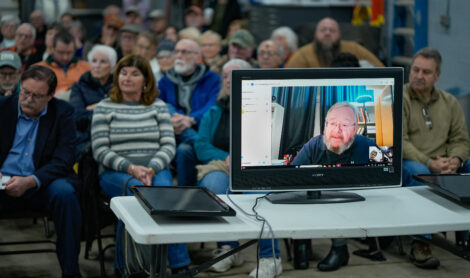
- John Kilpatrick (a witness for the coalition) gives testimony via a video call for a second appearance at the conditional use hearing by the Muncy Creek Township Supervisors in Muncy. DAVE KENNEDY/Sun-Gazette
-

- Samuel Wiser, attorney for the applicant, listens to Howard Williams of Muncy give testimony during the conditional use hearing by the Muncy Creek Township Supervisors in Muncy. DAVE KENNEDY/Sun-Gazette
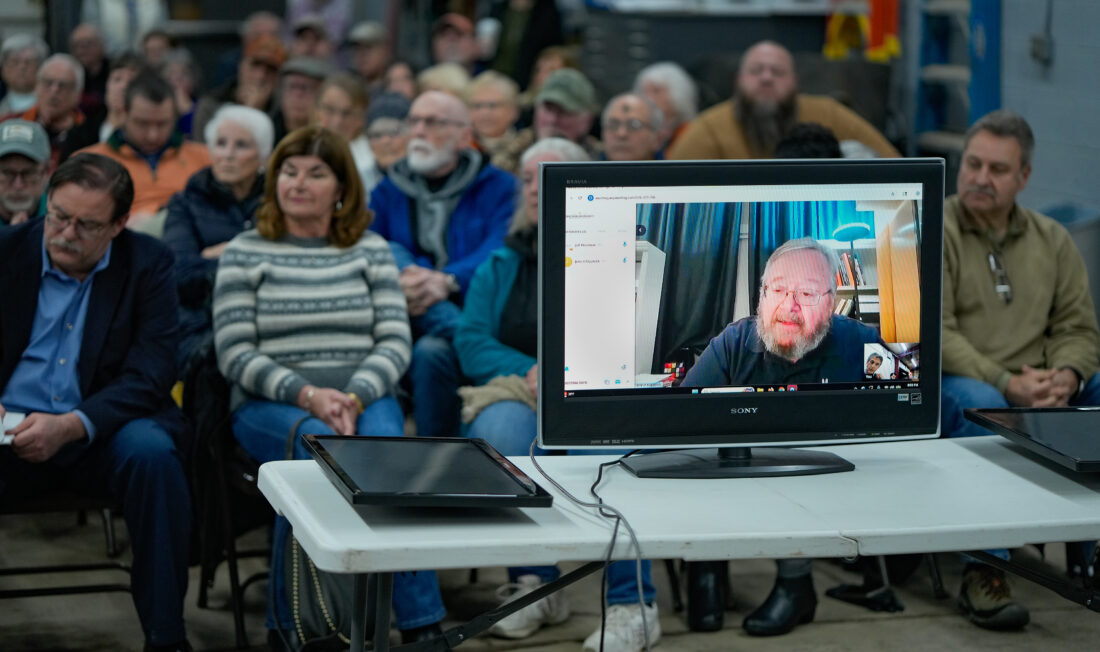
John Kilpatrick (a witness for the coalition) gives testimony via a video call for a second appearance at the conditional use hearing by the Muncy Creek Township Supervisors in Muncy. DAVE KENNEDY/Sun-Gazette
Potential property value losses from the operation of a proposed large chicken farm for egg production was among topics that dominated testimony at the conditional-use hearing for Sunny Side Up Farms this week.
The continuing hearing process before the Muncy Creek Township supervisors is for the concentrated animal feeding operation proposed by Sunny Side Up Farms, and what would be its daily corporate operator, Ag Ventures.
It also is a site for a proposed 33 megawatt solar farm by Bollinger Solar LLC. The land is zoned for agricultural conservation and residential use.
These are Lancaster County-based companies, a joint venture by the Wagner and Bollinger families and considered to be an “agrivoltaic project.”
The developers propose bringing a concentrated animal feeding operation (CAFO) of five barns, each with 70,000 chickens, or 350,000 free-range chickens laying eggs for production along with a solar array in 11 sections with 55,000-plus panels on its property along Clarkstown Road, between Fogelman Road on the east and Muncy Exchange Road to the west.

Samuel Wiser, attorney for the applicant, listens to Howard Williams of Muncy give testimony during the conditional use hearing by the Muncy Creek Township Supervisors in Muncy. DAVE KENNEDY/Sun-Gazette
Continuing with testimony Wednesday by remote, Dr. John Kilpatrick, a nationally-recognized property appraiser and author of numerous books and articles on the subject, spoke on behalf of the Muncy Area Neighborhood Preservation Coalition, which is the grassroots citizens’ advocacy group, which is paying for the witnesses to provide expert and specialized testimony and evidence, and is represented legally by Zachary DuGan, attorney with the firm Perciballi & Williams, Williamsport.
One of the questioners was resident Jeff Hiserman, and he referred to Kilpatrick’s report and testimony.
One question was specifically related to Kilpatrick citing 1,092 homes that would be within one mile of the proposed site.
He basically asked Kilpatrick how this proposal compares to typical CAFO locations.
“I could see this is a really complicated case, that is why I wanted to come to Pennsylvania to take a look at it,” Kilpatrick said.
Situations he said he had looked at do not have the “density of nearby residences” that are in this proposal.
Hiserman asked Kilpatrick to revisit a University of Michigan study where CAFOs were cited as typically located near older or lower-valued homes, while high-valued residences may be impacted by a greater degree.
Given the average home value is $225,000 as previously testified to in the residential district, does that suggest that your projected 20 to 25 percent losses may actually underestimate the impact in this … highly-valued area?” Hiserman asked.
“Yes, Kilpatrick said. “As you go up … buyers have choices … and so it’s not a matter of having settled because this is all you can afford, it is a matter of saying, ‘Wow, this house is across the street from a CAFO or a quarter mile from a CAFO, or down wind from a CAFO … I will go somewhere else and buy a house,'” he said.
Houses that Kilpatrick said he observed around the proposed CAFO site were “very nice houses.”
“It is clear that the kind of buyers who would be shopping for houses of that caliber would have economic choices,” Kilpatrick acknowledged.
“It is not a matter of negotiating 10 % or 40 % discounts,” he said, adding “those buyers could easily say, ‘I don’t want to raise my kids here, I will go on the other side of town.'”
Some mitigation, as Kilpatrick replied to Hiserman’s related question, is “not uncommon in CAFOs, such as buffers like trees.”
“We still know that a CAFO is a negative externality,” he said.
“You can dress it up, plant some trees, but at the end of the day you’ve got this negative thing that is going to be within a mile of your house. If your house is downwind … or 100 feet, 200 feet, 300 feet, the wind doesn’t care. The flies don’t really care. The pathogens don’t really care.”
There may be setbacks done, but the “value diminution is still there,” according to the academic and professional literature and court cases that Kilpatrick said he reviewed.
“It tells us what was found in applications for property tax reductions,” he said. “It tells us, more likely than not … what is going to happen in your neighborhood if this thing is built.”
Hiserman also probed Kilpatrick on cited cases in Missouri where homeowners received settlements ranging from $100,000 to $1.1 million for CAFO-related property losses, and in certain cases in other states where homeowners abandoned their homes entirely, receiving 50 to 60 % of the value compensation.
Does this documented litigation history suggest that property value concerns are speculative or actually based on actual legal outcomes?” Hiserman asked.
Applicant Attorney Samuel E. Wiser objected, saying that question calls(ed) for speculation.
“None of this is speculative,” Kilpatrick said. “These are real people in situations now like your’s,” he said.
It was an assertion by Wiser that demonstratively irked the appraiser.
“There is nothing speculative in here,” he said, adding, “I think that is a very important takeaway from this.”
Top News
Lycoming County Prison still seeking employees
Staffing at the Lycoming County Prison continues to be a challenge as Warden Brad Shoemaker shared at this ...
Lycoming Law Association announces 2026 Law Day Competition
The Lycoming Law Association (LLA) has announced its 2026 Law Day Competition criteria in a recent press ...

Muncy Creek Township resident shares fears of contamination

Property values topic at hearing for proposed chicken farm in Muncy Creek Township
Muncy Township’s transparency and objectivity questioned in wake of delayed development
With controversies emerging about actions taken by the Muncy Township Board of Supervisors, who took office last ...