Firefighters warn public about hoarding’s dangers
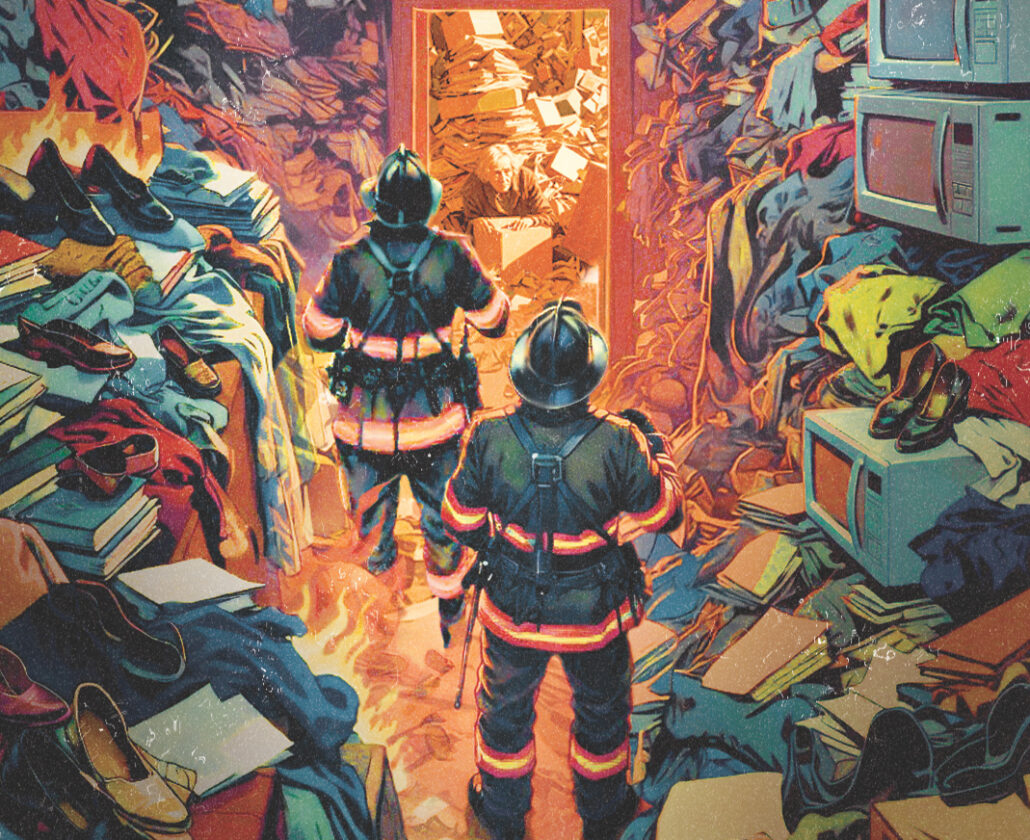
SUN-GAZETTE ILLUSTRATION
Dispatched to a recent house fire in their first-alarm coverage area, Montoursville firefighters arrived on the scene and saw flames shooting from a single first-floor bedroom window. All occupants were already out of the residence. Putting on self-contained breathing apparatus and grabbing a hose off their fire truck, the crew of firefighters approached the burning structure thinking they should be able to get in the house quickly and knock the fire down in a matter of minutes, saving the property.
However, that’s not at all what happened.
“As they entered through a garage, trying to advance to the bedroom where the fire was located, the firefighters encountered hoarding conditions immediately,” Montoursville Deputy Fire Chief Tyler Schramm said.
“There was a massive amount of clutter that was stacked, creating maze-like paths that firefighters had to try to traverse through in order to reach the fire. There was hoarding in the garage and all through the residence. Items were stacked in some areas from floor to ceiling and in other areas from floor to head height,” Schramm said in explaining what firemen faced.
The piles were “stacked with everything from clothes, shoes, books, papers, multiple microwaves, any personal effects that you could imagine were inside the home,” he said. “It was all combustible material, meaning it was stuff that easily burns,” he added.
Since the beginning of this year, Montoursville firefighters have been called to nine structure fires in the county.
“We encountered mild to severe hoarding conditions in at least four of those properties,” Schramm, a volunteer firefighter for at least 20 years, said.
Hoarding is defined as holding on to or accumulating an excess amount of possessions that can often lead to unsafe living conditions inside a home.
“Severe hoarding conditions create a 100 percent death trap not only for the residents that live in these types of houses, but also for firefighters who respond to these homes,” Schramm said.
“The American Psychiatric Association says there are five levels of hoarding, level five being the worst. This was a level-five home,” he added. “In all my years of being in the fire service, it is very rare that we encounter this kind of hoarding. At level five, complete rooms, as well as parts of the residence, are uninhabitable,” he said.
Because of the very narrow, single-file maze-like paths, often no more than two-feet wide and called “goat paths” by firefighters, the crew “made it close to the bedroom, but never got to it. In these maze-like conditions, you never have a direct path or straight line to individual rooms. You have to follow these paths, so firefighters end up having to stretch more hoses. In this particular case, they made it at least 250 feet into the house, but still could not reach the room” because of the hoarding conditions, the deputy chief explained.
“It’s like putting out a fire in slow motion,” he said.
Firefighters have to work a lot harder to reach the fire. “They have to move things out of the way as they try to maneuver through the paths,” Schramm said. As the firemen deal with limited visibility due to heavy smoke conditions, the fire continues to grow, spreading much quicker due to the overabundance of belongings piled inside the property, he explained.
“Because firefighters were slowed down by the amount of hoarding in the house, that really allowed the fire to continue to grow unchecked in rapid fashion. After nine minutes, we ended up pulling all the firefighters out of the home because they could never reach the fire. There was no way they could get ahead of it,” Schramm said. Out of safety concerns, the firefighters went into a defensive position, battling the flames from the outside. A fire that under normal conditions could have likely been contained to the single room and its contents ended up consuming the entire home, which was a total loss.
Paul Lester, an assistant fire chief with the Loyalsock Volunteer Fire Company, said hoarding houses “create a very dangerous situation, and is a chronic problem for emergency responders.”
While he and Schramm have fought several house fires together, hoarding is certainly not limited to any particular community.
“With hoarding, one really can’t move freely though one’s home,” he said.
At another recent blaze, firefighters arrived to find flames coming from a porch, Lester said. As one crew of firefighters began to douse the flames, another was assigned to search the smoke-filled house for any possible victims by entering a side door. Smoke was pouring out of the door.
“As soon as they got in about two feet, they were dealing with a room full of belongings. They went down this two-foot wide path, they got to one room and it was just filled with stuff. They managed to get to a second room and they found the same thing,” said Lester, who was the incident commander at this fire scene.
“There were boxes and boxes and boxes of accumulated belongings. This is what our crews are running into,” he said. Like the house fire where Schramm helped direct operations, all occupants in this home also made it safely out, Lester said.
A crew of firefighters looking for any possible occupants in a burning home could easily become trapped themselves, Lester said. The firemen might not be able to get out the same way they came in, and hoarding conditions may very well block their access to all windows, he explained.
“When you have houses that have that much stuff in them, it increases the fire load overall. Fires can take off, spread a lot quicker and it takes more water to put them out,” he said.
“In a home, you could find 50 years of newspapers and books stacked high, and all that added weight in a house” substantially increases the potential for a structural collapse because “the home was never designed or built to hold that much weight,” Lester explained.
“Until you are inside the home, you really have no idea what you are facing. We are now instructing our firefighters who are on the initial interior crew to report immediately the conditions they find inside a property” so that the incident commander can make the appropriate decisions on how to best battle the fire so that no one is needlessly injured,” Lester said.
“We want to know right away if we are dealing with a hoarding house because that will help us determine if there is a need to send extra equipment and manpower to the scene. It will also impact our decision on how long we should keep crews inside the house. Can we keep fighting it aggressively or do we need to back out and take a defensive position,” Lester explained.
At most structure fires, a Rapid Intervention Team (RIT) of trained firefighters are sent to the scene with the sole purpose of entering a burning structure and rescuing any firefighter who suddenly finds themselves trapped inside the building.
“Suppose there is a firefighter trapped inside a home, so we send in our RIT team to climb
through a window, and what do they find? All of a sudden what you thought was an entrance from the outside is obstructed on the inside (by belongings stacked to the ceiling),” Lester said.
“Our EMS (ambulance) crews see it a lot more than firefighters because they are in a lot more homes” handling medical emergency calls, Lester said.
Emergency medical technicians and paramedics have been documenting whenever they come upon hoarding conditions at a property. They share that information with other emergency responders who might one day be called to the same home to fight a fire, Lester, a firefighter for 30 years, said.
“It will help us to know what we are dealing with as soon as we are out the gate and en route to the scene,” he added.
Both he and Schramm said it is imperative that everyone – not just those struggling with hoarding conditions – have working smoke alarms in their houses.
Having piles and piles of belongings stacked in the home may very well prove fatal if a person’s only way out of a home is suddenly blocked by smoke and fire, the two veteran firefighters said.
Lester and Schramm said hoarding conditions clearly prevent firefighters from doing what they are trained to do: save lives and save property. Fortunately, no one has been killed or injured in any of the recent fires where hoarding was an issue.
“With severe hoarding properties, we may have to take a more defensive posture right from the beginning,” meaning firefighters will forgo doing any aggressive interior attack that could put them in harm’s way needlessly, Schramm said.
“We will make every effort to enter the residence to try to do rescues and extinguish the fire, but hoarding conditions could certainly prevent us from doing both,” Schramm warned.
Top News

Housing project planned for Hughesville area takes another step
City council believes computer provided to public addresses access concerns
Williamsport City Council believes it has addressed the need for allowing public accessibility at its newly-formed ...
Lycoming County commissioners continue push for more detail on spending
In an ongoing effort to allow county residents to have the complete picture on how their tax dollars are being ...
Student cell phone use called ‘catastrophic’ as ban mulled
(The Center Square) - The national discussion on keeping students off cell phones during school has reached full ...

Piper Aviation Museum, foundation announce partnership for expansion