
How Grafius Run in Williamsport, Loyalsock Township got its name
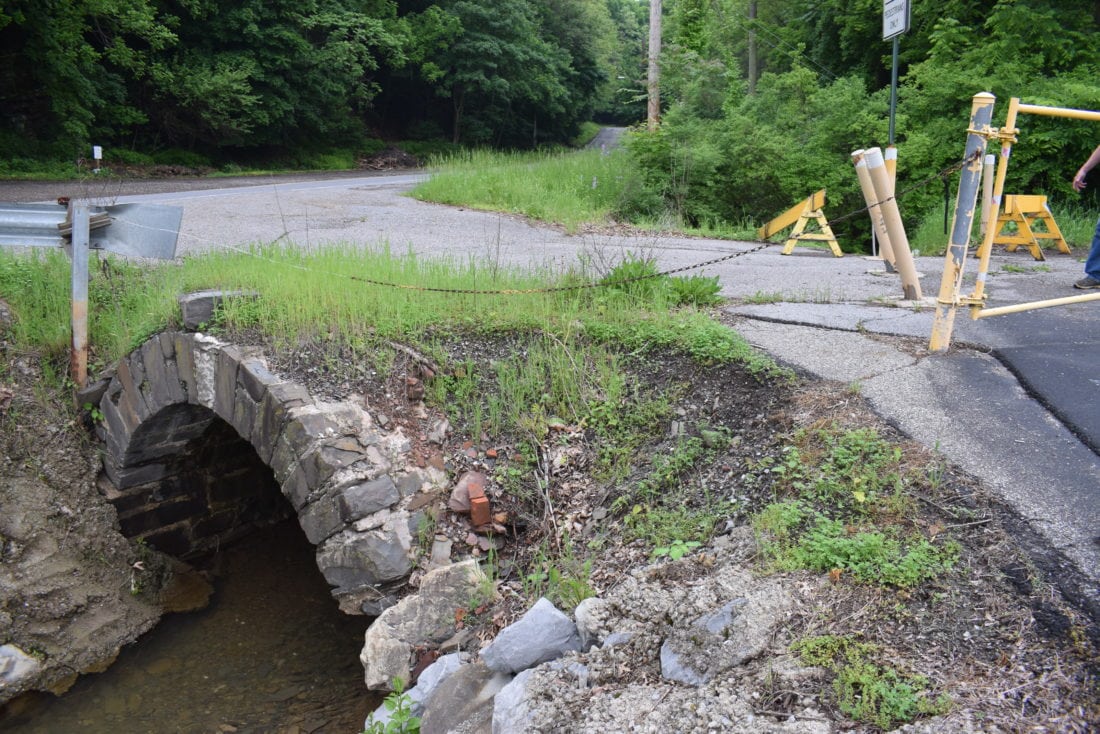
SUN-GAZETTE FILE PHOTO Grafius Run passes under a bridge.
Ever wonder how Grafius Run, the cause of much street flooding in the city’s northcentral neighborhoods, got its name?
Prior to being named Grafius Run, the tributary to the Susquehanna River was considered Wallis Run by locals in the 1800s. But the county had another Wallis Run, which flowed into the Loyalsock Creek, and the tributary was renamed Grafius.
Grafius Run, which flows from Loyalsock Township north of the city through areas along Cherry and Hepburn streets, required diversion because of frequent floods, even in the mid-1800s, according to H. Joseph Grafius, of South Williamsport, who wrote a book on his family’s history.
The Grafius family was among the first settlers here in the early days after the Revolutionary War, according to local historian John F. Meginness in his 1892 book, “History of Lycoming County.”
Jacob Grafius arrived in 1796, just as another early settler, Michael Ross, was laying out plans for Williamsport. Grafius bought a plot at the southwest corner of Market and Third streets, according to Meginness.
His older brother, Abraham Grafius, who arrived in 1802, had been a soldier of the American Revolution and later became a state assemblyman representing York, Joseph Grafius wrote.
The house at the corner doubled as a whiskey distillery, he said.
“It was an easier process for the grain to make into whiskey versus trying to ship it,” Grafius said. “Also, it was easier and more profitable for settlers.”
During construction of the first Lycoming County Courthouse, the distiller donated nine gallons of whiskey to the workers, Grafius said.
In 1799, an old friend, Thomas Updegraff, who had settled in modern-day York, decided to float upriver with his wife.
“They landed at Williamsport, where Updegraff’s wife was said to have proclaimed, ‘Where is the town you told me about?’ ” Grafius said. What she could not have known is this community dotted by log cabins would become the lumber capital of the world in another 60 years.
Nevertheless, Updegraff and his wife accepted the offer to stay at the house, sharing a meal of salted shad, Grafius said.
Updegraff, a tanner by trade, also bought land in the vicinity of today’s Church Street, which then was called Black Horse Alley, Grafius said.
Over the span of his life, Jacob Grafius served on the town council, was elected in 1819 to the position of county auditor and, in 1826, became county commissioner, according to the family history.
During those years, many of the settlers spoke German and carried their native language Bibles. Jacob Grafius and Abraham Grafius joined a building committee intent on constructing a German Lutheran and Reformed Church, the cornerstone of which was laid along West Third Street in May 1827. It would be positioned where the former Midtown Parking Garage was located before it was razed in 2011 to make room for the Trade and Transit Centre II, Grafius said.
Before Jacob Grafius died at the age of 58 on June 6, 1827, his will bequeathed his wife the house, a trust of $538 and $150 in cash, according to a copy of the will at the Thomas T. Taber Museum of the Lycoming County Historical Society.
Jacob’s son, Joseph Grafius, was elected school director in 1834 and later was given title of captain of the Williamsport Band, predecessor of the Repasz Band.
Joseph Grafius married a daughter of Lycoming County Associate Judge Apollos Woodward and took on the role of secretary of the local Anti-Masonic political party.
Other notable Grafius family members included Elizabeth, who married prominent resident Peter Vanderbelt. Their daughter married William Packer, who would become the state governor, Grafius said.
When one of the Grafius girls married William Harris, who was county sheriff, land was purchased between Market and Hepburn streets. The name of the street became Harris Street and a block or two away became Grafius Street, Grafius said.
Throughout the years, Grafius family members are mentioned in the family history and by Meginness. They include William Grafius, a moulder by trade, who fought in the Civil War; Vanderbelt Grafius, whose son, Eugene Grafius, was among the first soldiers from the city to die in World War I; and William G. Grafius, a carpenter who assisted in building the first Little League World Series stadium and was wounded during service in World War II.
Today, Joseph H. Grafius, who served in the Vietnam War, continues his research of the family and remains interested in local history. Many early documented sources indicate the family name is spelled Graffius.
Asked why, Grafius said the name changed over the years and depends on where the family settled and lives.
For example, in parts of Ohio, the family spells it with two Fs.
Top News

Lycoming College professor lists implications of war with Iran
Bill clarifies insurance eligibility for National Guard
Free speech group defends violent flyers at Penn State
(The Center Square) – A second anti-ICE flyer discovered on Penn State’s campus has brought bipartisan ...
How Grafius Run in Williamsport, Loyalsock Township got its name

More than 20 states, including Pa., sue over new global tariffs Trump imposed after his Supreme Court loss
Region’s congressmen back Trump’s Operation Epic Fury
U.S. lawmakers representing Williamsport and the vicinity are clear about their support of Operation Epic ...