
Lycoming College professor lists implications of war with Iran
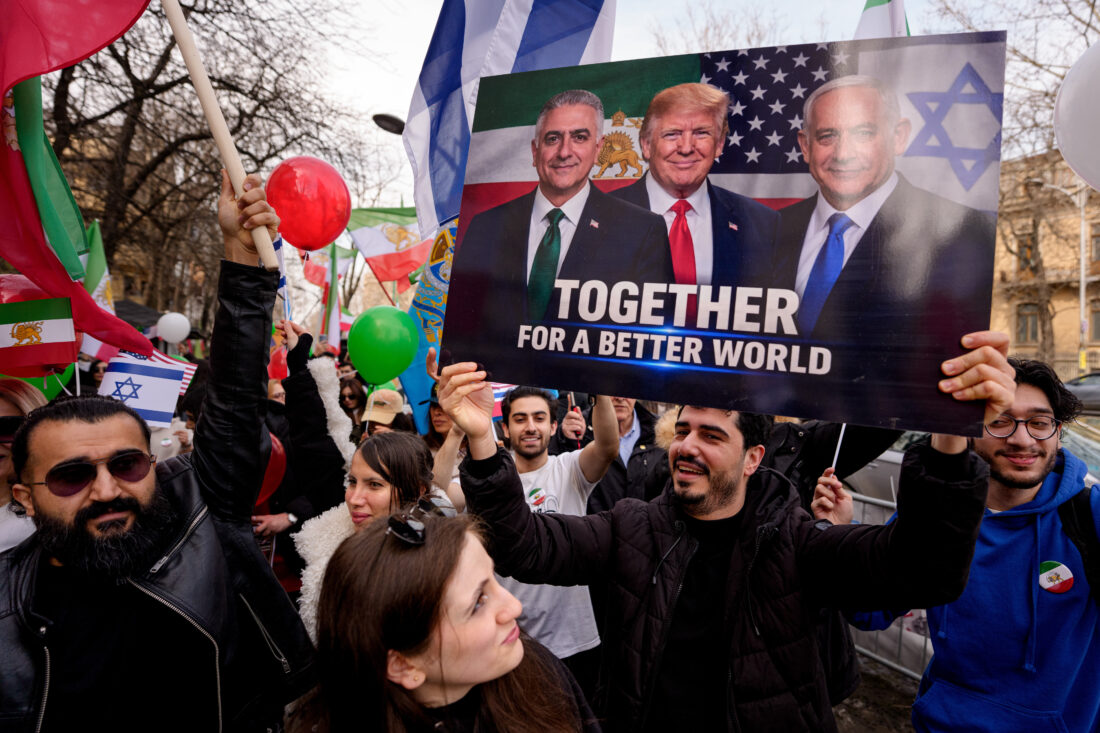
A member of the Iranian community holds a poster during a rally outside the Iranian embassy in Bucharest, Romania, Thursday, March 5, 2026. (AP Photo/Andreea Alexandru)
At approximately 1:15 a.m. EST on Saturday, Feb. 28, 2026, the U.S. Military, in conjunction with the Israeli Defense Forces, launched Operation Epic Fury, targeting Iranian military installations and regime leaders with a barrage of miles, drones and fighter jets.
The attack followed weeks of negotiation between U.S. Envoys and Iranian counterparts, aimed at convincing Iran to abandon its nuclear ambitions. Though there were glimmers of a positive outcome, President Donald Trump signaled that he was not happy with the talks, but said he would allow for more time on Friday, Feb. 27. Only a day later, the attack began.
With so many questions having been raised regarding the intervention, Caroline Payne, Ph.D., associate professor of political science and department chair at Lycoming College, discusses many of these concerns, including the possibility of further regional instabilities, effects that may be felt at home, and if these actions actually constitute a war.
“I would consider it a war because of the sustained engagement between actors. It’s not just strikes initiated by one actor without response, and the death toll is getting pretty high, which is also often an indicator that we look at,” Payne, who studied political science with an emphasis in international relations and comparative politics from Louisiana State University, said.
“This is a complex story, and it can be hard to hold two things true at the same time, but they can be true,” Payne said.
“The Iranian regime and the Ayatollah were absolutely abhorrent in terms of how they govern, but also bombing a country without a clear cause and also killing people is problematic, as well,” she said, adding the recent negotiations were unusual to begin with.
“You had the president’s son-in-law, Jared Kushner and his chief negotiating partner, Steve Witkoff, talking with the Iranians up to the day before we bombed them. That is fairly unconventional. Usually, you have seasoned diplomats who are doing those kinds of negotiations. That was not the case in this instance,” Payne said.
“It’s also clear that it is not just a war between a few countries, but it’s becoming a regional conflict. If you look at all of the Gulf states that are being targeted, this has the potential to set off a series of additional conflicts that will last for a long time, not to mention the potential for a civil war,” she said.
The long-stemming animosity between the U.S. And Iran can be traced back to 1953, when the U.S. and British intelligence assisted in staging a coup d’état, overthrowing the democratically elected Prime Minister Mohammad Mosaddegh and instead strengthening royal ruler Mohammad Pahlavi, known as the Shah of Iran.
The repressive Pahlavi was himself overthrown during the Iranian Islamic Revolution of 1979, which saw the U.S. Embassy stormed, and the holding of 52 citizens held hostage for 444 days by forces loyal to Ruhollah Khomeini. Khomeini would become the Ayatollah, or supreme leader, following the revolution.
The relationship between the U.S. And Iran has generally teetered depending on the American administration in power at any given time, with former President George W. Bush branding them as part of an “Axis of Evil,” following the Sept. 11, 2001 attacks.
“Under the Obama administration, the Joint Comprehensive Plan of Action (JCPOA) was negotiated, and that did put constraints on the development of Iran’s nuclear technology, in exchange for loosening up sanctions that were crippling their economy,” Payne said.
“By all accounts, that was working. When President Trump came into the office, the first time, he pulled out of that agreement, and so there were no more international legal pressures on Iran to hold themselves back from developing nuclear technology,” she explained, stressing that outside objective observers have found no evidence that Iran had gotten close to developing nuclear capabilities.
“I always like to tell my students, there’s fodder, and then there’s a spark for any fire,” Payne said.
“The regional balance of power is really crucial to understanding this relationship, and anybody who’s watching the news understands that Israel plays a key role in this, and the fact that we’re their strongest ally is a crucial part of understanding what’s going on,” she said.
“The tinder has always been there, the fodder is global power dynamics, regional power dynamics, and trying to maintain non-proliferation of nuclear weapons,” Payne explained, noting that the spark is less clearly defined at this point.
“The administration has said two contradictory things. On the one hand, we have Secretary of State, Marco Rubio, who says that we attacked before Iran attacked us, because Israel said they were going to attack Iran no matter what, and we thought that that would generate a response targeting the U.S., so we we kind of got dragged into it by Israel,” she said.
When the President was asked if that was accurate, he said that was not true, that in fact, we likely dragged Israel into the conflict and insisted that they could attack at this given moment,” Payne said.
Though Operation Midnight Hammer reportedly “obliterated” the Iranian nuclear program by carrying out airstrikes against facilities at Fordow, Natanz and Isfahan, another reason offered up as the recent military action has been that the country was on the verge of obtaining a nuclear weapon.
“Another argument that the administration has made on top of all of those reasons for going to war, is ‘we’re protecting the civilians in Iran,” Payne added.
“Objectively, it is absolutely true that the Iranian regime was a brutal regime. The Ayatollah was a horrible, horrible person, so nobody liked what the regime was doing. And about a month ago, there were major protests in Iran after the economy, their currency kept declining in value, and the regime shut those protests down with force, and at a minimum, 7,000 people were killed,” she said.
“At this point, there’s just a lot of reasons that they’re giving, and not a lot of consistency across it. I’m not really sure that there’s a definitive answer right now,” Payne said.
The latest military action continues a pattern of shifting roles of the presidency and congress.
“My area of expertise is in international relations, but it is clear that the balance of power between American political institutions over time has been altered, and the power of the president has grown and the power of Congress has declined,” Payne said.
Prior to the initiation of Operation Iraqi Freedom in 2002, then-President George W. Bush sought and received congressional authorization in support of invading the country. That was the last time such authorization was pursued by an American president prior to the start of a military campaign.
On Jan. 3, the U.S. Military initiated airstrikes in support of an effort to apprehend Venezuelan President Nicolás Maduro on a U.S. Warrant signed in 2020. This action was also taken without consulting Congress.
“One of the interesting things about the current administration is there’s been a deviation from the Bush-era conservative principles, and what we’re seeing in Iran follows in the path of actions taken in Venezuela. It is about regime change and not state building,” she said, adding that while immediate regime change is easier, it’s up in the air as to whether the next leader is acceptable to the U.S.
“Today, we view the invasion of Iraq as a violation of international law because it was not authorized by the Security Council and the entire international community rejected it,” Payne explained.
“It’s an interesting rewriting of history that well, ‘this is okay because Iraq was okay. I don’t accept that premise,” she said.
“Iraq set off years of war and civil war, and hundreds of thousands of people died, not to mention mass waves of migration,” Payne said.
“To me, the most concerning thing is the violation of sovereignty,” she said.
“Sovereignty has been the organizing principle of the international system since the Peace of Westphalia in 1648, and later in the United Nations, and that is the principle that states get to do what they want within their own borders without interference,” Payne explained.
“All of these actions are violations of sovereignty, which means that the organizing principle of the international system is no longer broadly accepted,” she said.
“Most of the interviews I’ve seen with the president suggest that goal number one was to get rid of the Ayatollah, and he’s said himself that it might end up with somebody just as bad,” she said.
“There’s a lot of parallels being drawn with Venezuela, but one of the big differences that people need to understand is that the power that the Iranian regime has consolidated over the country is far greater than what Maduro had in terms of control over Venezuela, so the ability of the Iranian population to rise up and actually take Iran down a different path is very challenging,” Payne said.
“You have established structures and heavily militarized structures in place, like the Iranian Guard, the Basij militia, the Assembly of Experts who are charged with picking a new leader. You have succession plans. And this was all created because of the fear of an intervention from the United States and Israel,” she said.
Several unintended consequences of the war could rear their head as well, including secessionist movements, and civil wars encompassing ethnic groups that cross state boundaries.
“One of the ways we’re treating this is like when the U.S. and/or Israel decides to stop firing, that the war is over, and that’s not true, and we’re only part of the equation,” Payne said.
Though an outcome to the conflict can’t be accurately predicted, Payne does see some signs of hope that a resolution may be on the horizon.
“There are a few signs that people in power are trying to take off ramps,” Payne said, citing a recent New York Times article, stating that Iranian intelligence officials had reached out to U.S. counterparts in the CIA asking for a way to bring about an end to the strikes.
“That was even after the Ayatollah and a lot of their leadership had been killed,” she said.
“You’re also getting pressure from some of the Gulf states, because there are some reports that within a week, they’re going to be out of their missile defense systems, and so then they’re going to be vulnerable, so they’re pushing the U.S. to take the off ramp,” Payne said, stressing the role oil may play into a resolution.
“The Strait of Hormuz has not been seeing very much movement of trade at all, and a fifth of the world’s oil supply goes through there. So there’s a lot of self-interested reasons for the U.S. to say ‘maybe we don’t want to continue escalating this,'” she said.
“The big question is, what degree of control can we, and are we willing to exercise over Israel,” Payne added.
Pressure at home may also play a role in ending the conflict, as Democrats and even some Republicans in Congress debate the passage of a new War Powers Act to restrict the Trump administration’s ability to act militarily against Iran without consulting them.
“You also see right wing influencers and media personalities that have historically been very powerful in the conservative movement, like Tucker Carlson, and even the very controversial Nick Fuentes, saying ‘this is not okay,'” she said.
“Maybe that means that in the near future, we’ll get some conversations across the aisle about how we need to start reining that in. It’s kind of hard to see, given the degree of polarization in the U.S. and the fact that we’re in a midterm year,” she said.
Currently, the biggest effect of the war likely to hit Americans at home, including the central Pennsylvania region, are rising gas and oil prices, according to Payne.
“The President has said the U.S. military would escort container ships through the Strait of Hormuz, and we would also guarantee that they have insurance coverage, but even when the strait isn’t officially closed down by Iran, companies aren’t willing to insure them, and so nobody’s going to travel through there, because if their cargo gets hit, they’re not going to get paid back,” she said.
“The longer this drags on, the bigger the effects are going to be, especially to the price of oil, and then that affects everything else,” Payne said.
Top News
Lycoming College professor lists implications of war with Iran
Bill clarifies insurance eligibility for National Guard
Free speech group defends violent flyers at Penn State
(The Center Square) – A second anti-ICE flyer discovered on Penn State’s campus has brought bipartisan ...

How Grafius Run in Williamsport, Loyalsock Township got its name

More than 20 states, including Pa., sue over new global tariffs Trump imposed after his Supreme Court loss
Region’s congressmen back Trump’s Operation Epic Fury
U.S. lawmakers representing Williamsport and the vicinity are clear about their support of Operation Epic ...