
Trending
In the 60 years since STEP began serving the needs of the community, it has grown from two programs to a literal smorgasbord that encompass every stage of life from infants just starting their journey to the elderly who are winding down at the end of their travels and everything in between.
In 1964, the federal Economic Opportunity Act created community action programs with the intent of mobilizing public and private resources in communities in order to eliminate the cause of poverty. STEP was one of 1,100 such programs established at that time.
"STEP's full name is actually the Lycoming-Clinton County's Commission for Community Action, so we are a community action agency," said Rachelle Abbott, the current president and CEO of the local STEP.
Abbott explained that in 1966, a group of local individuals, including elected officials like the county commissioners came together to develop a bi-county agency.
"They worked with the county to really look at what are the things that the counties do that we could help support…that's why we are the Office of Aging and the transportation provider," she said.
While in other countries across the state some of STEP's programs are based in county and municipal government, Abbott credits the "founding fathers" of STEP with being forward thinking in setting it up as a non-profit organization.
"To ensure that we were maximizing the support to our local communities, our local municipalities, the local people, to ensure that Lycoming and Clinton (counties) were a great place to live, work and play in the future," she said.
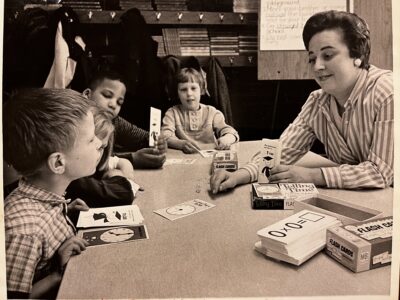
One of the first programs that STEP supported was Head Start, which is still in existence today.
"Our Head Start program focuses on lower income children and families to ensure school readiness," Abbott said.
She pointed out that the number of children they have served over the years has grown and changed, particularly with the addition of an Early Head Start component.
"We now provide those Head Start services from zero to five and between Head Start, Early Head Start and some of our other pre-K programs, we're right around 600 children per year today," Abbott said.
The Neighborhood Youth Program was another endeavor during the early years. It was a workforce development for youth where they worked for STEP for the summers.
"While we don't do that specific program anymore, the evolution of it is that we still have a very important youth program called the Youth Enrichment for Success program that is through our Service Navigation Program," she said.
"That program is a three level of need area where we actually help youth who are maybe unsure of what their future is going to be. They may be referrals from JPO (Juvenile Probation Office) or from a school district and we help them get on the right path to move forward, whatever that path is for the, whether that's secondary education, whether that's on the job training, whether that's workforce. All of those pieces and when we help them be successful in life and be successful as community members," she explained.
Although it was initially mandated by the government, STEP is a private non-profit organization, one of 43 community action agencies in the state and because of the territory that they cover and the breadth of services they offer, they are the second largest statewide.
Because they were established to meet community needs, every three years, STEP is required to do a needs assessment.
"That is what helps us to ensure that the programs that we have inside that we're working on and the partnerships we have are really focused on those needs," Abbott said.
Throughout the community, STEP has over 320 designated partners that they work with for specific reasons.
"While we are not a government entity, we very much work, collaborate and focus on implementing the government programs that they have," she explained.
"Many of the programs were developed in connection and coordination with local governments, such as the Homes in Need program, the Supportive Housing program. Much of the funding that we receive actually comes through the county government as a pass through before it gets to us, such as the medical assistance transportation program," she said.
Because of the large number of designated community partners, STEP is able to offer wrap-around services for families or what Abbott called the whole family approach.
For example, if a Head Start family or their child needs extra support, STEP can connect them with the BLaST IU's which operate in Clinton and Lycoming County. STEP actually has classrooms within the Head Start facility that are BLaST classrooms.
"In terms of those partnerships, we're also kind of focusing on what is going to make individuals successful for the long run," Abbott said.
"That may be looking at, how do we help with resume-building, job shadowing? What does it look like? What are those goals that we can assist with to make individuals be able to move forward in their self-sufficiency journey. So economic mobility is truly one of those key components that we are focusing on with many of the individuals that come through our doors and so we do those emergency kind of services," Abbott said.
That could mean helping someone who is homeless to find a place to live that is affordable. That could be through the supportive housing program. Something that's just temporary so that they can get back on their feet. Or maybe someone needs to be referred to the Rescue Workers for support or to any of the other partner agencies.
Or, there are instances where the partner agencies are referring those who need help, back to STEP.
"We have partner agencies across the community that refer individuals that they're helping with us. Whether that's Children and Youth services, or MH (Mental Health), ID (Intellectual Disabilities) or any of our local partners...all of those pieces," Abbott said.
"It's really a lot of that collaboration, of focusing on what we do best in terms of that case management, kind of whole home approach, but then also making sure that we're working with all of the partners and what they do best as well," she added.
Another component of STEP's work is focusing on vulnerable populations, such as older individuals or others who might have mobility issues with transport or for younger children, there's Head Start. Programs to help ensure independent living is happening.
"We're able to help seniors stay in their homes as long as possible. We're helping them to get around the community whether it's on a Friday to get their hair done, or going to the grocery store-any of those kings of pieces," Abbott said.
She described the Office of Aging as more dynamic because of the increase of older adults in the community and "just the nature of older adults wanting to stay involved."
"I think that has helped to push our programming right to the next level," Abbott said.
This has made the programming more participant-driven, so that when someone expresses an interest in an activity then resources are sought to provide that activity. At some of their eight centers for healthy aging there are pickleball leagues. Another has woodworking and gardening programs.
"I think we've made them more inviting, more welcoming. A couple of the centers are relatively newer in terms of construction and I think that when it's a place that people want to go to every day, they're more likely to go to it," she said.
At the other end of the spectrum in terms of age, STEP has always been involved with childcare, from the early days of providing child care centers in addition to their Head Start program.
As the state moved in terms of what they considered childcare, STEP became more of a childcare information service to support families in connecting with childcare and obtaining subsidies, if needed.
Then in 2019, the state moved the office of child development and early learning to Early Learning Resource Centers (ELRC) and STEP now serves as the ELRC for Lycoming, Clinton, and Tioga counties, continuing to provide not only support and resource referrals for families but also ensuring that childcare providers have the resources to be "high quality centers within the community," Abbott said.
Over the years, with the expansion to include so many programs, if there is a need, there is no "wrong door" to find help.
"If you come in for utilities, we connect you with transportation and child care," said Jamey Williams, administrative coordinator at STEP.
"We've moved to that one step concept," added Abbott.
"You come into our facility at any of our programs, we're going to assess and see what you may need to ensure that economic mobility for you and your family moving forward," Abbott said, adding, "it's kind of that we're working ourselves out of a job."
With over a staff of 300, STEP is also an economic driver in the community.
"You don't have to look too far to find someone in our community that works or worked or retired from our agency," Abbott said.
I also think that's what makes the 60th anniversary so special-STEP has touched so many lives within our community," she said.