
The life of Sally Foresman Hoyt Spofford
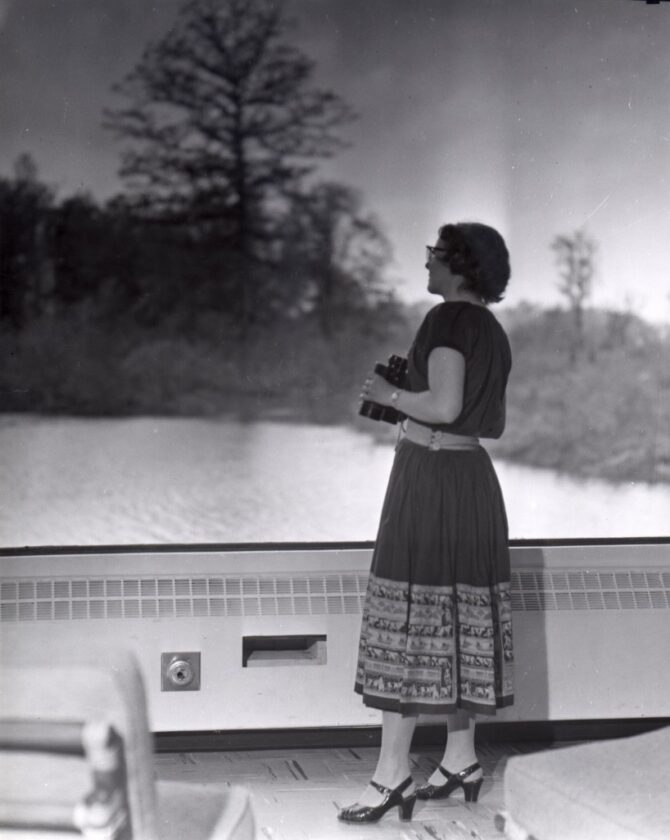
PHOTO PROVIDED
Special to the Sun-Gazette — This is the second collaboration by the authors focused on uncovering the stories of remarkable women from Lycoming County.
Many area residents recognize the name Robert Porter Allen, honored in the Robert Porter Allen Natural Area along the Susquehanna River on Sylvan Dell Road. Allen, born in South Williamsport, was a renowned ornithologist and president of the National Audubon Society. But Lycoming County also produced another remarkable bird scientist — one whose work helped shape how Americans study and listen to birds. Her name was Sarah “Sally” Foresman Hoyt Spofford.
Born and raised in Williamsport, the daughter of John H. and Julia E. Foresman, Sally was part of a family with deep roots in the area. Robert Foresman, whose ancestors immigrated from Ireland, had settled in nearby White Deer Valley in 1794. Sally’s grandfather, Seth T. Foresman, a lumber dealer and manufacturer, was mayor of Williamsport in the early 1900s. Seth’s wife, Sally Updegraff, was from another prominent local family. The Updegraff family’s log granary from the 1830s still stands on South Reach Road. The Foresman family tree includes Herdics, Ottos, McCormicks, Reighhards. Gambles, Emerys, and many other familiar local names.
Sally grew up in the family home of West Third Street, now an apartment building. Her early years reflected the curiosity and civic engagement that would define her life. Records preserved locally show that she attended Clay Elementary School, then Stevens Junior High School and Williamsport High School. A member of student government and involved in many activities, she also belonged to the school’s Audubon Club — an early sign of the lifelong interest in birds that would later define her scientific career.
Her academic promise was already evident in 1931, when Sarah Foresman was one of three commencement speakers at the Williamsport High School graduation. In 1935, the Harrisburg Evening News pictured her as one of the honor students graduating from Wilson College in Chambersburg, noting her Williamsport roots.
After earning her bachelor’s degree, she continued her studies at the University of Pennsylvania, completing a master’s degree in biology. By early 1937, local news in the Daily Gazette and Bulletin reported that Miss Foresman was leaving Williamsport to assist in the biology and psychology departments at Wilson College, and later that year noted she would spend Easter at home before returning to her academic work. These early newspaper mentions show that her community followed her accomplishments with pride.
In 1939 she was accepted for graduate studies at the Cornell University Lab of Ornithology. In 1941, while still a graduate student, she gained national notice when an
Associated Press story announced that Miss Sarah Elizabeth Foresman of Williamsport had been awarded the first Simon H. Gage Fellowship for graduate research in histology and embryology — a significant scientific honor.
Sally met her first husband at Cornell, John Southgate Yeaton Hoyt, a fellow ornithology student. They married in 1942 and both received their doctorates in 1948. Tragically, Hoyt became ill with cancer. In 1951, the Ithaca Journal carried the obituary of Hoyt, who died at age 38 in New York City, describing him as a respected authority on the pileated woodpecker and a leader in Cornell’s ornithological activities. Sally, who had been taking care of Hoyt, returned to Cornell.
By the early 1950s, she had become well known on her own terms. In 1954, Williamsport newspapers announced that Dr. Sarah Foresman Hoyt would lecture at Lycoming College and present her program, “A Year With Birds at Aviana,” sharing her Florida field observations and photographs with local audiences.
In 1956, the Sun-Gazette covered the 25th reunion of the Williamsport High School Class of 1931, listing Sarah Foresman Hoyt, Etna, N.Y., among the out-of-state alumni who attended. Her continued connection to her hometown was evident to classmates and neighbors alike.
Even after leaving Williamsport, she remained strongly identified with her “Billtown” home. In 1960, the Sun-Gazette printed a lighthearted note from “a former Williamsporter, Sally Hoyt,” who had mailed in a clipping mentioning Williamsport as a tourist location. In 1957, she even wrote directly to the Sun-Gazette to correct a story about robins; the editor identified her as “the former Miss Sallie Foresman, of Williamsport,” and noted that she and her late husband were members of the Cornell faculty.
Sally’s career at Cornell was remarkable not only for its scientific rigor but for its impact, at a time when the Laboratory was pioneering birdsong recording and modern field ornithology. After her husband’s death in 1951, “Doc” Arthur A. Allen offered her a position at the Lab. She became the administrative heart of the Lab, working under early directors including Allen, Peter Paul Kellogg, and Olin Sewall Pettingill.
Randolph Little, whose deep association with the Cornell Lab of Ornithology spans seven decades, wrote that she managed correspondence, helped organize seminars and meetings, and became “a one-woman information service” who knew “where everyone was, what he was doing and when he would be back.” In 1996, the leading ornithological journal The Auk described her as the “de facto manager of the Cornell Laboratory of Ornithology,” a testament to her reputation and influence on the field.
Sally’s work extended beyond administration. According to later professional tributes, she published dozens of short papers based on her own field observations and Sally collaborated in studies of bird behavior. She co-authored the bird guides Enjoying Birds inUpstate New York and Enjoying Birds around New York City and was an active member of the American Ornithological Union. For years she also shared her knowledge over the radio program “Know Your Birds” on WHCU and led bird walks for the public.
On Nov. 2, 1964, she married Dr. Walter R. Spofford in Williamsport. A contemporaneous newspaper notice described her, modestly, as administrative assistant to the director of the Cornell Laboratory of Ornithology. Sally’s colleagues knew she was far more than that. Dr. Spofford was a neurosurgeon and a leading authority on golden eagles. Sally retired from Cornell in 1969, and in 1972 the Spoffords relocated to Portal, Arizona, where their home — Rancho Aguila — became a celebrated birding sanctuary, attracting visitors from around the world. Walter died in 1995, and Sally continued her conservation work and support of birding organizations until her own passing in 2002.
Her ties to ornithology also preserved a link to the other noted Williamsport birder. In 1975, the Ithaca Journal reported that Sally Spofford believed a Williamsport house might once have been the home of Robert Porter Allen, showing that she knew about Allen and remembered him as part of the town’s past. It is likely that Sally helped Cornell’s Doc Allen with his documented correspondence with Robert Porter Allen – who, it turns out, briefly attended Cornell University in the 1920s.
Sally’s lifelong commitment to birds, science and education touched both local, regional, and national communities. Whether through lectures in Williamsport, scientific leadership at Cornell, or conservation efforts in Arizona, Sally Foresman Hoyt Spofford helped shape the way generations of birders observe and appreciate the natural world.
Adam E. Sieminski, WHS ’65, is a Cornell graduate and enthusiastic bird photographer.
Mary L. Sieminski, WHS ’61, is a founder of the Lycoming County Women’s History Project.
Lifestyle News
Saturday bringing ice sculptures to Wellsboro
The life of Sally Foresman Hoyt Spofford
How to create calm with indoor plants
Have you dreamed of creating a calm and cozy spot at home to relax and recharge, but don’t think you can spare ...
James V Brown Library encourages public to ‘donate, enjoy, volunteer, own, let’
The James V. Brown Library is excited to celebrate Library Lovers’ Month with its community again this February! ...
Weekends in Wellsboro celebrate winter
Camp to host April gala
Camp Koala will host its annual Camp Koala Gala on April 11 from 7 to 11 p.m. at The Rusty Rail Brewing Company, 5 ...