
US puts negotiations with Iran on hold as ceasefire deadline nears
Trending
ISLAMABAD (AP) -- Last-minute ceasefire talks between the United States and Iran looked uncertain Tuesday as a two-week truce was set to expire and both countries warned that, without a deal, they were prepared to resume fighting.
U.S. Vice President JD Vance, expected to lead U.S. negotiators if talks continue, called off a trip to Pakistan, a U.S. official said. And Iran said it hadn’t decided whether to participate.
Pakistani leaders, including Prime Minister Shehbaz Sharif, worked intensively late Tuesday to get both sides to agree to a second round of ceasefire talks, according to two officials who spoke on condition of anonymity because they were not authorized to speak to the media.
The ceasefire was set to expire Wednesday.
Iranian Foreign Ministry spokesman Esmail Baghaei told Iran’s state TV there has been “no final decision” on whether to attend because of “unacceptable actions” by the U.S., apparently referencing its recent blockade in the Strait of Hormuz.
As Vance put on hold traveling for more ceasefire talks, President Donald Trump’s special envoy Steve Witkoff and son-in-law Jared Kushner were expected in Washington on Tuesday afternoon for consultations about how to proceed, said an official, who spoke on condition of anonymity to discuss internal administration deliberations,
The official cautioned that Trump could change his mind on negotiating with Iran at any minute, and declined to predict what would happen if the current ceasefire expires without another meeting in Islamabad but noted that Trump retains options short of restarting airstrikes.
Trump says he doesn’t favor extending ceasefire
Both sides remain dug in rhetorically. Trump has warned that “lots of bombs” will “start going off” if there’s no agreement before the ceasefire deadline, and Iran’s chief negotiator said that Tehran has “new cards on the battlefield” that haven’t yet been revealed.
The ceasefire, which began April 8, could be extended if talks resume, though Trump said in an interview Tuesday with CNBC: “Well, I don’t want to do that.”
“We don’t have that much time,” Trump said, adding that Iran “had a choice” and “they have to negotiate.”
White House officials have said that Vance would lead the American delegation, but Iran hasn’t said who it might send. Iranian state television on Tuesday broadcast a message saying that “no delegation from Iran has visited Islamabad ... so far.”
US says its forces board sanctioned oil tanker
On Tuesday, the U.S. said its forces boarded an oil tanker previously sanctioned for smuggling Iranian crude oil in Asia. The Pentagon said in a social media post that U.S. forces boarded the M/T Tifani “without incident.”
The U.S. military did not say where the vessel had been boarded, though ship-tracking data showed the Tifani in the Indian Ocean between Sri Lanka and Indonesia on Tuesday. The Pentagon statement added that “international waters are not a refuge for sanctioned vessels.”
The U.S. military on Sunday seized an Iranian container ship, the first interception under a blockade of Iranian ports. Iran’s joint military command called the armed boarding an act of piracy and a violation of the ceasefire.
Strait of Hormuz control key to negotiations
The U.S. imposed the blockade to pressure Tehran into ending its stranglehold on the Strait of Hormuz, a key shipping lane through which 20% of the world’s natural gas and crude oil transits in peacetime.
Iran’s grip on the strait has sent oil prices soaring. Brent crude, the international standard, was trading at close to $95 per barrel on Tuesday, up more than 30% from Feb. 28, the day that Israel and the U.S. attacked Iran to start the war.
Before the war began, the Strait of Hormuz had been fully open to international shipping. Trump has demanded that vessels again be allowed to transit unimpeded.
European Union transportation ministers were meeting Tuesday in Brussels to discuss how to protect consumers after the head of the International Energy Agency warned that Europe has ” maybe six weeks ” of jet fuel supplies remaining.
Over the weekend, Iran said that it had received new proposals from Washington, but also suggested that a wide gap remains between the sides. Issues that derailed the last round of negotiations included Iran’s nuclear enrichment program, its regional proxies and the strait.
Iranian parliament speaker Mohammad Bagher Qalibaf on Tuesday accused the United States of wanting Iran to surrender.
“We do not accept negotiations under the shadow of threats,” he wrote in an X post.
Pakistan hopeful talks will proceed
Pakistani officials have expressed confidence that Iran will also send a delegation to resume talks that mark the highest-level negotiations between the U.S. and Iran since the 1979 Islamic Revolution. The first round April 11 and 12 ended without an agreement.
Pakistan said Foreign Minister Ishaq Dar met Tuesday with the acting U.S. ambassador in Islamabad to urge a ceasefire extension. Dar also met with the ambassador from China, a key trading partner with Iran.
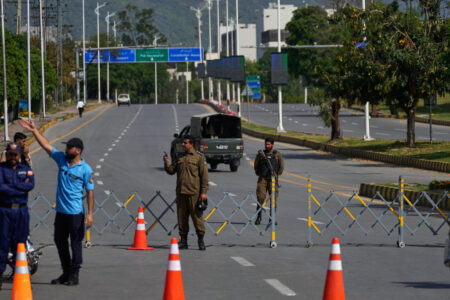
Security has been tightened across Pakistan’s capital, where authorities have deployed thousands of personnel and increased patrols along routes leading to the airport.
Israel jails soldiers for defacing Jesus statue in Lebanon
Israel’s military said Tuesday it has sentenced two soldiers to 30 days in jail and removed them from combat duty for smashing a statue of Jesus Christ in Lebanon. Images of an Israeli soldier with a sledgehammer smashing the statue’s head emerged over the weekend, bringing widespread condemnation.
Israel said one of the soldiers being punished hammered the statue to the ground. The other filmed the destruction. The Israeli military said it replaced the statue.
Meanwhile, historic diplomatic talks between Israel and Lebanon were set to resume on Thursday in Washington, an Israeli, a Lebanese and a U.S. official said. All three spoke on condition of anonymity to discuss the behind-the-scenes negotiations.
The Israeli and Lebanese ambassadors met last week for the first direct diplomatic talks in decades. Israel says the talks are aimed at disarming Hezbollah and reaching a peace agreement with Lebanon.
A 10-day ceasefire began on Friday in Lebanon, where fighting between Israel and Iranian-backed Hezbollah militants broke out two days after the U.S. and Israel launched joint strikes on Iran to start the war. Fighting in Lebanon has killed more than 2,290 people.
Since the war started, at least 3,375 people have been killed in Iran, according to authorities. Additionally, 23 people have died in Israel and more than a dozen in Gulf Arab states. Fifteen Israeli soldiers in Lebanon and 13 U.S. service members throughout the region have been killed.