
Reflections in Nature: Spiders often maligned
Trending
Have you ever walked into a spider's web? Did you go ballistic as you tried to wipe it off your face? One day last week I was cleaning our basement when I walked into a cobweb and it stuck to me like glue. It probably appeared as if I had gone loco.
Through the years, my wife. Mary Alice, who is only 4 foot-10 inches, gave the kids a nickel for each cobweb they spied hanging from the ceiling or in the corners.
Perhaps, if you have never seen a spider on a cobweb, you might believe that cobwebs form randomly due to dust particles adhering to each other; however, cobwebs actually are formed from abandoned spider webs. After the spider abandons the web, dust forms on the sticky web, and, presto, a cobweb.
Are spiders responsible for those single strands of dust seen hanging from a cellar's ceiling? Spiders use these single strands of silk for jumping or swinging from place to place. This is called ballooning. Usually, these single strands aren't noticed until dust has gathered on them.
Have you ever gone out into the garden early on a summer morning, with dew on the ground, and noticed the many spider webs that had gone unnoticed before being covered by a blanket of dew.
Our word spider goes back to the Old English word spinthron, meaning spin.
The word spin is a general Germanic word that goes back to the Indo-European base word spen or pen, which means stretch.
Spiders have long been celebrated for spinning silk from their bodies. They belong to the class of animals known as arachnid, which comes from the Greek word arachne, meaning spider. It commemorates the name of Arachne, a Lydian princess, who became so accomplished in the art of weaving that she dared to challenge Athena to a test of skill.
Arachne's work was flawless, but that of Athena was perfect beyond attainment of mere mortals. Arachne was so humiliated that she attempted to hang herself; however, the noose was loosened to become a cobweb, and the maiden was changed into a spider and condemned to perpetual spinning.
Spider silk is one-one hundredth the size of a human hair and 100 times stronger than steel of the same size. Some of the threads will stretch one-half their length before breaking. While the thinnest lines are only one-millionth of an inch wide and invisible to the human eye, other lines are much heavier.
Steel can be stretched only 8 percent and nylon about 20 percent.
Orb weaving spiders make their webs at night and usually take them down in the morning. They eat the silk, leaving only the base line to rebuild on.
Each species builds its webs differently. For instance, the funnel spiders build their webs to look like a funnel.
Glands in the abdomen of the spider produce fluids that harden in the air and form silk. The outlets from these glands are at the end of the abdomen and are known as spinnerets. The spinning organs are fingerlike appendages that are tipped with many tiny spinning tubes and a few large ones known as spigots.
There are at least seven known distinct kinds of spider glands, which allow spiders to have the capability of producing various types of silk. Compare the way spiders produce silk to the way silk is produced by insects. For example, silk comes from the mouth of a caterpillar.
Of all our small animal neighbors, spiders have been the most maligned. Many people fear spiders. Could the reason be that parents recited this poem to their children:
Little Miss Muffet
Sat on a tuffet,
Eating some curds and whey.
Along came
a spider,
And sat down beside her
And frightened
Miss Muffet away.
During the autumn months, many spiders die after producing egg sacs; however, there are adults that live throughout the winter months, mate in the spring and then die. Some spiders survive for two or more years.
Although the young spiders are hatched when the weather becomes warmer, there are a few that are hatched during the fall or winter months; however, these spiderlings remain quietly inside the egg sacs until spring and seldom are noticed.
After emerging from the egg sacs, most species of spiderlings spin a dragline and balloon away.
While still very tiny, spiderlings climb to either a branch, fencepost or other tall object, where they tilt their spinnerets up into the air. After a breeze pulls silk threads out of the spinnerets, the threads form a dragline. The spider is still very tiny and light.
When the thread becomes long enough the wind suddenly plucks the thread upward, along with the spiderling at the other end, and carries them away. This works because the spiderling is so light and its dragline is long enough to give both enough surface area for their weight.
Although the average female spider's egg sac holds about 100 eggs, there are some large spiders that can produce a sac that holds as many as 2,000 eggs.
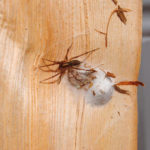
Some spider females (wolf spider) protect their egg sacs until the spiderlings emerge, while other spider females attach the sacs to webs, plants or structures. There even are females that carry the egg sacs on their abdomens wherever they go; some drag their sacs behind them and still other females are attached to their spinnerets.
Bower retired after 34 years as a wildlife conservation officer for the state Game Commission. Questions and comments may be sent to him at 1224 Redington Ave., Troy PA 16947.
BILL BOWER/Sun-Gazette Correspondent
Writer Bill Bower
found this wolf spider with an egg sac
on his woodpile
this winter.