
Trending
Happiness. Fulfillment. Opportunity.
Abstract, perhaps relative terms that might well define what many people reflected upon during the pandemic.
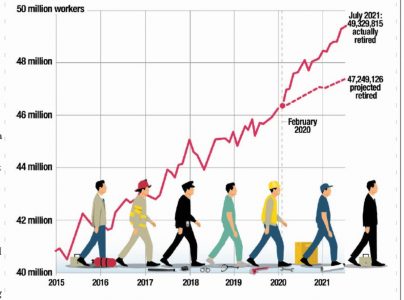
For many people, COVID-19 may have prompted a big life decision, that of retiring, or simply giving up a job or career.
In fact, more than 4.5 million people voluntarily left their jobs in November, according to the U.S. Labor Department. Roughly 2 million more people than expected have retired during the pandemic, according to The New School's Schwartz Center for Economic Policy Analysis and National Public Radio.
That figure is the highest in the two decades the government has been keeping track
So what's happening?
Bucknell University Professor Melissa Intindola, of the Freeman College of Management, feels perhaps trends and new ways of thinking have evolved with regard to work and life choices.
"We've always had this idea that we were supposed to work and have these other compartments of our lives," she said. "People are demanding something else."
In other words, there may well be an inclination, a need for growing numbers of people to want happiness in their jobs rather than just a paycheck.
And being engaged in what one does at work is a big part of that happiness.
"I think research has shown that if we are not engaged in the workplace that we feel alone in the workplace," Intindola, who conducts work-life balance research, said. "I think the pandemic has increased this existential crisis."
COVID didn't necessarily cause what has been termed the Great Resignation, but it was a fulcrum point, according to Intindola.
"They (workers) watched how their organizations responded to those things when COVID hit and they made decisions accordingly -- for the betterment of lives," she said.
The pandemic pushed people over the edge who had been contemplating a job change or weren't happy with the way organizations were handling this new scenario.
Beyond that, the pandemic brought many face to face with illness and even death.
"We saw a perfect storm where people tried to figure out what is valued in life, what are actual needs and how to become happy. We had mortality hanging over us," she said.
Younger people, she said, perhaps became more cognizant than older generations of this need to be happy in the workplace.
"I think that is why we are seeing people seek a living wage and better treatment," she said.
Traditionally, workplaces have been places where social lives and family are to be kept separate from jobs.
"This idea of hyperconnectivity. It affects all of us. We can be simultaneously connected to work, family, and social lives," she said. "Organizations have tried to keep us from doing that. I think employers have to realize that people can’t be separated from other parts of their lives."
But overall, many people may be demanding something else in life.
For older people, including those nearing retirement, the pandemic was a wakeup call of the amount of time spent in jobs that they didn't like or feel passionate about.
And so, they opted for retirement.
"People began to realize that they could perhaps live frugally and not work," Intindola said.
She conceded that retiring early is perhaps easier for higher income earners and those with sufficient savings.
"We are talking about something that not everyone has the privilege of doing," she said.
Intindola feels it's no coincidence that the pandemic has brought an increasing demand in many job sectors for higher pay, with many employers feeling the pressure to surrender to those demands.
Are people now looking at work, career choices differently?
"Very few things happen that affect all of us," Intindola said. "COVID had a global effect. I think it will perhaps re-define how we see work."
Barry Rake and Kent Bennett, of Kent A. Bennett Associates, Inc., Montoursville, have been working in retirement planning for many years and have their own perspectives on the issue.
Rake said he's seen a slight uptick in the numbers of people taking early retirements, and feels perhaps some decided to leave jobs in the rearview mirror because of COVID.
"I think that has changed peoples' frame of mind," he said.
COVID may be a trigger for many people on the fence about retirement, but other factors are likely at play as well. Retirement packages have become more generous to allow people to leave work at an earlier age.
"I can remember when the IRA's started in the 1970s," Bennett said. "Now, you have all kinds of things."
Rake, 80, is well past the average retirement age, but says he has no intention of calling it quits.
"I've got a saying: I'm not retired. I am re-fired," he said.
Still, he understands that many people don't feel that same way about their own jobs and are eager to give up working for good.
"People are often looking for more free time or even an adventure or a change," he said.
Bennett said. "I talk to people who have been counting the days to retirement for years. They don't care for their jobs. Other people love their jobs."
Still others, he noted, are forced to quit work due to health problems.
Rake and Bennett feel it's best to plan for retirement. Too often, people wait too long to make out a plan.
"I think 401(K)'s have helped many people plan better," Rake said.
"A lot of people don't understand their 401(K)'s and what they can do," Bennett added.