
Deer are eating up corn farmers’ profits
Trending
There's a bitter taste in the mouth of local farmers growing sweet corn these days.
While they say supplies are being sold throughout Greater Williamsport, and crops are sweet, hungry white-tail deer are also reaping the benefits of the farmers' hard work.
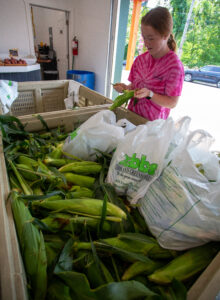
As the ears of corn fill up the bins and are sold at markets and along roadsides, farmers are saying deer are chewing into their profits.
Recently, more than 70 deer were spotted standing in a single, five-acre parcel owned by Tebbs Farms & Greenhouses in Loyalsock Township, according to a post on the business's Facebook page.
Even with the large numbers of deer in a few of Tebbs sweet corn fields, Manager Rachel Tebbs wants to reassure customers that their supplies are plentiful.
"There is a lot available. It is excellent this year. We're into one of the sweetest varieties that we grow, so it's perfect for freezing or canning. We have big amounts available now," Tebbs said.
It can be frustrating to see the deer eat away at your profits, Tebbs said.
"People are like oh they are so cute, and they are, but it'd be like someone coming into your house or a deer in your house and eating your paycheck," Tebbs said.
Dennis Gilbert of Clover Meadows Farm said his hobby farm produces hay products this summer.
"Deer in the Montoursville and Loyalsock Township areas are out of control," he said.
What's worse is, with urban sprawl, people new to more rural areas are so proud and excited when they lure deer into their yards with feed, Gilbert said.
"This is contributing to the loss of our small farms," he said.
Matthew Henderson, who operates Foxdale Farms at 4259 Kehrer Hill Road, Montoursville, said deer and racoons have consumed about a quarter of an acre of the property.
He also noticed the deer behavior changing somewhat.
One factor for that might be that more people live where the deer roam in townships and rural settings, he theorized.
"They seem far tamer this year," Henderson said, adding he tried to scare them off by playing a radio.
He thought another possible solution for farmers experiencing crop damage is growing a specially assigned area for deer to chew on.
Deer are browsers, eating grass, acorns and twigs -- but when they see a cornfield, they help themselves.
"Since the first kernel was dropped on the ground, deer have been eating the crops," said Mark Ternent, a wildlife biologist with the state Game Commission's north central region in Antes Fort.
Ternent said this part of Pennsylvania consists of farms interspersed with forests and human habitation. With the high availability of food, between farm crops and people providing salt licks or other treats, deer appear to be more tame and more difficult to scare away.
Moreover, he said, corn provides a healthy diet for the deer -- the more healthy the doe, the more likely she is to produce twins.
"Keeping deer out of crops, particularly corn, is a problem that is always going to be there," Ternent said.
Hunting is the primary means of controlling deer population, he said.
If a farm adjoins the property of someone who does not permit antlerless deer hunting or any deer hunting, the corresponding increase in the number of deer will follow suit.
The state has a Deer Management Assistance Program, which provides additional tags in antlerless hunting season, Ternent said.
Secondly, the state has a program known as the Agriculture Deer Program that gives additional tags outside of the hunting season.
Farmers also can shoot deer to reduce crop damage but the program requires the deer to be field dressed and the commission to be contacted within 24 hours to salvage the deer, he said.
Farmers whose properties are a main source of income may shoot deer damaging their crop, Ternent said.
If farming is a primary means of gaining a livelihood, the farmer and his/her immediate family, as owner, lessee or tenant, as well as any regular hired help, may hunt without a license during regular hunting seasons on the farmed property including detached lands within ten air miles from the home farm.
Karen Vibert-Kennedy, Sun-Gazette news editor, contributed to this story.