Center For Community Resources holds open house to celebrate Williamsport location, new services
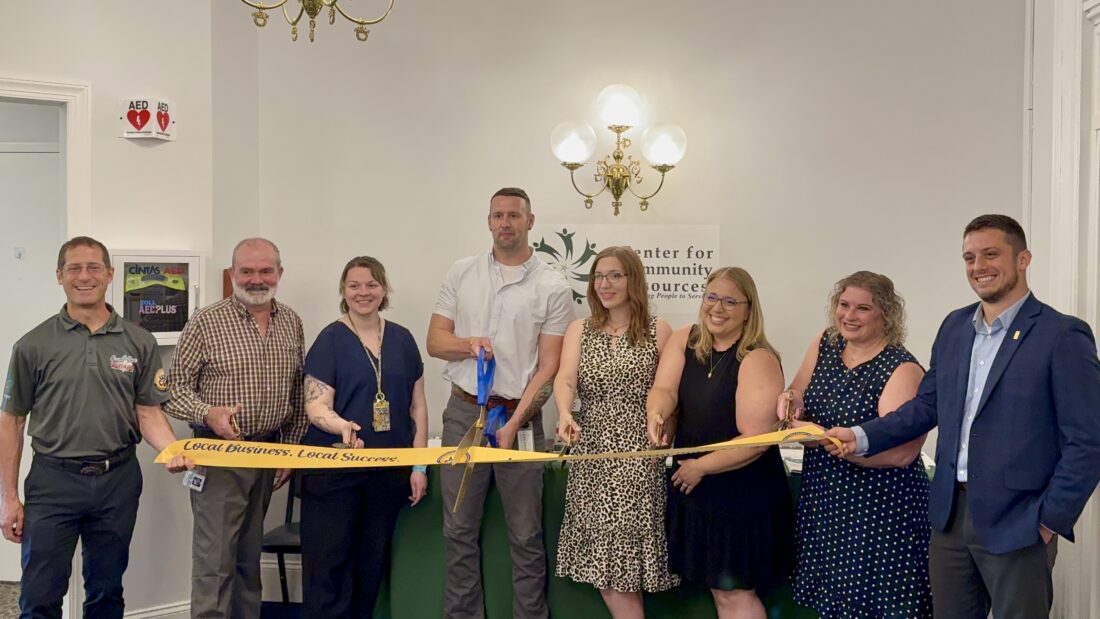
The Center For Community Resources held a ribbon cutting and open house recently to celebrate its Lycoming County location, 800 W. Fourth St., Suite 104, giving the public better insight into services the center offers to the community.
Headquartered in Butler County, Center For Community Resources is a statewide service agency, geared towards helping those facing a number of challenges to live productive, independent lives.
“We’ve been in this space for just a little bit, but since we brought in our new services, which include blended case management and intellectual disability services, we wanted to showcase them as well, so we brought everybody together and put all of our services out there so everyone can get educated on what we offer,” said Chief Program Officer Katie Doerr.
“We don’t define what a crisis is, so anybody can reach out and ask for support,” Doerr said.
“I could have a food insecurity that’s affecting my overall mental health or my housing, and you could be suicidal with a plan to end your life. Those are two different things, but my struggle is not less than yours,” she said.
Those seeking assistance can do so in a number of ways, including visiting the center, calling or even texting.
The crisis management team assists not just locally, but also through the 988 national crisis number, Communications Coordinator Ian Gillan added.
Interim housing was added to the center’s services about a year ago to assist those facing a housing crisis or homelessness.
“It’s up to 30 days, and it’s beautiful, and gives them the skills to get back on their feet and get permanent housing, a job, whatever they need,” Doerr said.
All applicants must be 18 years or older and there is no required mental health or substance abuse diagnosis to receive housing services, Doerr said.
Those required to register with the Megan’s Law Registry also are not accepted.
“We do have a small wait list at times, but we try to get people through as quickly as possible and housed,” Doerr said.
Blended case management is another service added recently, with its origins reaching back to the late 70’s with the goal of helping people with mental diagnoses reintegrate from state hospitals to the community.
“What they decided to do was start with case management so people would work one-on-one and with other people,” explained TCM Program Manager Brian Krah.
“Our main goal is to keep them out of the hospital, or if they do go to the hospital, we try and coordinate the services so that when they come out of the hospital, they’re successful,” he said,
“When people go to the hospital, we coordinate their care and get them back in the community, maintaining their apartments. That’s one of the things that’s big with me, in particular, is that I want a good rapport with the landlords,” he said.
“A lot of times, people are afraid to rent to somebody that might have a mental illness, but in actuality, if they have the case worker in there, they’re gonna have a great tenant, because you’re gonna have somebody that’s watching them and helping them. And a lot of people have what’s called a payee through Social Security, so they’ll make sure their rent gets paid,” Krah said.
The Intellectual Disability Supports Coordination Program assists residents with intellectual disabilities such as autism and other diagnoses that are initially enrolled by their home county.
“Everybody touches base with the county first to determine eligibility and intake, and then they get to choose a support coordination organization,” said Chief Program Officer Ashlee Hershberger.
“We then assist people in living their everyday life and to locate, coordinate and monitor services in the community,” she said.
Some of the services the office connects individuals with include post-high school and employment skills, daily independence skills and other community options.
“Our services are connecting to other services in the community, so we’re utilizing the great resources that you already have. So we’re really just the people that get people where they need to be or if they need something different, we get them connected with something different,” explained Brandon Savochka, chief executive officer.
“It’s nice to have staff that came from Lycoming and Clinton counties, they’re experts in their communities. There’s a lot of resources that nobody knows about, and their job is to get people from point A to point B,” he said.
If someone is seeking assistance, but isn’t sure where to reach out to, Doerr said simply calling the crisis line will get them where they need to be.
All crisis services are available 24 hours a day, seven days a week, and can be reached by phone at 844-707-3224, by texting 63288 or by walk-in at 800 W. Fourth St., Suite 104, Williamsport.
For more information, those interested can also check out their website at www.ccrinfo.org/lycoming-county.
Top News

‘Everyone is welcome,’ YWCA’s Race Against Racism held at Brandon Park
‘Protect the nation’s bravest’: Congressman tours defense contractor in Woodward Township
Halfway house relocating to Well Church in Williamsport
A halfway house for reentrants — those who served their time in prison — will be relocated into a current ...
Woodward Township elementary school’s rebirth touted as ‘model’
Community turns out for Juneteenth celebration