
‘We care about the kids’: Lycoming County commissioners host meeting on ways to help youth
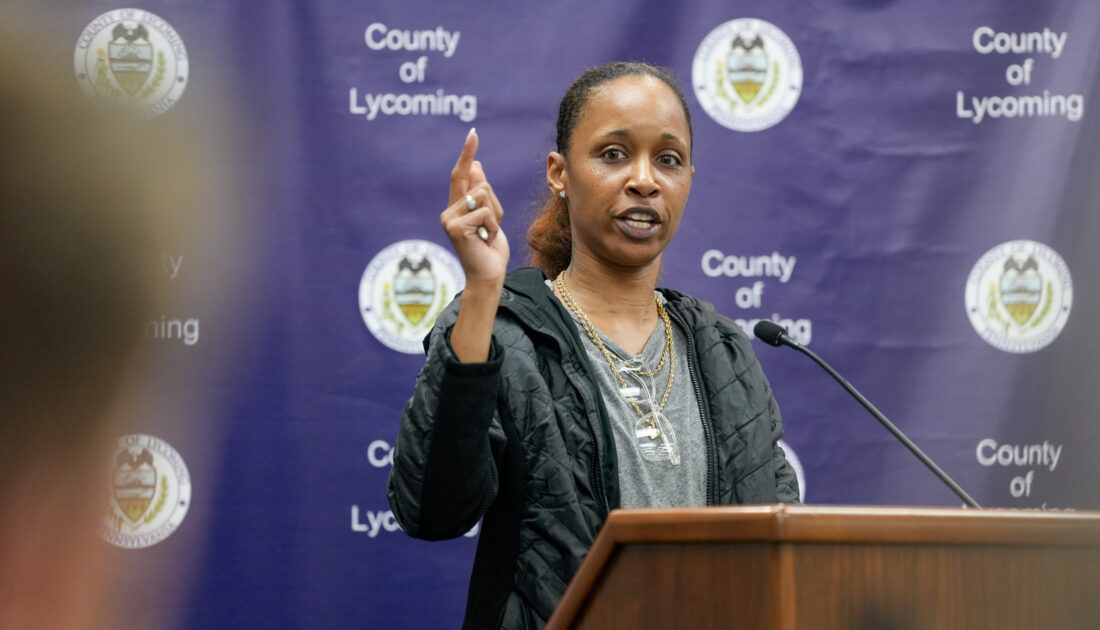
Loniqua Howell comments on the work her organization “Mom Boy Marathon” and other grass-roots organizations during the Community Juvenile Justice Meeting Wednesday evening in downtown Williamsport. DAVE KENNEDY/Sun-Gazette
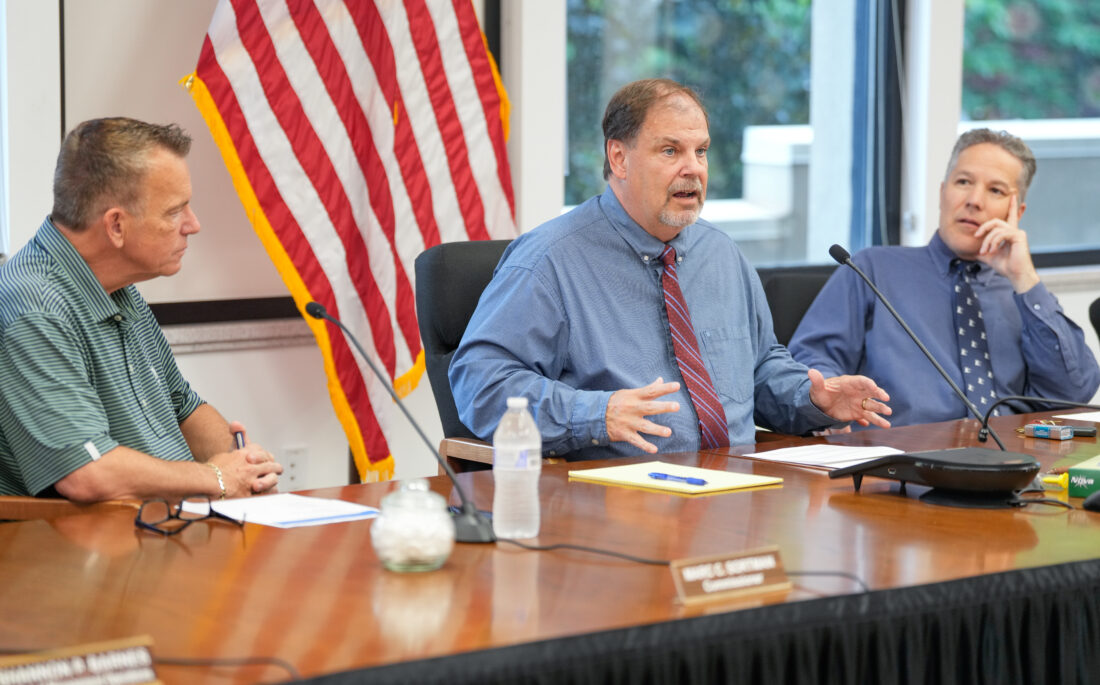
Lycoming County Commissioner Scott Metzger is flanked by Marc Sortman and Mark Mussina as opens the Community Juvenile Justice Meeting Wednesday evening in downtown Williamsport. All three commissioners set the tone for the meeting by asking all speakers and visitors to the meeting to have positive and constructive ideas as they presented them during the meeting. After more than 2 hours the meeting was closed after local grass roots organizations, governmental organizations and faith-based groups agreeing that it was a good start to discuss the topic by pulling people together to have this discussion. DAVE KENNEDY/Sun-Gazette
Loniqua Howell comments on the work her organization “Mom Boy Marathon” and other grass-roots organizations during the Community Juvenile Justice Meeting Wednesday evening in downtown Williamsport. DAVE KENNEDY/Sun-Gazette
Lycoming County Commissioner Scott Metzger is flanked by Marc Sortman and Mark Mussina as opens the Community Juvenile Justice Meeting Wednesday evening in downtown Williamsport. All three commissioners set the tone for the meeting by asking all speakers and visitors to the meeting to have positive and constructive ideas as they presented them during the meeting. After more than 2 hours the meeting was closed after local grass roots organizations, governmental organizations and faith-based groups agreeing that it was a good start to discuss the topic by pulling people together to have this discussion. DAVE KENNEDY/Sun-Gazette
Trending
Members of the community representing non-profits, the clergy, law enforcement and agencies that work with juveniles, came together this week for a roundtable discussion on ways to help not only the youth who are at a high risk of entering or have already entered the juvenile justice system but those who might be enticed to follow them down that path.
More chairs had to be added to the Commissioners' Board Room as the crowd of all ages and ethnicities gathered to participate in the evening's discussion which had been called by the Lycoming County Commissioners and was tagged as an opportunity to strengthen partnerships in the community to help reduce juvenile delinquency.
Commissioner Scott Metzger, who was instrumental in organizing the event, said that this first of many meetings was "strictly about information."
The impetus for having these discussions came after the City of Williamsport canceled its Fourth of July fireworks display this year due to an incident involving juveniles after last year's event, however Metzger pointed out that the problem doesn't just fall along city lines.
"This is not just a city, not just a county-this is a national issue," he said.
"It starts in the home. It starts with accountability and responsibility in the home and how we as a community...how can we assist them at making things better and at the same time holding those who don't want to follow the rules, accountable and responsible," he said.
Matt Minier, the deputy chief of juvenile probation who is currently acting chief, offered data on from his department to put the juvenile issue in perspective.
Even though there has been a significant increase in certain types of crimes committed by juveniles in the past two years, due to evidence-based probation instituted in 2009 there has been a gradual decrease in juvenile allegations overall,
Evidence-based probation, which focuses on specific behavioral, psychological, and environmental risk factors, tends to be more time consuming, difficult and technical, which leads to increased workload for the staff.
"It's a lot more involved. It requires a lot more testing, it requires assessments, it requires individual case plans for juveniles, so we assess risk, low, medium, high, and then we put our resources into where they can do the best and where the evidence has proven," Minier explained.
"Our allegations have actually decreased 50 percent over the last 15 years. We serve juveniles from age 10 to 21 Out of that population, there's 3 percent of the population of Lycoming County juveniles on probation supervision, and out of that, there's only 0.3 percent of them are either high or very high risk.
Although the data suggests a decrease overall, Minier noted that there has been a significant increase in juvenile crimes related to vehicle thefts, gun store robberies and possession of firearms.
"But that population is only 5 percent of the total population of juveniles on probation. It's a small population of juveniles that are committing crime, getting detained, getting placed," he said.
"Some of those work in conjunction with each other. So, a vehicle gets robbed. Juveniles are looking in vehicles for guns. They are taking the vehicles and using them to ram gun stores. Those are things that all happened in '24 and '25-a little bit less here in 2026," he said.
His department has also seen an increase in allegations being filed on juveniles with significant mental health and intellectual disabilities issues.
When juveniles are charged, there are two options, detainment or placement. Minier explained that the only juveniles who are detained are those who have committed felony offenses or a juvenile that has already been adjudicated that commits serious offenses or serious parole violations.
"It's similar to jail. There's no treatment there and it's meant for short-term," he said.
The court has to conduct a hearing within 72 hours, similar to an arraignment. At that point, the juvenile gets a defense attorney, prosecution has to present a case, and the juvenile, or the judge, makes a decision as to whether to keep that juvenile in detention. If the juvenile stays in detention, there has to be another hearing within 10 days. If it's a new charge for a non-jury trial, basically, and the case has to be presented, the DA's office has to be ready, defense makes their argument, and again the judge ultimately makes a decision on what happens after that," he explained.
They can then be placed on supervision or in a residential facility where treatment happens, he said.
Although there were questions about juvenile detention centers as a punitive answer to the juvenile problems, many of those in attendance were part of non-profits which are seeking to help juveniles from ever entering the system by offering alternative activities and an often unique perspective on the problem.
Loniqua Howell is the founder and executive director of "Boy Mom Marathon," a community-based organization serving youth in Lycoming County since 2022.
"We work closely with juvenile probation, we work with CYS (Children and Youth Services), we work with family shelters, parents, and other community agencies. When incidents happen, I do not turn away, I respond and intervene when it is safe," Howell said.
"Some of the issues that we are speaking on, are at home problems, things that start at home...some of these issues are not new issues, they're old issueOne of the other biggest issues," Howell stated.
"I find that a lot of community members will watch and stand by when incidents are taking place, rather than stepping in. They're pulling out their cell phones, they're taking pictures, they're taking videos.
So that's one of our biggest problems, is we have too many bystanders and lookers that don't do anything until someone else steps in," she said.
Her solution-"getting more people to actually be more interactive, and rather standing by, pulling out phones to record and tape and see who's there."
Her program also rewards children for good behavior, offering incentives.
"We do a sneaker program throughout the year, so kids can get gifted a pair of sneakers. One kid came to our program, he didn't see a pair of Jordans or what he liked, so he also had a behavioral issue. He was on an IEP plan," she explained.
"Me and Mom connected, it was made where that, okay, you change your behavior, I'll make sure that you get a decent pair of sneakers. Luckily enough, we had a donation given in, a pair of Jordans were in the donation, his IEP slipped away. He no longer needed it. He got granted those pair of sneakers," she said.
"So incentives like that also pay off as well. It doesn't always have to be monetary values, just little things, connecting with them, being able to relate," she added.
Other non-profits, such as Firetree Place offer activities to encourage youth to find a replacement for time spent just hanging out.
Billy Dayton, CEO of Firetree, said that their programs are primarily for youth three to 13 years of age, but with an expansion of their facility they have more space for teen-oriented activities.
One-by-one, representatives from the non-profits, explained what they are doing to help the juveniles in the communities across the county.
For Intisar Martin, founder, president and interim executive director of JUMP (Juvenile Uplifting Mentoring Program), the main goal of her program is to lower the recidivism rate for those ages 9 to 24 who may have already entered the juvenile justice system.
They have started a day treatment program where, from 10 a.m. to 8 p.m., they will work with kids who might have truancy issues or have broken curfew during the week.
"We're trying to arrange to be able to work with the same group of kids who are coming through the court system," she said
"We've spoken with Judge (Ryan) Tira, so we're going to be getting referrals from him for kids who are non-violent offenders and just need help with guidance and mentorship," Martin said.
After almost three hours and presentations by several groups -- Big Brothers, Big Sisters and scouts, just to name a few -- Metzger spoke to what happens moving forward.
"The next step is to go back and meet with the superintendents, law enforcement -- the key stakeholders -- to share this information from tonight with them, identify solutions and then develop a coordinated plan to move forward," said Metzger.
"Bring back the youth commissions. Bring back different programs or larger programs that are out there. What can we do that's going to work? What can be tweaked? How can we move forward? Then we'll schedule public meetings in the future for all those parties to attend, present the solutions to the public as a united front, because we talked about relationships and I'll go a step further -- partnerships," he said.
"The way you get things done is through relationships and partnerships -- doing things together. We're here tonight because we care about the kids, so if anything comes out of tonight, it's a message to show the kids we care. Show law enforcement we're going to be united with them. Show parents that we want to help -- we're here to help you," he added.