
Williamsport City Council votes to pave two brick street sections
Trending
Two brick street sections in the City of Williamsport will be paved over after a vote taken on second reading by City Council.
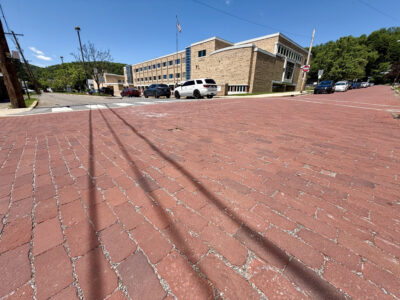
The brick streets to be paved are First Street, between Campbell and Walnut streets, and Wayne Avenue, between West Fourth Street and Hillside Avenue, said Bill Scott, city engineer.
The estimate given by the state Department of Transportation (PennDOT) to reconstruct First Street in that block was pushing $500,000, he said.
In comparison, repaving that section would be about $70,000, he said.
"Wayne Avenue would be a very similar cost," Scott said.
Ultimately, after a 30-minute or so long discussion, the vote was 6-1.
Councilwoman Liz Miele voted no. She said since the work would not be done until next year, there was time, and suggested $50,000 be put into the brick streets budget for maintenance, acknowledging that would not be enough.
"We did discuss this in depth at the last meeting," Council President Eric Beiter said.
In between readings, Councilman Adam Yoder said he had a resident from Newberry reach out to him expressing hopes the council might reconsider Wayne Avenue.
Yoder acknowledged he gave it some thought and spoke with Scott Livermore, director of the city Department of Public Works. "Yeah, he mentioned it," Scott said.
Yoder said he looked at this with the concept of finding a middle ground, or compromise regarding Wayne Avenue. He also wanted to ensure what was done would not burden the public works team.
Specifically, safety for children attending Jackson Primary School, arriving on buses and at dismissal times, was expressed by the Williamsport Area School District in correspondence.
The city does not have a solid "funding strategy to keep them up and redo them," Yoder said.
"I've grown to find value in them," he said. "I think it is just a little bit of a part that makes us unique."
He added how he thought there were more residents who live on brick streets that want them than "we probably realize, "not saying they're the majority."
"I do think it would be wise of us to take a look at this ordinance comprehensively and, notably, think about how do we maintain them long term? What funding streams are out there that we may be able to capture to harness these and utilize these better and what can we actually maintain?"
It may be, based on what is realistic, the city has to "streamline and remove some brick streets," but Yoder also said he thought it would be good to do that in the context of what can the city afford to maintain. With that context, he said, he thought the council should have that conversation.
"I'd rather preserve these where we can," he said.
Councilman Jon Mackey said, "Correct me if I am wrong but did we not have some outreach from the school district about this road?"
"We did," a councilman replied.
"Okay," Mackey said, "and their concerns were what we talked about two weeks ago," he said. "Safety," another councilman said.
Safety concerns expressed by the district regarded the children walking to and from the buses at Jackson Primary School, with the winter time snow and ice freezing on the brick surface and causing slippery conditions, according to prior discussion at council.
"So, my question is does the school district's opinion not trump a handful of Newberry residents?" Mackey asked. "We're now saying that we are going to ignore the school district's request to improve this street for safety purposes because a few residents reached out to us and that their concerns are more valid than the school district's," he said.
Mackey added how he was not an expert on paving, but looking at the Wayne Avenue near West Fourth Street where it was paved at some point, he added, there appears to be a concrete divider in the brick.
"My question is – "We are just going to slap down some asphalt or blacktop over the bricks?"
"I mean that's not going to hold up," he said. "That's going to be gone in six months. What are we talking about here?"
"I get it, I get it," he said of the brick streets preservation, but he added, "we cannot spend Williamsport's money because a few people want to see brick streets when they walk their dogs down brick streets."
"It's not responsible," he said. "Quite honestly ... I know some of you are not going to agree with me on this but it's why we still have City Hall sitting over here," Mackey said. "We were ready to sell City Hall and had 0.5 % of the population of Williamsport come in here and yell at us and we are still sitting on City Hall," he said.
"This is kind of what this feels like," Mackey said, adding, "we have to move forward here. We have a school district telling us this is a problem and we are going to address it, and all of a sudden we have a couple people call us ... it's frustrating it really is."
The feedback Yoder said received from the district were concerns, primarily, of safety and accessibility.
"In my mind if we address the crosswalks sections, where students should be crossing, that should eliminate the safety and accessibility building concerns," he said. "To be candid, if there are additional sections near the school district that would make it easier for students to get across ... to incorporate another crosswalk ... if we could pull that off, I think that would be a great idea," Yoder said.
At the same token, he said, "I don't know that we are going to want students walking across the street anywhere they want right beside a school in a residential neighborhood, right."
Yoder said he hoped there could be a middle ground to incorporate legitimate safety concerns that the school district brought forward and "buying us some time to think about a long-term solution, not just for this street but for brick streets in general, right."
"I am not disagreeing with their concerns but I am hoping that this is a way to listen to and validate their feedback on both sides of it," he said.
"I guess I just want to say that the school district had safety concerns," Councilman Jonah Milliken said, reading from an email, the primary concern was student safety. Additionally, a concrete span along the west curb on Wayne Avenue extends about two feet into the roadway. Because some vehicles do not park on the surface, travel lanes are narrow, contributing to congestion, complicating traffic flow during peak arrival and dismissal times.
Moreover, snow removal can be difficult, he said. The combination of heavy bus traffic, narrow roadway conditions and brick surface irregularities increase wear and presents operational challenges that are not consistent with the primary school zone, he said, reading from the email.
While Milliken said he appreciated Yoder bringing the concerns of the resident, which he said he thought that is exactly what "we should be doing," he also noted thinking about accessibility, meeting the requirements of the Americans with Disabilities Act (ADA) considerations on the crosswalk, but also outside of the crosswalk, were important factors.
"I think about the congestion," he said, acknowledging that he was not an expert on paving or brick road maintenance but added: "In my mind I think it's just time for some nice asphalt."
Scott noted there are sunken areas along the curb and that needs to be rebuilt. "Not just paving," he said, adding, "that's a full reconstruction."
"That's where your costs come in," Scott said. "When you have to reconstruct these brick streets it's just labor intensive."
The plan is to do isolated spot repairs and pave over the brick, he said. "We're not ripping up the whole street and rebuilding it."
Councilman David Dussinger asked if the city knew how many streets in the city are brick. The brick streets ordinance indicated a list of 12 or 13, Scott said.
"Most of them are segments," Miele said. "I think Rural Avenue is the only lengthy stretch of actual brick streets that we have in the city."
A couple of them are full lengthy blocks, Scott said, adding "even Fifth Avenue is a good section."
Councilman Vince Pulizzi also favored paving in one clip, with the potential cost of repeat visits by contractors adding to the price.
Beiter noted he saw repair work done near the intersection of Wayne Avenue and Fourth Street and noticed asphalt over the top of the brick as approaching the south side of Wayne Avenue to come to the light at Fourth Street.
"Clearly, we need a plan," Beiter said. He said his opinion was to agree with Mackey and Milliken – saying until there is a plan for these brick streets, he did not think the city, especially with the school district and their concerns, should be "messing around at this point," and he supported moving ahead with the ordinance amendment.
"I appreciate the residents," he said, "very much so." "Obviously, it's a lot of charm and a few years ago when this conversation came up, initially, there were some residents on Rural Avenue who went around and got petitions signed."
"I believe every resident on Rural Avenue probably signed that petition," Beiter said, adding he could not recall the number of who wanted to maintain that brick street.
"But, again, without a plan I think we put ourselves further behind the eight ball, and we can't afford to do that," he said.