
Author: Jimmy Hoffa mystery has roots at USP Lewisburg
Trending
LEWISBURG -- The mystery surrounding a legendary alleged crime started with an encounter at the United States Penitentiary Lewisburg, according to an author who has extensively researched the life -- and disappearance -- of Jimmy Hoffa.
Dan Moldea, who now lives in Washington, D.C., has penned 10 books -- primarily focusing on high-profile crimes -- since the 1970s. His first book was titled "The Hoffa Wars: The Rise and Fall of Jimmy Hoffa."
"Hoffa was a bad guy," Moldea said. "He started out as a working-class hero. He was a champion with the rank and file.
"He had a problem with a rival union in Detroit that was threatening the Teamsters," he continued. "He turned to the mafia in Detroit, so he was corrupted."
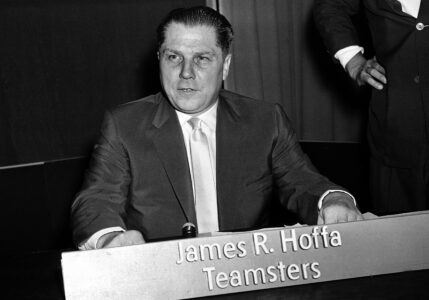
Hoffa -- who was born Feb. 14, 1913 -- disappeared July 30, 1975, and was declared dead June 30, 1982. He was president of the International Brotherhood of Teamsters from 1957 until 1971.
Through his dealings in Detroit, Moldea said Hoffa attracted the attention of Sen. Bobby Kennedy, who was chair of the Rackets Committee.
"Kennedy targeted Hoffa," Moldea explained. "In 1960, John Kennedy was elected president… He appointed his kid brother, Bobby Kennedy, as the attorney general.
"While Bobby Kennedy was the head of the Senate committee… he was eating mafia guys for breakfast," he continued. "When he became attorney general, he started eating them for lunch and dinner too."
Through Kennedy's investigations, Moldea said Hoffa was indicted for extortion. During a trial, he said information was revealed which indicated Hoffa was trying to "fix the jury."
Ultimately, the jury was "hung" on the case, and could not reach a decision.
In 1964, Moldea said Hoffa was sentenced to eight years in prison for jury tampering, and five years for pension fraud. After the Supreme Court turned down an appeal filed by Hoffa, Moldea said he was incarcerated at USP Lewisburg on March 7, 1967.
While conducting research for "The Hoffa Wars," Moldea interviewed Ed Edwards, a convicted killer who was incarcerated with Hoffa in Lewisburg.
"We had long, long conversations, interviews," Moldea explained. "He told me there was a very important moment that occurred in Lewisburg."
According to Moldea, one of Hoffa's top rivals -- Anthony "Tony Pro" Provenzano -- was locked up in Lewisburg at the same time as Hoffa.
"While they were in prison, there was a fight, a fistfight between Hoffa and 'Tony Pro,'" Moldea recounted. "It was a result of that fight that, literally, a blood feud emerged from prison between 'Tony Pro' and Jimmy Hoffa."
Provenzano ended up "engineering the murder of Jimmy Hoffa," according to Moldea.
Moldea became interested in reporting on crime while working for a federal poverty agency in Ohio.
"I caught our executive director embezzling money," he said. "He fired me… I walked across the street and went to the prosecutor's office.
"During the investigation, it came out he was dealing with this mob loan shark… I thought the mafia had been cleaned up by Elliot Ness and The Untouchables."
Moldea began to write about crime for a local newspaper, The Reporter. Eventually, he was given a ledger book from the Teamsters Union to pore through.
He started writing about the ledger, and was contacted by national newspaper journalist Jonathan Kwitny, who saw his work.
Moldea served as an unpaid intern for Kwitny, who released a three-part series on Hoffa one week before his disappearance.
Hoffa went missing after visiting the Machus Red Fox restaurant in a Detroit suburb. He believed he was attending a meeting with Provenzano and Anthony "Tony Jack" Giacalone.
According to Moldea, FBI informant Ralph Picardo alleged that Salvatore and Gabriel Briguglio, and Stephen and Thomas Andretta were involved in Hoffa's murder, along with Sal Briguglio, who allegedly killed Hoffa.
Picardo, Moldea said, alleged that Hoffa's body was placed in a 55-gallon drum and shipped via a Gateway Transportation truck to a destination in New Jersey.
In the days following Hoffa's disappearance, Moldea and Kwitny came up with another theory on the case. The two thought he was hiding out at a lodge in Wisconsin.
After traveling together to Wisconsin, and discovering their theory was off the mark, Moldea traveled to Detroit. There, he started following NBC News reporter Irving R. Levine.
Levine asked Moldea why he was shadowing him.
"I said 'you need me,'" Moldea said, adding that he explained that he worked with Kwitny on the Hoffa series of articles.
"I got hired (by NBC) on the spot," Moldea recounted. "I was involved in the Hoffa disappearance from day one."
He alleges that Picardo stated the drum containing Hoffa's body was buried at the PJP Landfill "Brother Mosacto's Dump" in Jersey City, N.J.
After years of continuing to dig into the case, Moldea in September 2019 spoke with Frank Cappola.
He was 17 at the time Hoffa disappeared and worked part-time at the dump.
Cappola allegedly told Moldea that his father, Paul Cappola, worked at the dump at the time and was responsible for burying Hoffa's body.
"Paul, instead of burying him where (owner Phillip Moscato) wanted him… he decided to go off site," Moldea said. "He buried it on state property, under the bridge, the Pulaski Skyway, that connects Jersey City and Newark."
Before Frank Cappola passed away, he and Moldea visited the area of the bridge. Frank pointed out the spot where he claims his father buried Hoffa's body.
"The area is about the size of a Little League baseball field," Moldea said. "I did a long interview with him on field. I recorded it, I insisted he sign a sworn statement, which he did. He offered to fully cooperate with law enforcement."
However, Frank died before that could happen.
Moldea provided the information to the FBI. In October 2021, he claims the FBI searched the site but came up empty handed.
However, Moldea states he worked with two different technicians with ground-penetrating radar.
He claims both companies found an area which appears to show buried barrels.
"I'm sure Hoffa's there," Moldea said. "There's no doubt in my mind."
He's still trying to convince the FBI to go back to the site, and further examine it.
In addition to "The Hoffa Wars," Moldea's other books include: "Interference: How Organized Crime Influences Professional Football"; "Dark Victory: Ronald Reagan, MCA and the Mob"; "The Killing of Robert F. Kennedy"; "Evidence Dismissed: The Inside Story of the Police Investigation of OJ Simpson"; "A Washington Tragedy: Bill and Hillary Clinton and the Silence of Vincent Foster"; "Money, Politics and Corruption in U.S. Higher Education"; "Hollywood Confidential"; and "Confessions of a Guerrilla Writer," his memoire.
Currently, Moldea is working on another book focused on the mafia and Hollywood. He hopes to also pen another Hoffa book.