
Williamsport company uses insects to prevent food waste
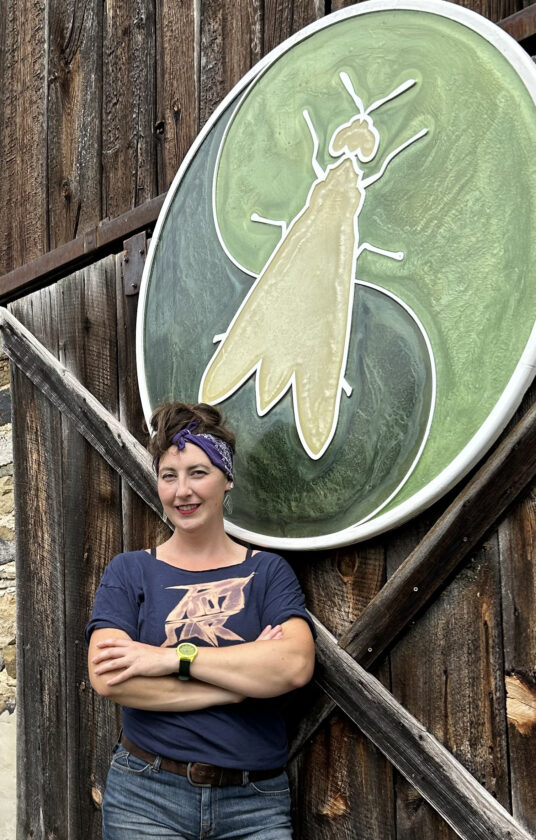
PHOTO PROVIDED Aubrey Fornwalt poses outside the sign to Full Circle Bioconversion, a company that she’s the owner. Full Circle Bioconversion uses black soldier fly larvae to convert over 180,000 pounds of food waste into compost.

PHOTO PROVIDED Aubrey Fornwalt, owner of Full Circle Bioconversion, feeds food waste to black soldier fly larvae.
PHOTO PROVIDED Aubrey Fornwalt poses outside the sign to Full Circle Bioconversion, a company that she’s the owner. Full Circle Bioconversion uses black soldier fly larvae to convert over 180,000 pounds of food waste into compost.
PHOTO PROVIDED Aubrey Fornwalt, owner of Full Circle Bioconversion, feeds food waste to black soldier fly larvae.
Trending
Inside a large aquarium, a ten-inch-deep mass of caramel-brown maggots eats and eats and eats. While the army of black soldier fly larvae might alarm some, to Aubrey Fornwalt, owner of Full Circle Bioconversion, this is just business as usual.
Based in Williamsport, Fornwalt's company feeds food waste -- including meat and dairy -- to BSFL, converting the organic material into compost. The company is the first of its kind in the state and can reduce food waste between 50-80%.
The company partners with local households and businesses such as Bullfrog Brewery and Kathy's Cafe. Its BSFL products are sold at H&K Nursery, and compost deliveries go out each spring to area clients.
Fornwalt says, "My goal with this business is to create an alternative to the landfill that keeps our food in a circle."
Thus the story behind the name Full Circle Bioconversion.
"Feeding our future selves is a tenet of this operation. My customers are investing in that," she continued.
Though BSFL compost doesn't boast the high nitrogen-phosphorus-potassium ratio of worm compost or vermicompost, it offers valuable microbial benefits.
"The organisms that are introduced into the soil via compost and frass help to transport what the plant needs to really thrive. This can also make stronger, more resilient plants. And, when the soil is rich with a robust microbe population, it can absorb rain better and retain it longer," Fornwalt said. "Droughts can be less lethal. Soil amendments are an important tool to create a long-lasting foundation to continually grow food and healthy plants."
This spring, Fornwant is partnering with the University of Delaware on a frass (larvae manure) study on fiber flax.
"We'll be trialling cow manure, compost and frass to compare soil analyses as well as monitor insect and weed pressure through the growing season," Fornwalt said. "I'm really interested in the insect pressure findings because I've read that using insect frass on plants can potentially bolster the plants' defenses of pest pressure."
Fornwalt's path to becoming a fly farmer was far from conventional. She spent 14 years in journalism, working first at The Baltimore Sun's now-defunct free tabloid, then at Newsday on Long Island.
"It stopped giving me fulfillment and in a very mundane moment I just thought, 'I want to compost,'" Fornwalt said.
In 2018, she moved back into her childhood bedroom to begin working towards her vision.
"O worked with the Department of Environmental Protection to amend an existing permit to incorporate black soldier fly larvae -- coined hermetia composting -- to get up and running," Fornwalt said. "This is the first of its kind operation in Pennsylvania. It's all housed in an insulated room in a family-owned barn."
Today, Fornwalt processes between 600 and 1,000 pounds of food waste each week. It's converted into frass and dried larvae, which are sold as feed for chickens and birds.
"I keep track of all the food I've diverted since 2020, and it's just over 188,000 pounds," Fornwalt said, noting the tally is updated regularly on the her website. "That might seem like a small number, but it's all gone to insects. That's pretty wild."