Regional bus service grows over 50 years
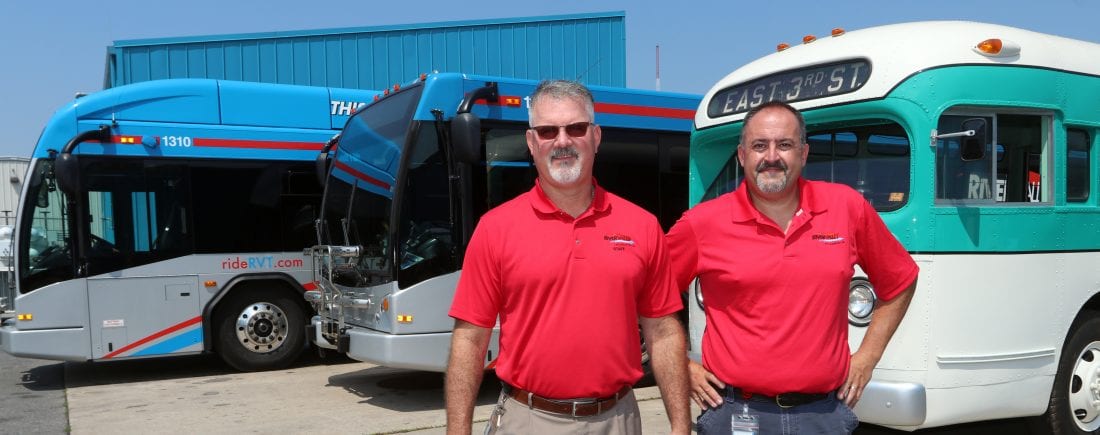
It was a buyout of a private bus company by the city 50 years ago this coming Thursday that led to the formation of what is today’s River Valley Transit.
Mayor Richard J. Carey, who served as the city’s chief executive from 1968 to 1972, initiated the purchase of Williamsport Bus Co. on Aug. 8, 1969, said William E. Nichols Jr., who has been general manager of the city-based transit system for 41 years, the longest serving general manager in its history.
The community was looking at forming an authority, as other cities were doing at the time across the state, Nichols said.
“Carey said, ‘No, we are going to buy the system,’ ” Nichols said. It was “unique in the way the city stepped up,” Nichols said.
The purchase price was $75,000, and Carey, in pushing for it, helped to propel bus transportation forward in the city to where it is today, Nichols said.
Carey set in motion getting grants from the Urban Mass Transportation Administration and the state Department of Transportation, he said.
An agreement was forged between municipalities around the city to provide a local share for the grants to operate the system.
“It was one of the first types of regionalizations,” Nichols said.
When the purchase happened, the city began to operate a Bureau of Transportation.
The office and maintenance garage were at 1500 W. Third St., where they remain today.
The fleet of Twin Coaches ran on gasoline.
Nichols described the transport as “rag tag” and “poorly made.”
The buses were not equipped with radios, Nichols said.
When a bus driver would need to stop for some reason, usually if they broke down, he would get out and have to knock on the closest door — even at 6 a.m. – to call the bus garage, Nichols said.
Breakdowns were among the most prevalent complaints, he said.
The buses would stop downtown and people would pour into the warm confines of a merchant’s store, he said.
Nichols’ entry into the transit world began by chance.
In 1977, Nichols was going to go to law school, but he changed his mind and continued his studies at Penn State University, pursuing a master’s degree in public administration.
During that time, his professor, Dr. Ted Poister, wanted him to do a study about the public bus systems and Nichols obliged.
“I helped to do surveys as part of the classwork,” Nichols said.
The city was searching for a general manager of the bureau. Mayor Daniel Kirby and Thomas Spitler, city finance director at the time, were looking for the right person to fill the job.
Nichols said he filled out the paperwork and, at age 23, as he drove home from college over Thanksgiving holiday, he said he heard his name over the radio, announcing he was hired as general manager of the Williamsport Bureau of Transportation, the predecessor of City Bus.
Over the years, Nichols recalled some hard times as well as heart-felt moments, such as one in the 1980s. It was a night then-Council President Dr. Randall Hipple took council to different places.
Hipple took the council to the bus station for a meeting.
During that meeting, three generations of the Nichols family attended: His father, William Nichols Sr., who served on council and is on the Williamsport Municipal Water and Sanitary Authority, and his grandfather, who was a member of the Brandon Park Commission.
Also during the 1980s, City Bus began a popular slogan — “We Take Pride In Every Ride,” Nichols said.
In the 1990s, Nichols and Casey Steinbacher, then president of the Williamsport/Lycoming Chamber of Commerce, worked together to save the Hiawatha Paddlewheeler.
“It was do or die for the boat and we got the ear of Mayor Jessie Bloom, who was supportive of City Bus managing the riverboat,” Nichols said.
In the 1990s, a new generation of trolleys began to run, recalling public transportation of a century earlier.
In 1999, Trade and Transit Centre I became a reality with the “lead partners,” consisting of business leaders and government officials, all seeking a new vision for the merchants and a redone Market Street Bridge and entrance to the city.
“It was our bus station and home downtown,” Nichols said of the transit center. City Bus transitioned to the name River Valley Transit in 2005, to better support the vision of serving many more communities than the city proper, he said.
Later, as the Midtown Deck with 300 spaces was removed because it was deteriorating, a second parking garage was eyed.
But merchants said they wanted surface parking, and a space for entertainment and art displays, Nichols said.
A second Trade and Transit Centre was added, which would include parking space and space for sculptures, murals and relics that hold historic value to the city and its transportation history, Nichols said.
The plaza was named Midtown Landing and, today, doubles as a central space for bus riders to get on and off buses. It also has pathways to connect various parts of the downtown to each other.
The conversion of the buses to the greener or cleaner fuel has helped the city and region continue to offer transportation but do so without the dirty fumes of petroleum-based products.
Much of the River Valley Transit fleet is run on compressed natural gas, a cleaner-burning fuel than diesel or petroleum.
The fleet has been converted to include 19 compressed natural gas buses, with four more on order, and a fuel island for public use.
“I have had the privilege and opportunity over the years of working with different mayors and helping the city and transit system,” Nichols said.
In 2011, River Valley Transit began to manage the Endless Mountains Transportation Authority, which is called BeST Transit. Today, it operates a fixed route and shared ride service in Bradford, Tioga and Sullivan counties and provides service to north of the city.
“We’ve expanded to Clinton County and are looking at more southern counties, including Northumberland, Montour, Snyder and Columbia,” Nichols said. “We’re closing in on 1.4 million riders, and the commitment to excellent service for them will never wane.”
Top News
Variety of charges lodged in separate incidents
Convicted felon arrested on drug and firearm charges Convicted felon Dominic Aaron Reynolds was arrested early ...
Loyalsock Township school board passes budget with tax hike
The Loyalsock Township School Board passed its 2026-27 proposed final budget at its recent May meeting. While the ...
Williamsport Committee of the Whole talks curfew for youth
The City of Williamsport has been exploring what Mayor Derek Slaughter says is a “multi-pronged” approach to ...
Pine Street United Methodist Church reaches 200-year milestone
City of Williamsport explores approaches to managing juvenile behavior, crime