
Williamsport faces brick streets dilemma
City must change ordinance or pay for repairs
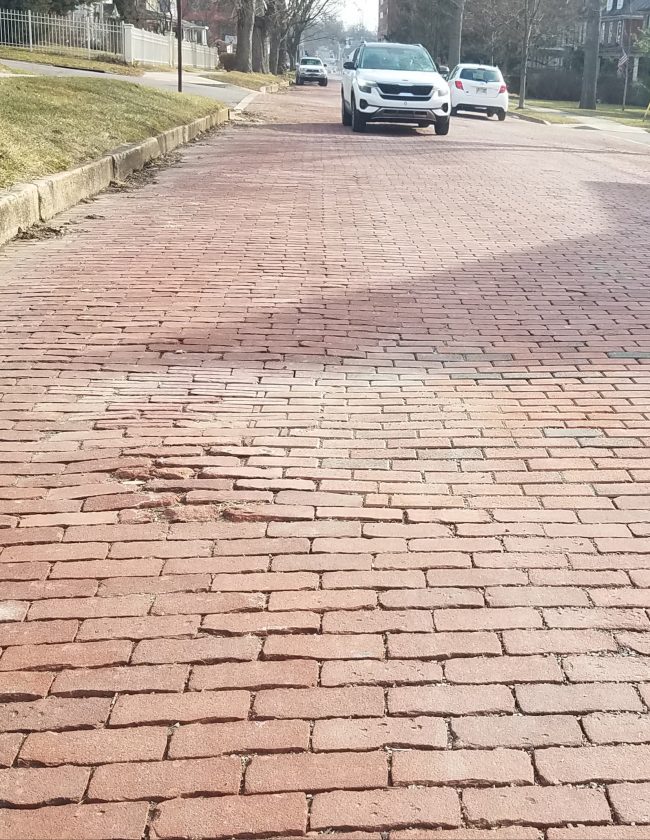
Rural Avenue in Williamsport on Monday morning. PHIL HOLMES/Sun-Gazette
Brick streets may be charming to look at, but several in Williamsport are falling apart and causing drivers havoc, city officials said.
In an American Rescue Plan work session the matter was discussed and strategized over what to do next for what constitutes less than one mile of them.
“Residents have complained of bricks falling apart,” said Councilwoman Bonnie Katz, public works committee chair and council vice president.
She said there are areas where the bricks can cause motorists havoc. But she also noted how charming they are and how an ordinance is in place to preserve them.
The brick streets include: Rural Avenue, between Campbell Street and Fifth Avenue; Laurel Street, between Sixth and DuBois streets; Harris Place, between Hepburn and Market streets; First Street, between Campbell and Walnut streets; Fifth Avenue, between Park and Rural avenues; DuBois Street, between Laurel and Market streets; Court Street, between Sixth Street and a point 50 feet south of the southern right of way line of DuBois Street; Campbell Street, from First Street south to Bethlehem Street; Brandon Place, between Franklin and St. Boniface streets; and Beeber Street, from Oliver Street and West Fourth Street intersection.
Adam Winder, formerly with the Department of Streets and Parks, now general manager of River Valley Transit, estimated the cost of at least $800,000 for the resurfacing of a section of Rural Avenue.
“You could easily sink that much into it,” he said.
To properly fix brick streets, the bricks are taken up by hand, sand is poured in, and then they are replaced by hand, a slow and deliberate process that adds to the overall cost, Winder said.
The most recent budget of $50,000 for repairing brick streets in the capital projects budget doesn’t add up to today’s inflation, Winder said.
Former Council President Randall J. Allison said perhaps it might be worth reviewing the ordinance.
He said the committee could also look at the possibility of restoration in bits and pieces rather than every street being repaired at once.
After the meeting, Councilman Eric Beiter said he and Councilman Jon Mackey have discussed the possibility of polling residents door to door whose homes are on brick streets to see what they are feeling as the city looks to increase revenue through economic development.
He also wanted to see the ordinance reviewed before further discussions on the issue.
Councilwoman Liz Miele, who has long expressed a need to preserve city history, said some of the brick streets are a century old and that not having a plan is not a strategy.
The ordinance goes into detail for anyone needing utility services on brick streets.
The ordinance states how the restoration of the excavation or cut shall be with brick paving, so as to match the size and color as closely as possible to the existing brick.
Additionally, the brick to be used for replacement shall be approved by the
manager of contracts/public services or by the city engineer.
The restoration shall be completed within one year of such cut or excavation and such person or entity shall be responsible for any defects that appear in the hardfill or restoration for a period of two years following completion.
All work performed shall be inspected by the Department of Streets and Parks.
The ordinance stated that beginning in 2006, the six-year capital projects budget shall include a line item “brick streets” under “public services, street improvements,” which shall be addressed each year in preparing the annual budget.
Any person violating the provisions of this article shall be fined not more than $600 or imprisoned not more than 90 days or both.
Top News

Pine Creek Township to consider ordinance amendment to address data centers
East Lycoming School District names interim district leadership
During a recent work session, the East Lycoming School District board appointed Gerald McLaughlin as interim ...
City of Williamsport, STEP Inc. partner on property rehabilitation
Elderly man’s body pulled from pond in Muncy
MUNCY — The Lycoming County Coroner’s Office and state police are investigating the death of an elderly man ...

Rose Valley Lake drawdown tentatively slated for Fall 2027 for dam rehabilitation
Lycoming County sheriff’s department offering two online services
County residents will now be able to apply for a license to carry (LTC) permit online following approval by the ...