
Trending
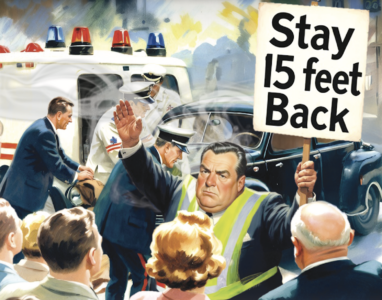
Legislation establishing a 15-foot buffer zone for police, firefighters and emergency medical technicians and paramedics responding as part of their duty and penalties for violating that "halo," has been proposed by a state lawmaker serving the region.
Just like a similar halo law in Florida, state Rep. Joe Hamm, R-Hepburn Township, believes it imperative that first responders be given the perimeter to work to perform their duties without impediments or obstruction from the public.
"It is absolutely imperative that our first responders can perform their critical duties in as safe a scene as possible and this legislation will help ensure that," he said of what is known as the Halo Act, or H.B. 1817, a piece of legislation that Hamm wrote.
He said he has received support from several lawmakers that he works with on both sides of the political aisle listing their names on the bill.
Oftentimes, first responders arrive at chaotic or even dangerous scenes to fulfill their duties, he said.
These scenes can become more dangerous for first responders when other individuals attempt to impede or interfere with the performance of their duties or otherwise threaten or harass the first responders.
How it would work
If a person gets to within that 15-foot barrier, (a peace (police) officer, firefighter, EMT, paramedic) would have one request – 'Hey mam or sir, I need you to step back,''' Hamm said.
"If they choose not to get out of that 15-foot halo area, they could be charged with a crime," he said.
Specifically, if a person receives a verbal warning not to approach from a first responder and that person knowingly violates that warning and remains within 15 feet of the first responder with the intent to impede the first responder's ability to perform their duties or threatens or harasses them, they will be held criminally liable, according to the legislation.
A first offense shall constitute a misdemeanor of the third degree, while a second or subsequent offense shall constitute a second degree misdemeanor, the legislation reads.
First Amendment rights are unchanged
Language in the bill protects the constitutional rights of bystanders and provides for an initial warning notice and penalty for violation.
"I am certainly cognizant that some individuals feel this type of legislation may restrict certain First Amendment protections," Hamm said.
Today, videographers, cell phone users, and legitimate news media all make their way toward such incidents involving police, firefighters and EMS personnel and some get close to the first responders performing their duties.
To make sure there is no confusion about the impact of this legislation on these constitutional protections, the bill includes a provision that makes clear that nothing in it is to be construed as limiting otherwise protected conduct under the First Amendment of the United States Constitution and Pennsylvania Constitution.
This proposed legislation would never impede social interaction between the public and first responders during non-emergencies, Hamm said.
"This is not saying you can't go up to an officer and on the street and say 'Hello,'" Hamm said. "Not at all, it is simply when they are engaged in the act of the incident and job," he said. "Nobody is going to be out there with a tape measure, it's simply saying give respect to the officers, firefighters and EMS personnel," he said.
Retired fire chief weighs in
It makes sense to retired Williamsport Bureau of Fire Chief Sam Aungst, who recognized the law came out of Florida and how it has received support from Democrats and Republicans, alike.
In a telephone interview, Aungst, who retired from the bureau in January, discussed two incidents in which such a law would have helped ease the situation.
In one, he and the bureau firefighters and city police responded to assist in a violent head-on crash on West Fourth Street, near Bowman Field, one in which an occupant was entrapped in the vehicle.
During this incident, a videographer, who was known to antagonize law enforcement and other public safety personnel by yelling at them at scenes, got too close.
He was standing over the shoulder of the firefighter who was using a powerful tool first responders use to cut through the metal of the vehicle to rescue a trapped occupant, Aungst said.
The proximity to the incident endangered the videographer, as shards of metal popped off and flew in the air as firefighters were freeing the trapped occupant. The vehicle was partially in the street and on the sidewalk. A police officer told the firefighters that, unfortunately, because of the videographer's First Amendment right, that he could continue to record the incident that was on the public right-of-way. The bureau in no way blamed the officer, because it was the constitutional right for the man to record the incident and without the halo law in effect, there was nothing that could change that. Aungst recalled how the videographer would step back a bit but then would return back.
Aungst acknowledged that firefighters do not have as much training as police in de-escalation and are more apt to defend the scenes.
Another time, Aungst said he and now-retired firefighter Kevin Breen were rendering medical treatment to a shooting victim outside of a nightclub downtown.
"We were there and trying to treat a lady and the two of us were around the kidney area," Aungst said. Her male friend was "intoxicated," and began pushing Breen away from the patient, the retired fire chief said.
In both instances, Hamm's legislation would ensure that had there been the halo law, these obstructive types of behavior would have been less likely to occur and those doing so would be violating the buffer zones and could face the charges.
"We are seeing where they have an individual who is down and they can't get to that person because of people being within that radius," he said.
Safety first
In the case of the need for using automated external defibrillators (AEDs), as they yell the command of 'Clear!' and no one is supposed to be in that space when that electrical pulse is sent out to shock a person's arrhythmia back to normal or restart a heart that stopped pumping, the law would save, perhaps, two lives.
"Someone who makes contact with the patient, now they are getting shocked," Hamm said as a possible scenario at an emergency incident.
"I can't imagine wanting to be in the way of someone who is trying to save someone's life," he said. "I want them to be able to do their jobs."
The legislation provides a means for first responders to inform the public to maintain the 15-foot distance and sets up the chargeable offenses if a person violates that buffer zone, taking it out of the hands of the district attorney, Hamm said.
"It truly is for the safety of the victim, for the safety of the first responders, and the safety of the person who is infringing on that space," he said.
"Let them do their jobs as, frankly, someone's life might be counting on that and if they are distracted by you in that intimate space where they are trying to do their job, every second matters," he said.