
Lawmakers discuss combating drugs
Trending
State Rep. Jamie Flick, R-South Williamsport, held his fourth Human Services Expo at Pennsylvania College of Technology Thursday, bringing together roughly 80 vendors representing a number of community based disciplines.
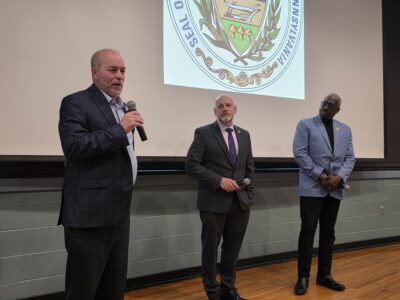
Prior to the start of the Expo, Flick was joined by House Human Services Chairs Rep. Doyle Heffley, R-Palmerton and Rep. Dan Williams, D-Sadsbury Township for a presentation on efforts to combat drug use and addiction throughout the Commonwealth.
"Human Services makes up 41% of that $50-some billion, so it's critical," said Flick, who sits on the committee, as well as the Children and Youth and Tourism and Economic and Recreational Development committees.
"We had an entire nation and a generation that got blindsided by the over-prescribing of opioids, and then the cheap black tar heroin coming in, run by the Mexican drug cartels," Heffley said.
Heffley, with a background in trucking, thought he would be tackling issues such as potholes and tolls until a conversion with some former classmates led him to the fight against opioid abuse.
Within his first and second terms, Heffley worked to pass legislation that cut opioid prescriptions to youth by 50%.
"We know that young athletes getting hurt on the field and getting prescribed a 30 day prescription for Percocet was, in many cases, a death sentence, so the fact that we did that in the first year, and we can see the decline now is proof we can bring about change through legislation," he said.
Other legislative victories cited by Heffley include a strengthening of the Prescription Drug Monitoring Program (PDMP), which helps track over-prescribing of medicines, a seven day supply cap on emergency room prescribed opioids and the wide availability of NARCAN.
"One of the pieces of legislation we can be proud of too is that we were able to work together on legislation to enable individuals to receive access to psychiatric help specifically through telehealth without the four walls limitations of having to be inside a facility," said Williams, also Senior Pastor of New Life in Christ Fellowship Church in Coatesville.
"Looking at some of the issues that confront the inability to go to a facility, whether it's the result of transportation issues, not having enough resources to make it there, the access of telehealth makes it easier to get the kind of help," he said.
To drive home the importance of these interventions, West Branch Drug and Alcohol Abuse Commission Assistant Executive Director Jennifer Reeder was on hand to not only talk about the varied work of the agency, but to offer some startling statistics.
"In 2024, there were actually 3,341 overdose deaths in the state. That's an average of nine people per day. That is, however, a decrease of 29.2% from the year prior. So we're moving in the right direction," she said.
Fentanyl was a contributing factor in 67% of those deaths, which was down 10% from 2023, with 41% of those deaths involving a combination of opioids and stimulants and 35% attributed to opioids alone.
"54.5% of all 2024 overdose deaths occurred in the deceased's own home," Reeder said.
"Over that time, there are only 17 counties that had a decrease of 50% or more, with Lycoming County coming in third in the state, with a reduction rate of 62%," she said.
Asked what can be done not only by the legislature, but by everyday citizens to curb the destruction caused by drug use, the representatives said it begins on the ground.
"Helping your law enforcement, setting up community watches is important, trying to keep drugs things out, but also educating our youth, educating young people of the hazards, what's out there, what's in your community, and we're seeing new drug trends," Heffley said, noting the rise of substances like kratom and xylene.
"Education, I think, is key, and working with your communities, creating good communities and keeping your communities together," he said.
"It is true that some of what is taking place is a reflection of what's happening in the broader society," Williams said, adding that several factors including economic, educational and environmental are often at play at the same time.
Removing the stigma of addiction should be a top priority, Williams stressed.
"To help people to understand that those who move through these spaces and perhaps become addicted for one reason or another, they're not less than, and those who don't suffer from addictions are not better than," he said.
"We all have the same struggles, and at least removing the stigma that's associated is one of the things we can do," Williams said.
"Lastly, while we serve in the legislature, the most important person in a democracy is you," he told those assembled.
"It is up to you to do some of the heavy lifting, some of the work in our communities, in our space, so that we can at some point, begin to push in ways that I think are more beneficial to the community," Williams said.
Meanwhile the work will continue on the government side, Flick said.
"Years ago, Gov. Shapiro, as Attorney General, sued the drug makers, and Pennsylvania was awarded $1.8 billion," he said, adding that the Supreme Court recently awarded the state another 232 million, set to be divided up among the 67 counties for 17 years based on meeting certain criteria, including the number of overdoses in each county.
"This year, Lycoming County got $1.83 million. I hope that amount doesn't go up. I hope it goes down to zero, so that we never need that again," Flick said, before vowing to continue the fight.
"We will keep suing these (expletive) until they live underneath a rock if they kill our kids," he said.