
Trending
For the fourth year, a Human Resources Expo hosted by State Rep. Jamie Flick, R-South Williamsport, returned to Pennsylvania College of Technology last week.
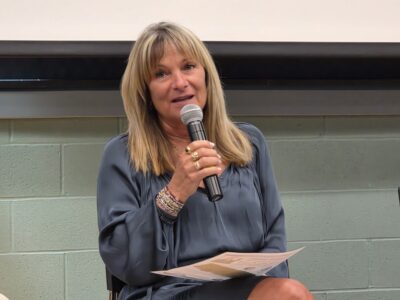
The topic of this year's Speaker's Series, entitled Opioid Addiction: Loss, Recovery and Hope, featured four highlighting the devastating impact Substance Abuse Disorder has not only on the user, but their loved ones as well.
While acknowledging that hopelessness is a feeling many affected by Substance Abuse Disorder feel, former Lycoming County Judge Marc Lovecchio opened with a message of hope.
"It starts with one person at a time," he said.
"There's a story about all the starfish washing up on the beach. Two people are walking opposite, and as one person is picking up one starfish, the other says, 'you're never going to save them all,' and the person with the starfish throws it in into the ocean and says, 'well, I saved that one, didn't I,'" Lovecchio related.
"That's what I tried to do when I was on the bench, to save starfish, one at a time," he said, lauding some of the alternative judicial routes available within the county, such as veteran's, mental health and treatment courts.
"Substance Use Disorder is an equal opportunity killer," Lovecchio told the audience.
This is a fact Lovecchio knows all too well, as in 2002, he lost his younger brother, David, to the disease, despite growing up in a "nice" family, where he and his five brothers and sisters were known as acclaimed athletes and academics.
"David was a larger than life figure. David was athletic. He was a little rebellious, but he also was smart enough to get away with a lot of things, perhaps, which was his first blessing and his curse," Lovecchio said.
After sustaining an injury while playing high school football, David was prescribed opiates, an occurrence that would repeat as he went on to play in prep school.
As treatment turned to an addiction to fentanyl, David would begin stealing to help feed his drug appetite, including stealing and selling his sister's engagement ring and cleaning out a home he was hired to paint.
"When he was at his lowest, his substance abuse disorder ruined my family," Lovecchio said, recounting the conflicting family dynamics created by the situation, with their parents determined to see that he got the help he needed, while their older brother wanted nothing to do with him by that point.
"When you have a loved one, you can't let them get rock bottom. It's just almost impossible to do," Lovecchio said, as he had become the point person between David and the rest of the family.
After attempting treatment through four inpatient facilities in the state and either getting kicked out or relapsing, which Lovecchio stressed is part of recovery, David would go on to a treatment facility in Florida, however one day the family would get the call they had always dreaded, David had succumbed to his disorder at the age of 36.
His death shattered the family, in some ways that may never be repaired, the judge said, himself wracked for a long time over the difference he thought he could've made.
Through therapy and medication, though, Lovecchio would come to understand that he had no control whatsoever over his brother's disorder.
"Part of the reason I became a judge was so I could address these issues and get involved in the treatment courts and whatnot. Part of the reason I stopped becoming a judge is that eventually it took its toll on me," he said.
Still involved to some degree, Lovecchio stressed that removing the stigma surrounding substance abuse is paramount in getting those suffering from the disorder the help they need.
"Just the words we use, they're an 'addict,' instead of a person with a substance abuse disorder, they're 'dirty,' or they're 'clean.' Those are the kinds of stigma we have to get rid of," Lovecchio said.
Next up, Kevin McNamara told the story of his son, Pat, who like David, was prescribed opioids following injuries sustained while playing football.
"When we talk about addicts, they are compared with statistics, and that's not the way it should be. They're all loving, caring individuals with a disease," he said, noting that Pat grew up in a loving, two parent household in Montoursville, but changed after being prescribed the pain killers following a second surgery.
McNamara said he and his wife, Mary, were naive and slow to react to Pat's substance abuse until he began to steal from his friends and family, as well as from his employer.
Through a deal made by McNamara, the employer agreed not to press charges in lieu of being paid back and Pat attending rehab.
"My wife and I at this point, were scared, as parents would be. Are we going to lose our son," McNamara said.
Pat would go through a series of treatment programs, staying sober for a time before city police would find him overdosed. He was rushed to the hospital, and fortunately survived the ordeal.
"I went up to pick him up, and he's laying in the hospital, and I was very emotional at that point, and I asked, 'what do you want me to say to people at your funeral.' He started to cry. He knew he was in trouble. He knew he was an addict. He knew he had no control over it," McNamara said.
Feeling the need to get out of the area for the help he needed, Pat attended a rehab facility in West Palm Beach, Fla., ultimately reaching over a year of sobriety with the program.
Sadly, however, just over a month later, Montoursville police would notify the family that Pat's landlord had found him deceased in his home in April 2016. He was just 25-years-old.
"If anyone would ask me now what we would do differently, I'd have to say, 'did we make the right decisions with this care.' I don't know that, but I can safely say that we did the best we could at that time," McNamara said.
Unlike Lovecchio's and McNamara's losses, the loss of Carolyn Miele's son, Zachary, began not with a prescription, but with high school experimentation with marijuana, she said.
"He then took up with a group of people who were using heroin, and he used for about 11 months until we then got him into treatment," Miele said.
For three years, Zachary responded well to his course of intervention, which included medically assisted treatment and a stay in a halfway house.
Tragically, Miele would come home in February 2016 to find Zachary had died of an overdose, at the age of 27.
"It's heart wrenching every day to live with losing your child, and not only for me, but for my other children who have to live with the loss of their brother as well," Miele said.
But out of that grief came the nonprofit organization Saving Lives for Zachary.
Founded by Miele, the organization seeks to decrease the stigma surrounding substance abuse disorder, provide community education to help prevent any drug usage and create awareness.
"I've had a lot of people share their recovery stories that have helped other people. We do that through social media outlets, by having events and collaborating with all of the wonderful resources we have in Williamsport," she said.
"Substance abuse thrives in silence and misunderstanding, but it loses its power when communities come together with knowledge and compassion. Treating people with compassion and kindness is helpful, so they want to get help and seek recovery," Miele closed.
Final speaker, Kydreece Burks, spoke of the role parental addiction has played in his life.
"My mother suffered from substance abuse disorders throughout the majority of my childhood and is still going through recovery," he said.
Burks recounted a time when, at 15-years-old, as he entered the bathroom for a shower following baseball practice, he discovered his mother lying in the fetal position next to a toilet full of vomit.
This wasn't the first time Burks had encountered such a sight, and with a cool head, immediately contacted his grandmother, who he credits with raising him the majority of his childhood.
"My siblings were upstairs, still doing their thing, they had no clue. Ignorance was bliss for them at that moment, but for me, I was the oldest boy of my family, so I had to be the voice of reason in volatile times like that," he said.
As his grandmother gathered his siblings, Burks was left trying to wake his mother enough to get her to the car to go to the hospital.
Fortunately, Burks' mothers' story would take a different turn as his grandmother later called to say she had pulled through.
"It was a huge sigh of relief, but I had a feeling she would be fine, because I'd seen it before," he said.
But for a long time, Burks carried resentment for his mom over the incident.
"I was put in situations where I had to cover up for her with my younger siblings, and try to be the second parent in the house, so I had an odd relationship with her," he said.
"I was forced to mature quicker than a lot of my peers, so that resentment built up in me, and it wasn't until I enrolled myself in psychological services at the high school that I started to notice subtle nuances with my relationship with my mother. I blamed her for a lot of things that weren't necessarily her fault. I blamed her for her addiction, which is something that I regret to this day," he said.
As with David and Pat, Burk's mother's substance abuse began after she was prescribed Percocet after a fall at work resulted in a slipped disc.
"It's so easy to be upset at a person with substance abuse disorder. It's so easy to resent somebody with an addiction, but it's just as easy to forgive them for what they may or may not have done for you, and it's so easy to forgive somebody and allow grace to come into a situation that is not totally their fault, Burks, a senior at Penn State University said.
Having to grow up faster than his peers, Burks stressed that the mentorship shown to him by the parents of his friends, teachers and coaches, who always lent a neutral ear, was instrumental in helping him build the life he has now.
"Talking about what you go through, whether you are somebody that suffers from substance abuse disorder, or you're somebody that has a relative, a friend, an acquaintance that suffers from substance abuse disorder, is the first step forward in making this problem obsolete," the public relations major said, giving special thanks to the Dawson family, with whom he would live for three years.
"That sort of mentorship changed the trajectory of my life," Burks said.
"There are eight million kids in America that have parents with substance abuse disorder. That number is larger than most states, but there are so many programs that can help a child that grows up with similar experiences as me, and there are so many different ways to help," he said.
"Be an ear, reach out and talk about it. It's okay to talk about. The more we talk about it, the further we get towards a solution," Burks said.