
Trending
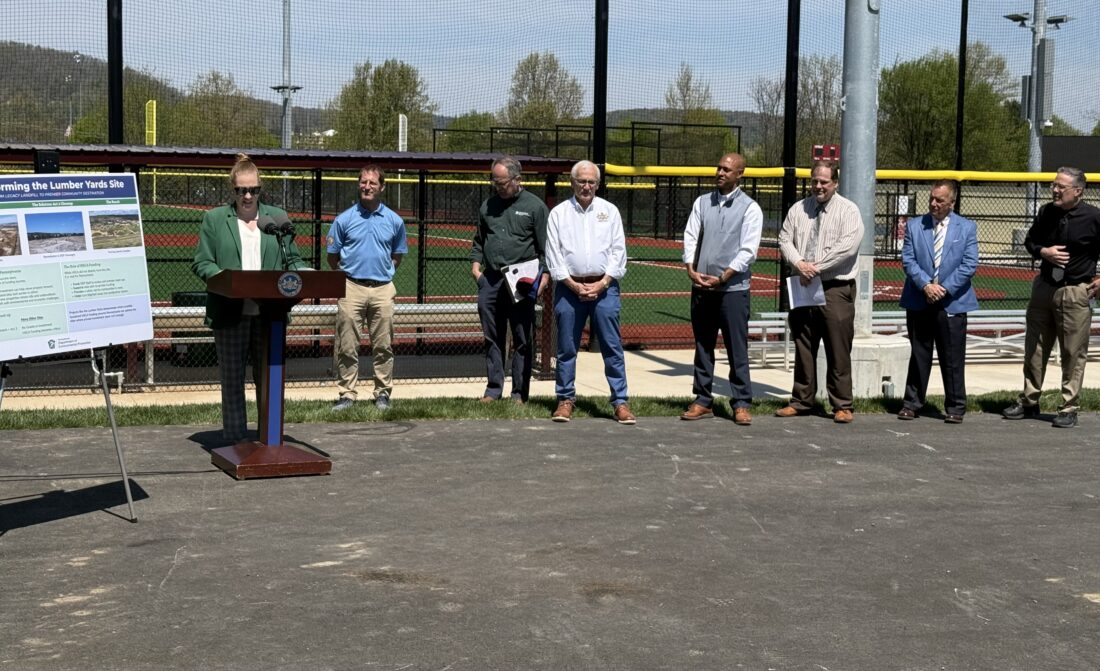
Catch phrases from the movie "Field of Dreams" were evident as local and state officials stood on what used to be a city dump but has been transformed into The Lumber Yards, a regional sports tourism destination illustrating that statement from the movie -- "If you build it, they will come."
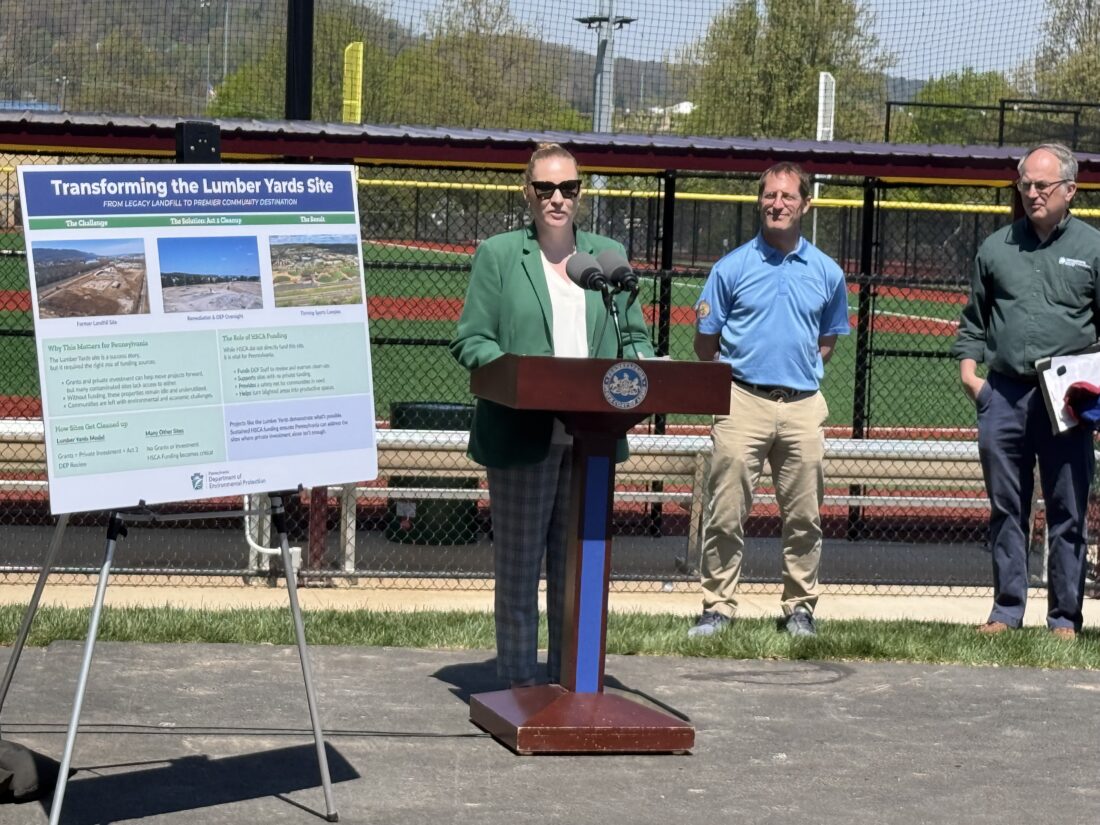
Jessica Shirley, the state's Department of Environmental Protection secretary, highlighted the Hazardous Sites Cleanup Act (HSCA) and the work that was done at the site to take it from a highly contaminated site to what Williamsport Mayor Derek Slaughter, who also spoke, called "something that's clearly full of life, energy and opportunity."
"That's what we envisioned. The regional destination that brings people into our community and supports the local economy," Slaughter added.
Shirley noted that "from 1960 to 1978 this 20-acre site was used as an unregulated landfill. That's the nice way that we say a dump, an unregulated dump, hazardous waste, commercial waste, construction waste, hospital waste, septic waste, you name it, and it was probably dumped here."
"When the landfill ceased operation through the 1980s, the land was used for disposal of tree and roadway waste. In the 2000s it was already partially vacant. Road salt and cinders were then stored on the portions of the site. So needless to say, it was a pretty big eyesore for a very long time to the city, right in the heart of Williamsport," she added.
Some remediation work was done at the site and then in 1999 after unleaded gasoline and diesel fuel were found in both the soil and the groundwater, a portion of the site received a relief from liability from the land recycling program that encourages voluntary clean up and reuse of contaminated commercial and industrial sites, she explained.
"Fast forward to July 2022, my agency issued a notice of intent to remediate, and our remedial investigation comprised of installing 55 soil borings to assess the soil impacts, both above and below the waste -- we needed to know what was in there. We conducted sampling of metals, pesticides, volatile organic compounds and other...semi-volatile organic compounds (VOC)," Shirley said, adding that VOC's were found in the soil exceeding residential limits.
"The scope of the damage became very clear, and so too did the solution to remediate the site. A three-foot thick layer of soil fill, cover and impervious materials were used and vapor mitigation techniques employed between 1960 and today. The difference is stark," she said.
Sen. Gene Yaw, R Loyalsock admitted that he was sceptical when he was first approached with the findings from a consultant that had been contacted by the Williamsport-Lycoming Chamber of Commerce about turning the site into a destination.
"The first time I think that I read that and looked at it, and they said, you know you can attract as many as, I don't know, 250-300,000 people to come to this area annually… And it's like, OK, well maybe … we start talking about it," Yaw said.
"The thing that we're looking at here today. Everybody says, 'Oh, this is beautiful. It's amazing how it came about.' There's a lot of behind the scenes that happened. And I got to tell you, everybody was not on board with this project...we heard every possible thing. It's not going to work. It's going to settle. The fields are all going to have holes in them. I mean, you name it, and it was going to happen here," Yaw said.
"Well, yeah, look at what's here today. It's like, you talk about the phoenix rising out of the ashes. I mean, this is it," he added.
Yaw pointed to a rural population study that indicated that the counties in his district were set to lose population from now and 2050, if the status quo is maintained and nothing is done to attract people to come to the rural areas.
"That's critical. So having this project and seeing what it is now, and if we can attract 250,000 visitors to come here, somebody just may say, you know, this is a great place to live, and the population is not dead just because they live in rural Pennsylvania is there's a reason to come here," he said.
Jason Fink, president and CEO of the Chamber of Commerce pointed out that the project was a collaborative effort involving the state, county and city.
"It took a lot of people...we appreciate all of the support that was provided to us, all the investment that has been made," Fink said.
Speaking on behalf of the Lycoming County commissioners, Scott Metzger, chairman of the board of commissioners, said, "Today marks the transformation of an underutilized site and a vibrant community asset and economic driver supported by an $800,000 EPA grant and DEP guidance. This Brownfield to a play field project marks a significant investment in our community and showcases how this site can now be utilized successfully.
"It showcases how an underutilized site can be utilized through those strong partnerships, and this county has a long history, as outlined by Brownfield redevelopment and reuse," Metzger said. "This latest EPA grant establishes the county's Brownfield revolving loan program that provides an initial investment to clean up sites in our community and gets them back into a productive use," Metzger continued.
"It's critical that we have something like that, and when repaid, these funds create a permanent, ongoing source of funds for future development projects in our community. So we look forward to this investment with our partners going forward, and as we look forward to future economic development, we also need to mention...the quality of life that these fields bring to Lycoming County as an attraction to have our youth participation. We look forward to many years made by our youth and families as they create memories on these fields of dreams," Metzger said.