
Trending
Area residents looking for fruit may find it in short supply this summer following an early season rollercoaster of above and below average temperatures.
Throughout April, the region saw unseasonably warm temperatures reach above the average high temperature of 63 degrees Fahrenheit on 15 days, according to accuweather.com, causing a slew of fruit crops to begin blooming early.
However, as the saying goes, what goes up must come down, and that is exactly what happened as temperatures plummeted below the average low of 39 on 10 separate occasions.
The coldest nights occurred on April 7 and 8, when night time lows reached 29 and 22, respectively, and again on April 20 and 21, with overnight temperatures dropping to 28 and 25, respectively, according to accuweather.com.
These rapid changes in temperature decimated a variety of crops not just in Lycoming County, but across a wide swath of the state.
To help alleviate the effects of these losses, on May 26, U.S. Secretary of Agriculture Brooke Rollins signed a disaster designation for 17 counties, including Lycoming.
"Fighting for our farmers means being there for them when Mother Nature hits," Rollins said of the declaration.
"This designation is a first step forward to help agricultural producers access emergency loans and programs in the aftermath of freezing temperatures," she said.
The designation allows the USDA's Farm Service Agency (FSA) to extend emergency credit to producers recovering from natural disasters via emergency loans, which can be used in a variety of ways including replacement of essential items, reorganization of a farming operation, or to refinance certain debts, a press release said.
Producers in the designation area will have until Jan. 26, 2027, to apply for the emergency loans.
Additional recovery programs offered by the USDA include additional loan programs and loan servicing options, risk management tools such as crop insurance, and financial assistance and conservation programs.
Several area farms have recently posted messages to their respective Facebook pages, making potential customers aware of shortages on a variety of products.
A post to Marshalek's Fruit Farm on June 12, stated that as a "result of April Freeze," the farm would not have cherries, plums, peaches or nectarines.
"Mother Nature took them all," the post said.
A similar message was posted on the Facebook page of Steinbacher's Orchard on June 21.
"We are sorry to report that we will not be able to take orders for cherries or peaches this year," Steinbacher's post read.
Nearby Eck's Orchard had a similar message for its customers.
"Unfortunately, we were affected by the frost and won't have any cherries this year. The Plums and Nectarines are also looking very sparse. The peaches and apples were also partially affected," a post to their Facebook account read, adding that they will continue to evaluate their peach and apple crop.
Paulette Shirey, who owns and operates Shirey's Blueberry Hill with husband, John, said they were spared from much of the damage suffered around the county.
"We have six varieties of blueberries in our field that blossom at different times, and the early ones that had their blossoms already beginning to form and open, were the ones that were affected most by the freeze," she said, adding that as much as 30 to 40% of their field was frosted.
"Although it affected us, I think there are some other factors that are going to benefit us enough that we are going to have a good year," Shirey said, adding that much of that is still up in the air.
"We have been a little concerned about the severe weather alerts with hail. That would do us in at this point," she said, adding that the blueberry field is expected to open next Friday.
Randy Lorson, owner and operator of A.P. Lorson Fruit Farm since 2019, however, told the Sun-Gazette that his stone crops were affected "tremendously."
"It took 100% of the sweet cherries, 90% of the sour cherries and probably 75% of our peaches," he said, adding that they are currently not taking orders.
Even as a part-time farmer, Lorson said the economic strain has been tough.
"Right off the bat, we're paying for fertilizer before we even know what's going on. We're paying for chemicals because we have a regular spray schedule we have to go by," he said.
"For instance, because we did have a few sour cherries, I sprayed right up until last Wednesday, figuring on starting to pick this week, and I went up a couple days later, and there was nothing left, so it's a big impact, because we have to put that money forward, and most of it, we're not going to get back, because there's no crops," Lorson said.
"It's such a funny thing, some of us are only miles apart, but we're all affected differently," he added.
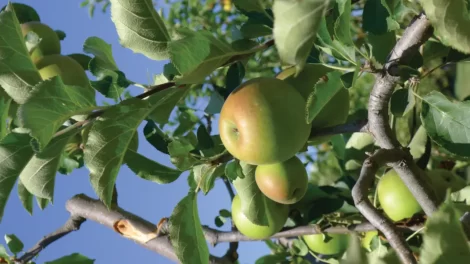
Despite the loss of so many stone crops, Lorson said his apple crops are looking good for availability around Labor Day.
"There should be enough for us to make some byproducts as well, like apple molasses and apple butter," he said, while, like Shirey, adding that that is largely dependent on outside factors like the weather.
"We have one eye on the radar and the other eye on the field," he said.
"Until we have them off the tree, it's such a guessing game," Lorson added.
Lorson is largely unfamiliar with Sec. Rollins's designation, but as a part-time farmer with a second job, he doesn't expect to receive much benefit from it.
"I'm thinking probably some of us small farmers are not eligible, but the full-time farmers hopefully will get some kind of relief from it," said Lorson, whose farm has been in the family since 1930.
Additional USDA disaster assistance information can be found on farmers.gov.