
Trending
Williamsport and surrounding areas are in for a hot one as they prepare to celebrate the nation's 250th birthday.
With temperatures expected to reach near record highs, the National Weather Service has issued an extreme heat warning from noon today to Friday at 8 p.m.
"We're looking at temperatures in the 90s, dew point temperatures in the 70s, and that's going to give us heat indices in the low 100s, between like 105 and 115," explained Brian Schroeder, chief meteorologist for Fox 56 Wolf Tv.
Dew point temperatures are a measure of how much moisture is in the atmosphere, and higher dew points inhibit the body's ability to evaporate sweat, which is the body's cooling mechanism, Schroeder said.
"That's when you start feeling clammy, sweaty and sticky," he said.
Schroeder said that night time temperatures will offer little relief.
"Lows are going to be around 70 degrees, so not as hot as we are in the afternoon, but we're going to stay pretty mild during the evening too. You're not going to be comfortably cool overnight," he said.
An interesting note is that the valleys will be hotter than the upper elevations.
"There's more steel, asphalt and concrete, and that's where all the people are," Schroeder said.
The incoming weather meets the technical definition of a heatwave, which requires three consecutive 90 degree or warmer days, Schroeder explained, adding that such an air mass is unusual for the area.
"For the most part, our record average high is in the low 80s, and so, we are warmer than average, and I would say we're closer to setting records for this time of year," he added, calling the incoming heat "tropical."
Going into the weekend, temperatures are expected to come down slightly with a high near 90 on Saturday before mid to upper 80s return on Sunday and Monday.
"Not cool, but we'll say not as oppressively hot, not as dangerously hot for Saturday into Sunday or Monday," Schroeder said.
Looking into the back half of summer, Schroeder said it is possible that the extreme heat could return.
"It could be a little on the hot side, but not drought conditions, so I wouldn't be surprised if we see another couple of heat waves for July into August. Nothing guaranteed, but climate data does show that we could be dealing with above average temperatures," he said.
"We've been forewarned, so everybody has a chance to do something if they can," said Deb Erdman, outreach and injury prevention coordinator for Geisinger Medical Group.
To keep homes cool, Erdman suggests covering windows with drapes or curtains, which help block sunlight and heat or aluminum foil covered cardboard to reflect sunlight back out.
Weather stripping doors and windows also helps to keep heat from entering the home, she said.
Keeping an air conditioner around 70-72 degrees is enough to not only keep rooms cool enough, but to also help remove humidity.
"If you're using overhead fans, make sure they're going in the counter clockwise direction, because that draws the heat up instead of pulling it down. If you're using box fans in windows, you want cross ventilation. You don't want to do it in a closed area, because basically the room becomes an air fryer because all you're doing is circulating hot air," Erdman, a critical care trauma nurse said.
"Having those fans on during the night or early in the morning, while the air is still coolish, is helpful, and then close everything up to kind of try to keep that cool air in," she added.
For those working outdoors, hydration is key.
"You want to avoid strenuous activities. Some people can't do that, whether it's construction or mailman or other people that work outside, but just do the best you can, take frequent breaks, make sure you're hydrated and wear the proper clothing," Schroeder said.
"Stay well hydrated, get into a cool shaded area if you can during breaks, if they can't come indoors," Erdman said.
Schroeder said it is important to keep an eye on urine color because that can indicate levels of dehydration.
"If your urine is yellow, you're dehydrated. Your urine should be clear or a very light yellow," he said.
"If your urine is yellow and you drink a glass of water, that's not sufficient. It takes you a while to rehydrate, and if your urine is yellow or dark yellow, you're already in trouble or you're at least kind of playing with fire," Schroeder said.
For anyone involved in outdoor activities such as exercise and gardening, Erdman advises doing so early in the morning, before 10 a.m. and 3 p.m., when the sun's at its highest, or around dusk when cooler temperatures settle in or a breeze might form.
"Wearing loose, light clothing or a hat, and using a cool cloth on your neck, your head, or on your face, will help with staying cool," she said.
In terms of hydration, Erdman stresses the importance of water and avoiding sugar, caffeine and especially alcohol.
"They're currently having a heatwave in France, and I read in the media that they have banned alcohol sales because of people drinking, becoming dehydrated, and just making things worse," she said, adding that foods can also be sources of hydration.
"It's also fresh fruit and vegetables. If you think of watermelon, that's 90% water, so your melons, your tomatoes, cucumbers, all those kinds of things. There's a lot of fiber and a lot of water content," she said.
"Taking fruit like grapes and bananas or fruit juices and freezing them, they become instant frozen pops for kids," she said.
Despite recent trends calling into question the safety of sunscreen, Erdman stresses its importance and safety not only in the summertime, but year round.
"I would take a lot of social media with a grain of salt, especially if they're trying to steer people away from common sense. Evidence-based medicine has shown that sunscreen is extremely important, especially as our climate and our environment changes. It's even more important," she said.
"We're always advocates for wearing sunscreen all year round because parts of your body are still exposed to sun and can get sunburned.
Erdman said the key is to reapply often as most sunscreens last two to three hours, but may diminish quicker if the wearer is engaged in swimming or sweating heavily.
Those on birth control or taking certain medications and antibiotics may be at an increased risk for sunburn, she added.
"People also don't realize how much sun exposure they get if they're boating out in a river or lake. That water is reflecting," she said.
Erdman said the general consensus is that sunscreen of at least SPF30 will help keep skin protected.
"Again, it's reapplying it. It's not just putting it on once and letting it go. And for people who use makeup foundations, you can get foundations now with SPF in it, so that's helpful too," she added.
Erdman also stressed that even in shaded areas, the body is still getting sunlight.
With the scorching temperatures fast approaching, everyone should be aware of the symptoms of heat exhaustion and heat stroke, Erdman said.
"If you're feeling dizzy or feel like you're going to pass out, intense thirst, excessive sweating, or your heart rate is going up. If you experience nausea and or vomiting, you're probably in the throes of heat exhaustion," she said, advising them to move to a cool space and hydrate.
"You need to have cool cloths or get into a cool shower or tub. You don't need to throw ice on them or anything like that, it's just getting into a cool space, in the shade, into an air-conditioned building or room," she said.
"If you get to the point where you have headache and confusion, you don't sweat, and you have a rapid strong pulse, nausea and vomiting, or red hot skin, you're probably in the throes of heat stroke, and that is in a medical emergency, and you need to call 911 or get to an emergency room," Erdman said.
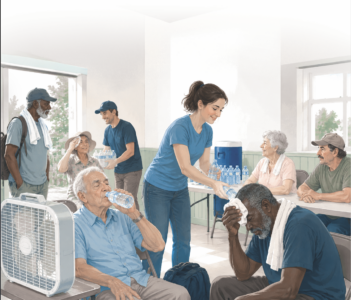
Keeping an eye out for each other is also crucial during extreme temperatures, she stressed.
"The biggest issue we have in the community is our extremes of age, so our older adults, and then our very young children, because they don't have the capacity to sweat, which is our body's way of cooling itself," Erdman explained.
"With our older adults, it could be due to chronic medical conditions or medication. Plus, as we age, we lose the capacity to sweat, and our sense of thirst. So, if you're thirsty, you're behind the eight ball," she said.
"With infants and young kids, first of all, their body surface area is larger relative to their body size, so they absorb more heat from the surrounding environment. They also have an underdeveloped sweat response, so the sweat glands in young children aren't mature enough to help them with that cooling ability," Erdman said
"So again it's making sure that these kids stay hydrated. You want to avoid high sugary drinks, so it's water, Pedialyte or juices," she said.
"It's usually the, we'll say, low-income people, where they might be stuck in their apartment, and they're not running their air conditioning, and their apartment turns into an oven, so, just check on people, make sure everybody's safe," Schroeder said.
"With the price of electricity assessment, a lot of people are reluctant to turn their air conditioners on or use the fans, but now is not the time to worry about that," Erdman stressed.
"The name of the game is keeping yourself safe," Schroeder said.
"Just use some common sense and you'll be fine. Find a pool, find a big glass of lemonade and relax a little if you can," he said.
Equally as important is the safety of furry friends during the impending heat, Erdman added.
"If you're going to walk them, walk them in the grass, and make sure they have access to cold water," she said.
In fact, surface temperatures can be as much as 40 to 60 degrees hotter than the current air temperature on materials such as asphalt, concrete, sand, and metal, leading to burns on paws in as little as 60 seconds., according to the American Animal Hospital Association (AAHA).
In order to minimize the risk of injuries to pets, the AAHA advises owners and handlers to plan walks during cooler parts of the day, including early mornings and late evenings, choose shady paths for those walks and avoid surfaces such as those listed above as much as possible.
Paw booties or wax can also be used to minimize contact with hot surfaces.
If in doubt, the AHAA advises those with animals to test surface temperatures by placing the back of their hand on the ground for seven seconds.
"If you cannot keep your hand in place, it's too hot for your pet," the AHAA website states.