
Laurelton State Village: Author’s research leads her to Union County historical site
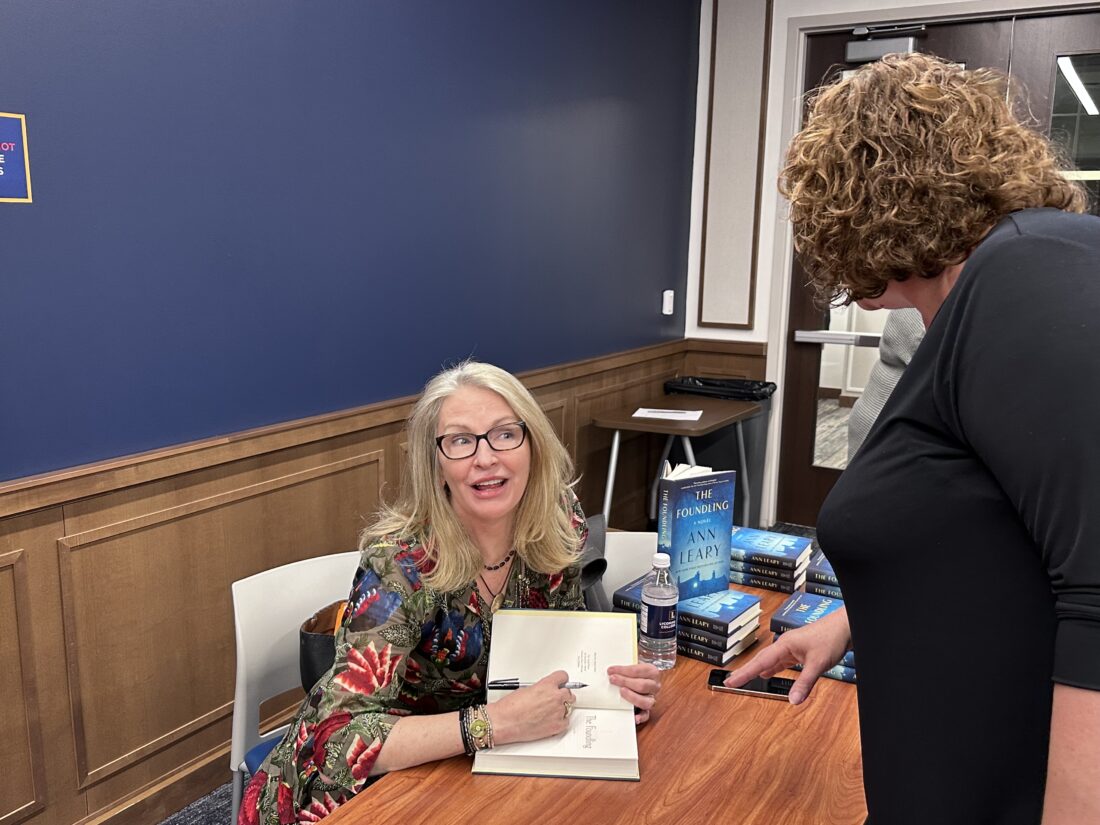
PAT CROSSLEY/Sun-Gazette Author Ann Leary, left, signs a copy of her new book, “The Founding,” during an event at Lycoming College recently. Leary’s research into her family led her to Laurelton State Village in Union County, which was an institution for “feeble-minded” women in the early 20th century.
Ann Leary’s journey to writing her novel, “The Foundling,” began when she started researching her family’s history, which led her to Laurelton State Village in Union County.
Laurelton had been established in 1913 to house “feeble-minded women of child-bearing age.” The buildings’ first residents arrived in 1917, according to historical records.
“I’ll just say there’s an author’s note at the beginning of this (the novel) that explains that the term feeble-minded, although it’s hard to hear, was actually not a slur. It was a political term in the early 20th century as was the word idiot, moron, imbecile. Those were actually rankings of intellectual deficits,” Leary, a New York Times best-selling author, said at the beginning of her recent presentation at Lycoming College.
Leary’s grandmother had served as a stenographer at the institution when she was 17 years-old.
Searching online for information about Laurelton, Leary said that at first all she could find was that it was beautiful.
“You can see it was really beautiful, almost like a college campus,” she said.
She read that it was a place for vulnerable women of child-bearing age with intellectual disabilities and was run by Dr. Mary Wolf, Leary said.
Wolf had earned her degree in medicine during the 1890s, an amazing feat for a woman at that time.
“She was one of the first women who graduated from Bucknell, and then she went to medical school. In 1899, she had a medical degree, really when most American women didn’t go to college,” Leary said.
“She was a suffragette. In World War I, she ran, like, the Red Cross for eastern Pennsylvania. She was amazing and I was fascinated by her,” Leary said.
Leary said she felt a sense of pride because her grandmother had worked for Wolf, but then she began to delve deeper to learn more about Laurelton and similar institutions across the country.
“There were many similar institutions. There were homes for feeble-minded children, there were homes for feeble-minded men, but specifically homes for feeble minded women, because women, poor women, were considered to be the menace in society at that time,” Leary said.
She admitted she had always been fascinated by that time period, which she thought of as a devil-may-care, decadent time for society.
That was true for the rich people in the 1920s, she said, but not for most people like her grandmother and the residents of Laurelton.
In her research, newspaper archives had given her accounts of some of the residents, which she said eventually came together and formed one of the main characters in her novel.
In Leary’s novel, the main character is named Mary, just like her grandmother. Both are orphans. And just like her grandmother, Mary goes to work at an institution called Nettleton in the office of the director, Dr. Vogel.
“She gets this wonderful job. She has this very, very fascinating boss, a female doctor, Dr. Vogel, who runs this asylum for women,” Leary said.
Everything’s great until she sees a childhood friend from her orphanage who is an inmate at the institution.
“She remembers Lillian has been kind of a wild child and very full of mischief. She got in trouble with the nuns a lot, but she doesn’t think she was necessarily feeble-minded,” Leary said.
Mary finds out the reason that Lillian is at Nettleton is because she had worked in a speakeasy singing with a jazz band, had fallen in love with a Black man and had his child.
Lillian is white, and interracial coupling was against the law in the 1920s. Her baby was immediately taken from her and put in an orphanage and Lillian was sent to Nettleton State Village for feeble-minded women.
“When someone was sent to this asylum — some girls were 14, some girls were 49 — you didn’t leave until you were no longer of childbearing age because this wasn’t a place you went for therapy or to get an education. It was to keep you from having children. It was part of the eugenics movement,” Leary said.
“If you didn’t learn about eugenics growing up, you’re not alone,” she said.
During the early 20th century when the story in the novel takes place, eugenics was an accepted practice.
There is a positive eugenics, Leary said, which is encouraging thriving healthy families to have more children while maybe discouraging people who are struggling or may have some type of hereditary problem to have fewer children.
The practice began in the late 19th century in Europe and the United States.
Some states allowed for the forced sterilization of people who were deemed defective, Pennsylvania instead sent them to institutions like Laurelton.
From her research, Leary learned that Laurelton had a thriving dairy where many of the girls worked, and the imagery of the cows walking in a straight line and having their calves taken away so that they’d produce milk reminded her of the women at the institution.
“So much of that reminded me of the plight of some of these girls who were not, I don’t think, considered certainly by the government as fully human. If you are considered too inferior a person because of your race, your ethnicity, your disability, you’re just not appropriate to have children, you’re not fully human,” she said.
“I do believe that the reason we weren’t taught about eugenics is because it did quickly disappear after World War II. The final solution of eugenics was the Holocaust. Hitler was in prison when he wrote ‘Mein Kampf,’ and he thanked specific American eugenics writers for teaching him about inferior and superior races and how to create a world where it would be much better,” she said.
Although she did a lot of her research online, Leary cautioned against that being the sole resource for information, particularly when writing an historical novel.
She searched through newspaper archives where she found information that wasn’t what she called the “whitewashed version.”
“I found newspaper articles about families that tried to get their family members out. About girls running away,” she said.
She learned that many of the women in the early 19th century had committed crimes against chastity, which included fornication or sex outside of marriage, adultery, and prostitution. Women convicted of prostitution could be sent to Muncy Prison and then if it was decided that they were feeble-minded, they were sent to Laurelton. Once there, they couldn’t leave until they could no longer have children.
“It was worse there because it wasn’t based on if you’re improving. You can improve all you want; you couldn’t leave until you were in menopause,” she said.
There many sad stories, she said about families trying to get their daughters out of Laurelton.
“In this newspaper article I read that the superintendent, the doctor, was rumored to have said to somebody in the community, she’s the best miler in the dairy, she’s never leaving,” she said, adding that although it was in the newspaper, she couldn’t say if it was true.
Leary said that although she’s not a scholar of asylums or institutions, she did discover that it wasn’t just places like Laurelton but also psychiatric hospitals that women could be sent to if they were determined to be feeble-minded.
“In the early 20th century, women did not have adult status. Their husband was their parent,” she said.
“Until the 1950s or 60s, women — if they were married, their husband handled the finances; if they got divorced, the husband got the kids. A husband could determine if his wife was insane or if she was mentally defective; they certainly didn’t want you to have children,” Leary said.
She also was able to find a brochure which listed the traits of a feeble-minded female at that time which included obstinacy, use of foul language, drinking, smoking and actively seeking sex.
“I know at the time, no one would think that was a defective man. A man of 20 actively seeking sex wasn’t considered defective, but a woman was,” she said.
“Laurelton State Village, like many other similar asylums in this country, went through many iterations and transformed and reformed,” Leary said.
“By the time it closed in 1998, it was a true training school for men and women with profound intellectual disabilities,” she said.
Lifestyle News
Museum to offer ‘farewell look’ at art exhibit
The public is invited to attend a farewell look at Echoes of Eden at the Thomas T. Taber Museum of the Lycoming ...
Concert salutes Broadway music
The May public concert of the Williamsport Music Club will be a program completely devoted to Broadway songs from ...

Muncy teenager earns Eagle Scout rank
Concert in Williamsport on Saturday to feature patriotic music

Over 500 breakfasts served at Sentimental Journey’s event
‘Betsy Ross’ to visit historical museum
The Thomas T. Taber Museum of the Lycoming County Historical Society will host its Society Program at 2 p.m., May ...