
Overdose Awareness Day: Remembering those whose lives ended tragically
Trending
It was a beautiful, late summer evening in Brandon Park.
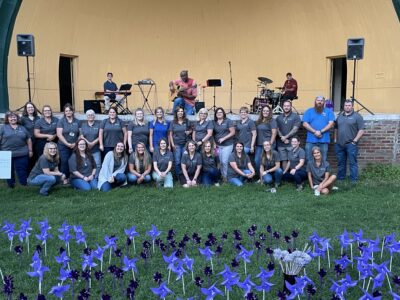
A gentle breeze whispered through the trees on either side of the Bandshell, swirling the purple pinwheels that dotted the ground in front of the stage -- a reminder of why people had gathered there, to remember those who lost their lives to drug overdose.
Organized by the West Branch Drug and Alcohol Abuse Commission, the event was part of International Overdose Awareness Day, which had offered opportunities throughout the day to learn more about the resources the community offers for people struggling with addiction.
Pausing to overcome the emotion of remembering what he called the "worst day of his life," Todd Burke, of Catawissa, shared when his son Thaddeus died from an overdose at the age of 22 on Oct. 2, 2016.
Thad, who lived with his parents, had injured his foot and then his hand, and during treatment for the pain, had become addicted to opioids.
Dorie Burke had discovered suboxone, a drug to treat opioid addiction, in her son's room and it was then that the parents realized their son had an addiction.
Two stints in rehab followed, but his son didn't seem to be himself, Todd Burke said.
On the day that their son died from an overdose, Burke said, "I woke up in the morning to hear my wife screaming, 'Thad wake up! Thad wake up!"
Grabbing his phone to dial 911, Burke said he went to his son's room where his wife was shaking Thad to try and wake him up. He dragged his son to the floor to start chest compressions, while his wife ran to get Narcan and then administered that.
By that time, the first responders had arrived and Burke and his wife Dorie went downstairs and waited.
The first responders worked to try to resuscitate their son, but after 45 minutes, they told the Burkes there was nothing more to be done. The coroner was called and their son was pronounced dead. The Burkes remained in another room as the body of their son was removed from their home.
"How do you recover from something like that," Todd Burke asked. "I had no idea."
Less than two weeks after their son's death, the Burkes started going to Griefshare.
"I learned that you will never be your normal self after something like this, but you will someday find a new normal," he said.
Speaking before the event, Todd Burke said that he and his wife had done different things to cope with their loss in addition to Griefshare. They had joined a group called GRASP, Grief Recovery after Substance Passing in Williamsport and had started a group in their hometown.
"We try to do things, positive things, to bring awareness to the issue of addiction and drug overdose," Todd Burke said.
One thing that Todd Burke wanted to tell parents is that even if your child is an adult, still control their medications.
"We didn't do that. We just figured he was an adult and he could do it and take it as instructed. I think as parents looking back, quarterbacking myself, I wish we would have done more to control the pain meds because once they don't have the pain meds, once they don't have suboxone, then they turn to heroin," he said.
Another misconception, Dorie Burke said, is the person in addiction must be running with the wrong friends.
"It wasn't his friends. Our daughter's like, he needs new friends. His friends don't do drugs," she said.
"They're never too old to keep an eye on. It's hard. We were naive. We didn't know...we didn't know," Dorie Burke said.
Speakers throughout the evening shared similar experiences.
Carolyn Miele runs a nonprofit organization in memory of her son Zachary, who died from an overdose six years ago.
Wanting to raise awareness about drug addiction, Miele said that she began the nonprofit to decrease the stigma associated with having a family member who is in addiction.
Zachary had been clean for three years before he overdosed, so his overdose was unexpected.
Her advice to parents on what to look for is to be aware signs of depression.
"Mental illness goes along with it. Bad relationships, when your kids are in bad relationships. Decreased self-esteem, being withdrawn from their family and their friends. Not being able to hold a job," she said.
Miele speaks at different events trying to help parents who have lost children to overdose, but she admitted that it isn't always easy for parents to speak openly because of the stigma attached to addiction.
"People don't want to, because of the stigma, come out and say, you know, I have a son or daughter, that's using, so it's all behind the scenes," Miele said.
Miele said that she works to get people the information they need and to get them in touch with people like Shea Madden, the director of West Branch Drug and Alcohol Abuse Commission, who can find the resources they need.
Tracey Mulcahy, whose son also died from an overdose, stressed the need for tough love when it comes to dealing with a child in addiction.
"If you see your child nodding off at the dinner table or active in another moment, it's the substance that's giving them the active high, the euphoria," Mulcahy said. "When they don't have the substance anymore, it flips the switch."
"Don't ignore it. You have to tough love it from the beginning," she added.
Seth Bucher, who was a former West Branch employee and the survivor of a drug overdose, rounded out the evening's speakers.
He shared that his addiction really started following a stint in Iraq with the military.
"They weren't really good at transitioning us from deployment back to civilian life, at all. None of the stuff that they have now, did they have back then," he said.
It was at that point that he started drinking and then found his drug of choice, heroin.
Bucher had left the military in October 2008, and by July, 2009, he had been arrested.
"A lot of people have given me one more chance. I honestly wouldn't be where I am at today if people hadn't given me chances," he said.
Following relapses, he overdosed.
"I called my mother and asked her if she had heard what had happened. She said 'yeah,' and I said 'what did you think about that?' She said, 'Honestly, I'm surprised it took me this long to get that phone call,'" he said.
"Right then and there I knew I had to do something different. That's not a phone call a mother should be expecting to get," Bucher said.
Although he is now in a job that he had always wanted, Bucher said when he was actively in addiction, he never thought that this would be the life he'd have.
"When I was out there using, I got to the point where I was OK with what I was doing. I thought that's all my life was going to be. I was going to be an addict for the rest of my life. I was just going to use until it was over and that's it," he said.
"Just don't give up on people. If I wouldn't have had these people that kept giving me chances, I wouldn't be here today," Bucher said.
Other speakers at the event included Williamsport Mayor Derek Slaughter and Dave Bower, who runs the GRASP group at St. John's United Methodist Church.